Perseid Meteor Shower 2019

24256488237_b737b0c757_b

The annual Perseid meteor shower is already underway although rates will be very low until the peak of the shower around August 11-13th.  A bright Moon will hamper the peak this year but this shouldn’t stop you venturing out when skies are clear.  Moonlight will make fainter meteors difficult to see but fireballs and brighter ones will still be readily visible.

To maximise Moon free viewing near the peak of the shower, try observing a few days before and 12th, starting from the 9th August.  The best times to head out are in the early morning when the Perseus radiant will be at greatest elevation in the East, although you don’t need to look at the radiant to see meteors and they’ll be visible from all directions.

Although rates are lower at the moment, now is also a great time to look up due to dark of the Moon conditions and darkening skies in general as we slowly leave behind the permanent summer twilight we experience in the north of Scotland.

Observing the Perseids

You don’t need any special equipment to view a meteor shower, in fact binoculars or telescopes will just narrow your field of view. Grab a deck chair or camping mat and (if it’s cold) a warm blanket, prepare a hot drink and lay out under the darkest conditions you can find. It’s an excellent activity to do alone, with family and friends, or if you have children they’ll love an excuse to get outside for some after dark play.

Put away any lights or bright mobile phone screens and simply look up and wait. Remember it takes up to 30 minutes for your eyes to fully dark adapt and any exposure to bright lights will start the process all over again. If you need a light, red LEDs or touches are best for preserving you night vision.

For optimal viewing, head out late at night after the Moon sets or in the darkness of the pre dawn sky., when the radiant is highest in the sky.

Photographing the Perseids

688x300_NightSkyCCD_ELMA_NPS_JeremyWhite

If your have a DSLR camera and tripod, or a suitable phone app like NightCap, you could try capturing some meteors with this rough guide.

  1. Firmly attach your camera or phone to the tripod.
  2. Disable autofocus and manually focus on some bright stars (make them as small and pin point as possible in your viewing screen)
  3. Set an ISO range somewhere between 1000-3000 depending on the capabilities of the sensor.  Mid 1000s is a good middle road.
  4. Turn off noise reduction or you’ll get big delays between each shot.
  5. Point your camera at a high and clear part of the sky.
  6. Shoot long exposures ranging from 10s to 30s, or simply use a remote shutter to take long manual exposures.  Note:  don’t go crazy with very long exposures or you’ll get amp glow from the sensor.
  7. Take lots and lots of shots and be patient!

If your camera has a time-lapse feature you can automate the shooting process and tell the camera to continually shoot 30 second exposures over a long interval.  Just watch out for dew forming on the lens if conditions are cold.  Some hand warmers stuffed into a sock wrapped around the lens will solve this particular issue.

Good luck and clear skies!


Stargazing and Partial Lunar Eclipse over Snowdonia

66636261_2349016558668616_892797141037088768_n

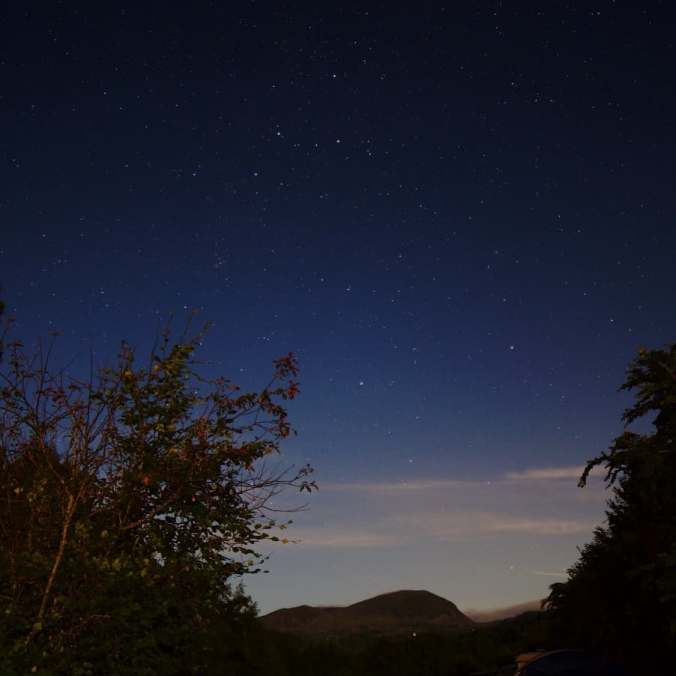
The Plough asterism, part of Ursa Major

I had the privilege of visiting Snowdonia this summer for a family camp in a beautiful river valley near Maentwrog.  During the evenings I managed a bit of stargazing before moonrise and captured a few bright constellations over the Welsh hills.

66618316_2349016528668619_5507654206833557504_n

Cassiopeia over the Welsh hills

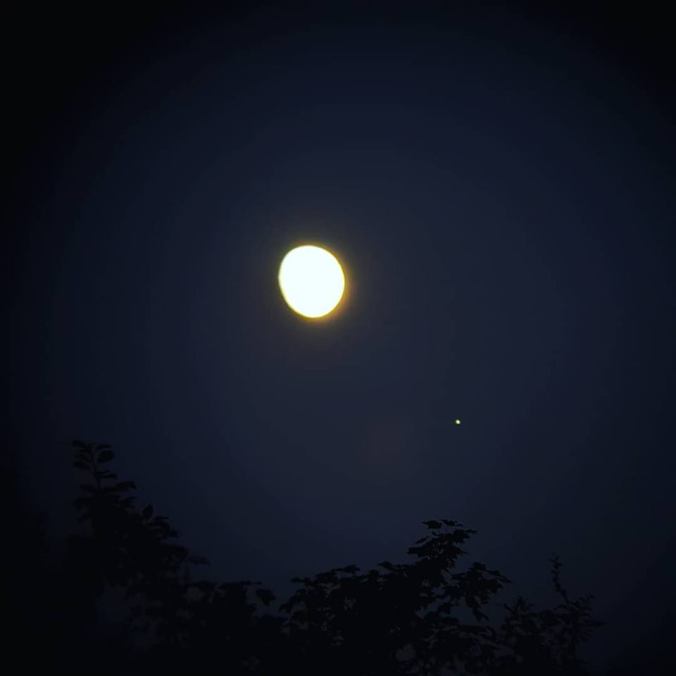
I also captured a lovely close pairing between the Moon and the planet Jupiter.

66357097_2348932338677038_1638252942198833152_n

Jupiter sits serenely below the waxing gibbous Moon

The highlight, however, was witnessing a beautiful partial eclipse of the Moon on Tuesday evening at around 11pm.

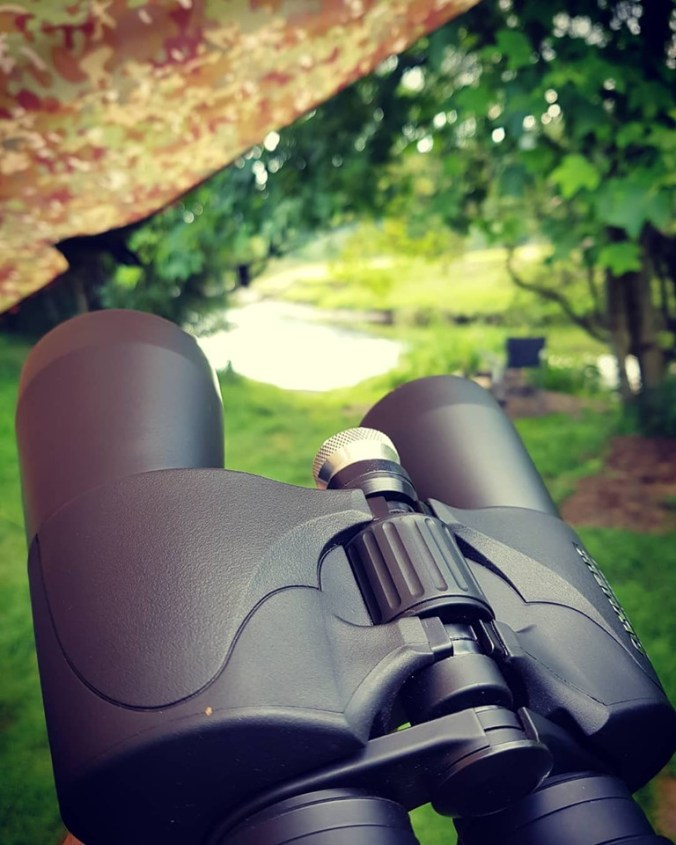
I took these pictures and a short video using my smartphone anchored to a simple pair of 8×40 binoculars (mounted for stability).  The eclipse was already underway when the Moon rose into view and continued until well after midnight.


Agile Observing

66425052_2349563911947214_3159317830575325184_n

A basic pair of 8x40mm binoculars lets you access around 500,000 stars

Many people think astronomy is a complicated or technical activity. While it can be, it very definitely doesn’t need to be. Over 90% of my observing is done with a simple pair of binoculars, like these light and inexpensive 8x40s, which I try to carry with me wherever I go on local walks or further afield.

With these I can access stunning images of the Moon, resolve the satellites of Jupiter, sweep through over 500,000 stars (most too dim to see naked eye), resolve glittering star clusters like the Pleiades and Hyades, and (under suitably dark skies) view the dim light from galaxies many millions of light years away.

Marry the binoculars with a small tripod and a night sky app on your phone and you have everything your need for agile observing during clear skies or brief opportune breaks in the weather.

Clear skies.

Destination Mars

Image result for mars pictures best nasa

The surface of Mars, image credit NASA

I’m very happy to be partnering with Skills Development Scotland and the Science Skills Academy to deliver day 2 of the ‘Destination Mars’ three day programme for S1 and S2 pupils in Thurso’s recently built Newton Room (22nd – 24th July).

On day 2 I’ll be exploring Mars impact geology, the solar system, night sky tours and a workshop on optics and spectroscopy.

Full programme details and registration details in the link below:

https://www.eventbrite.co.uk/e/destination-mars-tickets-61154289125

Solstice Sunsets

Video from the shores of Bunchrew looking over Ben Wyvis, panning from the north west to north east

The sunsets in the Highlands of Scotland are some of the best in the world when conditions are right, especially around the solstice when the setting Sun grazes just 8 degree below the northern horizon producing mesmerising night long sky glow.

On June 22nd I camped out at the Bunchrew shoreline with my daughter Violet and managed to capture some video and still images of the sunset looking north towards Ben Wyvis.  Footage captured around 10.45pm.


This slideshow requires JavaScript.


Star Stories – Solstice at the Shielings

This slideshow requires JavaScript.

Solstice celebrations up at Abriachan tonight. We had a nature walk and talk up to the Shieling above Loch Ness, with Suzann, Christine and Clelland imparting plant and flower lore at various points up the trail.  From the top we learnt all about Shieling life, dairying and got to sample some simple crofting fare.

I then presented a short talk on the Solstice and its astronomical significance, culminating in a human henge to illustrate the changing seasons, rising and setting Sun points and how the ancient Celtic people marked off their Wheel of Time.

We just managed to catch a lovely sunset from the top of the hill before making the trek back down.

The Star Stories events will be resuming in October with another event in collaboration with the Highland Archaeology Festival.  Look out for programme details as they emerge.