The Quadrantids Meteor Shower 2019

20552523531_ef720cd2f1_b

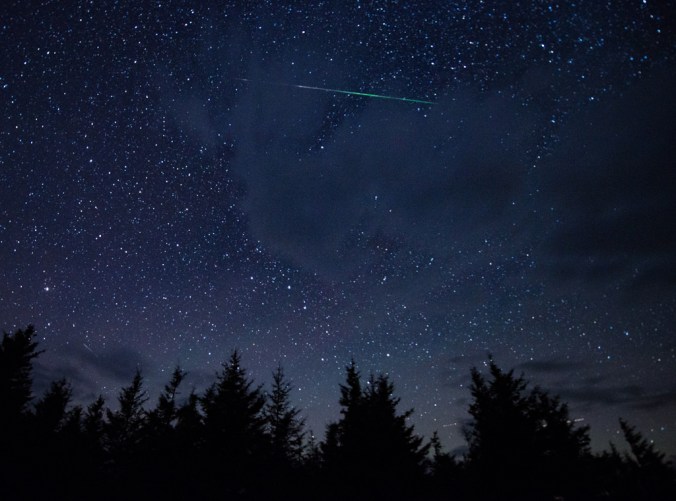
The Quadrantids meteor shower will peak on the night of Jan 3rd/4th

Although not normally singled out as a major meteor shower, the 2019 Quadrantids will peak under the darkness of a new Moon, offering the best chances of seeing an abundance of shooting stars if you can get away to a suitably dark location under favourable skies.

Like the Geminids, the Quadrantids are not produced by the debris from a comet, but by a large asteroid.  In this case asteroid 2003EH1 which orbits the Sun every five and a half years.

asteroid-243-Ida

An asteroid – 2003EH1 was discovered by Peter Jenniskens and astronomers of the LONEOS programme in Arizona

The time to begin looking up will run from January 1st until the 6th.  However rates will be low in general over this wide period.  For the best spectacle try and head out over the narrow peak of the shower, after midnight on January 3rd, when for a few hours the shower can theoretically produce between 50-100 meteors per hour, but only under ideal conditions.

If you’re observing close to midnight at Inverness latitudes (57 degrees) the radiant will be about 22 degrees high.  Therefore a more realistic estimate would be 20-30 per hour.  Stay out later and the radiant will rise higher increasing the theoretical rate.  If you’d like to know more about the technical considerations when estimating visible meteor rates check out this excellent blog post by Steve Owens.

The rough radiant for the Quadrantids is the constellation Bootes, although you don’t need to look in this direction to see them.

Screen Shot 2018-12-31 at 12.34.13.png

Remember you don’t need to look at the radiant when viewing a meteor shower

Observing the Quadrantids

You don’t need any special equipment to view a meteor shower, in fact binoculars or telescopes will just narrow your field of view. Grab a deck chair or camping mat and a warm blanket, prepare a hot drink, wrap up warm and lay out under the darkest conditions you can find. It’s an excellent activity to do alone or if you have children they’ll love an excuse to get outside for some after dark play.

Put away any lights or bright mobile phone screens and simply look up and wait. Remember it takes up to 30 minutes for your eyes to fully dark adapt and any exposure to bright lights will start the process all over again. If you need a light, red leds or touches are best for preserving you night vision.

For optimal viewing, head out late at night after the Moon sets or in the darkness of the pre dawn sky., when the radiant is highest in the sky.

Photographing the Quadrantids

688x300_NightSkyCCD_ELMA_NPS_JeremyWhite

If your have a DSLR camera and tripod, or a suitable phone app like NightCap, you could try capturing some meteors with this rough guide.

  1. Firmly attach you camera to the tripod.
  2. Disable autofocus and manually focus at some bright stars (make them as small and pin point as possible in your viewing screen)
  3. Set an ISO range somewhere between 1000-3000 depending on the capabilities of the sensor.  Mid 1000s is a good middle road.
  4. Turn off noise reduction or you’ll get big delays between each shot.
  5. Point your camera at a high and clear part of the sky.
  6. Shoot long exposures ranging from 10s to 30s, or simply use a remote shutter to take manual exposures.  Note:  don’t go crazy with very long exposures or you’ll get amp glow from the sensor.
  7. Take lots and lots of shots and be patient!

If your camera has a time-lapse feature you can automate the shooting process and tell the camera to automatically take 30 second exposures over a long interval.  Just watch out for dew forming on the lens if conditions are cold.  Some hand warmers stuffed into a sock wrapped around the lens will solve this particular issue.

Good luck and clear skies!


Christmas Wirtanen Sighting

DSC_0007.jpg

Comet Wirtanen to the left of bright Capella, above Bunchrew, Inverness

I’m almost always rewarded in some form when I head out to observe, even in less than perfect conditions.  As it happened I knew comet Wirtanen was in a favourable position over Christmas and close to the 6th brightest star Capella.  I posted about it on Facebook here.

Despite the unfavourable early rising of the Moon and some patchy skies on Christmas eve I decided to take a short walk in the woods over Bunchrew, in the off chance I might catch the comet.

When I was sufficiently well away from the western lights of Inverness I looked up, and there was the comet faintly visible in binoculars.  Not the clearest I’ve seen it this year, but probably under the darkest conditions.

The took the picture above before I continued my walk, with the comet and Capella sitting above the trees.

Happy comet hunting!

The Winter Sun at Clava Cairns

DSC_0052

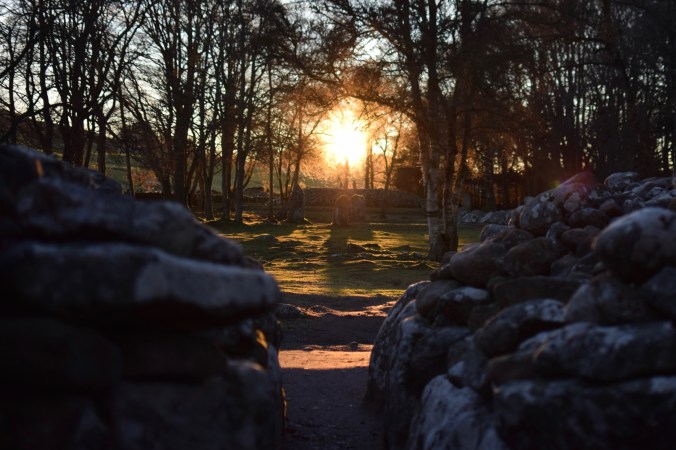
Looking south west from inside the north east cairn at Clava

As a family we have a yearly tradition of heading out for a longish walk on Christmas Eve.  We usually park up somewhere remote in the van, make some bacon rolls then head out along a forest trail or up a local hill.  This year we decided to see if we could catch the setting Sun at Clava Cairns, a beautiful bronze age site located only a mile or so from Culloden battlefield near Inverness.

During my astronomy outreach I’ve given quite a few talks referencing Clava Cairns in relation to the fascinating subject of ancient astronomy.  Often wild speculations are made about many prehistoric sites, in particular Stonehenge, with dubious claims of alignments to stellar constellations or complex planetary cycles.  But one thing is almost universally agreed by archaeologists and astronomers alike, that many of these ancient structures were configured to mark the passage of the solar year.

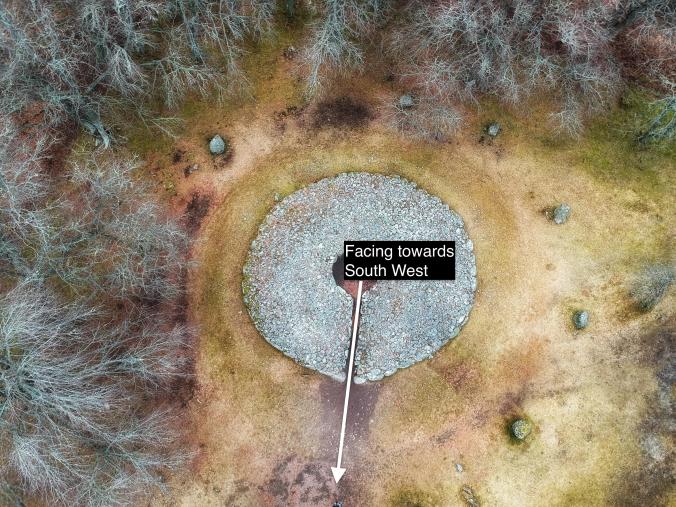
In Clava’s case, both main passage cairns have mid winter setting sun alignments facing towards the south west, such that for several days either end of the shortest day, the light from the setting Sun will shine down the central passage and light up the interior of the structure.

DSC_0054

Sun rays striking the winter solstice aligned passage.

Of course it’s one thing to read second hand accounts of this phenomena, and quite another to experience them first hand.  As luck would have it, when we approached the site around 3.30pm the Sun was clearly visible and just setting in the south west, allowing us to witness this amazing spectacle and to capture some photographs.

From inside the north east cairn, closest to the main entrance of the site, the passage was already brightly washed over with sunlight.  I was curious to determine if the sun’s position was low enough to light the passage when it was originally covered over (several thousand years ago), so crouched down within the passage to take some of my shots.  Sure enough, the rays of the Sun could be directly sighted down the camera lens.

49021095_10156997855994766_5057786481708367872_o

My daughter Violet standing in the sunlight directed down the main passage of the north east cairn.

The motivation for the astronomical alignment of these structures is still the topic of heated debate amongst historians and archaeologists, but one thing residents of the north of Scotland can appreciate first hand is the depressingly short days and long hard winters we experience at this time of year.  Some sort of large scale and perhaps communal confirmation that the south westerly extreme of the winter sunset (and its associated low midday elevation) had been reached would have been very reassuring to early agricultural societies.

It’s this concept of the Sun both halting its low elevation in the south at midday and the most southern extreme of its setting and rising positions that gives rise to the word Solstice – ‘sol ‘ sistere’ meaning Sun standstill.  The reverse applies during mid summer when the sun rises and sets at its most extreme positions to the north of east and west, and reaches its highest elevation at midday.

zuepze16k9n01.jpg

The two main passage cairns at Clava have south westerly mid winter sunset alignments.

There are some researchers who go much further, and point to alignments between the stones at Clava Cairns with the Celtic cross quarter days and the more complex dynamics of major and minor lunar standstills.  Whilst these may be true it should also be remembered that it only takes two points to make a straight line!  As ever we need to be cautious with our wish to believe, and back everything up, where possible, with evidence.

Mercury and Jupiter Conjunction


Mercury.png

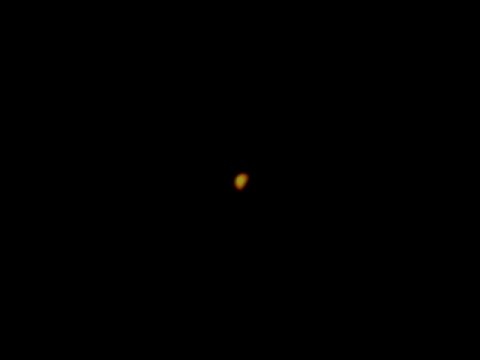
Have you ever seen the planet Mercury with your own eyes? It’s notoriously difficult to catch being situated so close to the Sun and often hard to pinpoint. You’ll only ever see it as a tiny disc in binoculars, very close to sunrise or sunset.

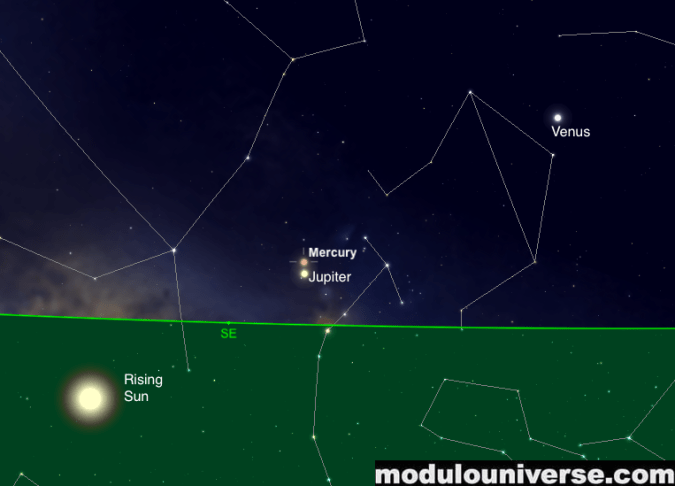
Over the next couple of days, centred on the Dec 21st solstice, there’s a unique opportunity to see Mercury as it forms a conjunction with bright Jupiter low in the south east in morning skies.

You’ll need a good unobstructed horizon to the SE to catch it. Use Venus as a guide to first find Jupiter, then look through your binoculars and you should see Mercury sitting above.

The window is pretty narrow, from around 7.30pm to 8.30pm. The longer you wait the higher Mercury will rise but the brighter the sky, as the Sun rises.

Good luck and clear skies.

merc.jpg

Mercury through a 10 inch telescope

Scapa Festival 2019

logo-scapa-fest-600px-x-60-px

I’m very happy to confirm I’ll be providing more stargazing and astronomy walks and talks at the 2019 Scapa Festival.  Details on my stargazing itinerary at the festival can be found here.

Last years’s festival was fantastic.  Very chilled, friendly and suited to a wide demographic, from families all the way to solo travellers.

I travelled with my family last year in the camper-van and we had a great time, despite none of us particularly being yoga people.  There were so many other great things to do, like bushcraft, nature walks and foraging workshops.  But probably the best time we had was just hanging out in the huge gardens, letting the wee ones play.

To find out more about Scapa please visit their website here or facebook.

Bespoke Stargazing Experiences at the Torridon

Screen Shot 2018-12-16 at 13.02.29

After the success of the first weekend stargazing experience I’m very pleased to be working with the Torridon to deliver bespoke evening stargazing experiences.  These evenings would make a very special treat for someone.

The skies around the Torridon are exceptionally dark with minimal skyglow.  Perfect for Moonless excursions under the stars.

Full details on the experience can be found here:

https://www.thetorridon.com/experiences/torridon-stargazing-experience/


Star Stories Astronomy Outreach Update

DSC_0028

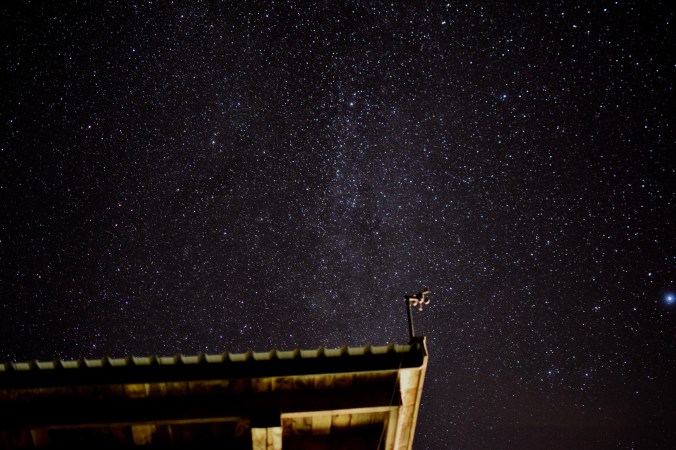
Starry skies above Abriachan, with Vega and Lyra at the extreme right of the shot.

The Star Stories astronomy programme at Abriachan Forest is going from strength to strength, with tickets selling out far in advance of each event.  Since the last update we’ve hosted two stargazing evenings, involving guest speakers Dr Anthony Luke (UHI) and Professor Martin Hendry (Glasgow University).

DSC_0027

More star studded skies above the classroom, close to brilliant Deneb in the Cygnus region of the Milky Way

The November event was a Leonids special, held near the peak of the annual meteor shower on Nov 16th, with the promise of perhaps observing some early atmosphere skipping Leonids.

Dr Anthony Luke presented a fascinating set of lectures on the chemistry of meteors and stars in the forest classroom, touching on the incredible pressure and heat generated within stellar forges that produce all the elements we see around us.

Meanwhile, I led the stargazing component outside with perfectly clear skies allowing us to take in the brightest stars, and views of the gibbous Moon in video telescope.  The lunar observing was particularly captivating, prompting discussion on the formation lunar maria, the highlands, and the Theia Moon origin hypothesis.

Clelland was also in action over the forest campfire making wooden star models for the younger participants.  There were no dramatic meteor sightings to match October’s spectacle but the event certainly whetted everyone’s appetite.


Then on December 5th, Glasgow University’s Professor Martin Hendry (of gravitational wave fame) joined us under dark skies for a Wednesday night special.

Martin is a hard working and inspirational advocate of all things astronomy and space.  Prior to me collecting him at his hotel he had already delivered a packed day of outreach to Inverness schools and hadn’t had a bite to eat since lunch.  Despite this he was incredibly grateful for the cold pizza I offered him on our drive out to Abriachan, and this meagre fare fuelled him sufficiently to deliver two fantastic talks on dark matter and gravitational waves in the forest classroom.  His talk highlighted some of the latest discoveries and simulations from the LIGO (Laser Interferometer Gravitational-Wave Observatory) team.

The following day he was off on the train again to speak to more schools in the far north.

DSC_0031

The Pleiades and red giant Aldebaran

We were also blessed with lots of clear breaks on the 5th, so I once again led the observing component outdoors, this time taking groups further back into the darker areas above the classroom where the Milky Way was ablaze, and fainter fuzzies like the Andromeda galaxy leapt out at us in our binocular and naked eye views.  Amongst many things we discussed the evolution of hot massive stars like Betelgeuse and the Kepler exoplanet survey, which has been scanning vast numbers of star systems close to Cygnus and Vega, cataloging extrasolar planets.

Prior to packing away the binoculars I snapped some pictures of the starry skies close to the forest classroom (attached).

DSC_0026

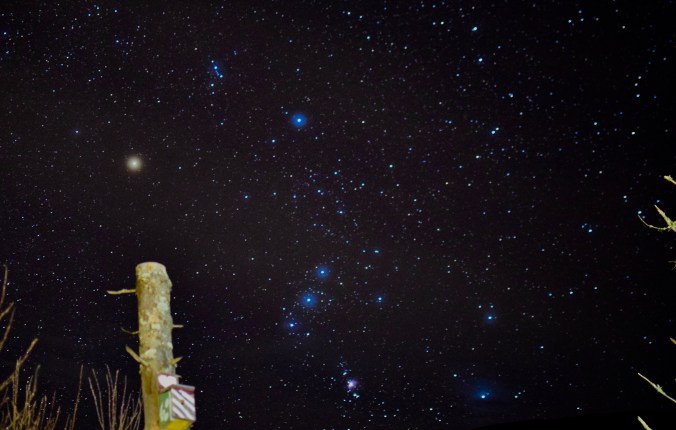
Orion rising in the east from Abriachan Forest

Both evenings have garnered fantastic feedback and we’re looking forward to the next events, listed below.

As always a big thanks to learning coordinator Suzann Barr, Ronnie, Clelland and the rest of the Abriachan team who help make these events so welcoming and successful.  We’re also grateful to grant funding from the STFC, allowing us to invest in observing equipment, free transport and to extend the scope of this year’s programme.

Future Star Stories Events

Winter Solstice Special (21st December 2018) – Solstice talk and Moon observing with astronomer Stephen Mackintosh, turn of the year campfire twists with Clelland.

Stargazing with Dark Sky Man Steve Owens (12th Jan 2019) – Stargazing with author of Stargazing for Dummies Steve Owens

Star Stories Photography Special with guest Graham Bradshaw (9th Feb 2019) – Local landscape, aurora and night sky photographer Graham Bradshaw shares his stories of nights spent on exposed hillsides and offers tips to budding photographers.