Waning Gibbous Moon

OLYMPUS DIGITAL CAMERA

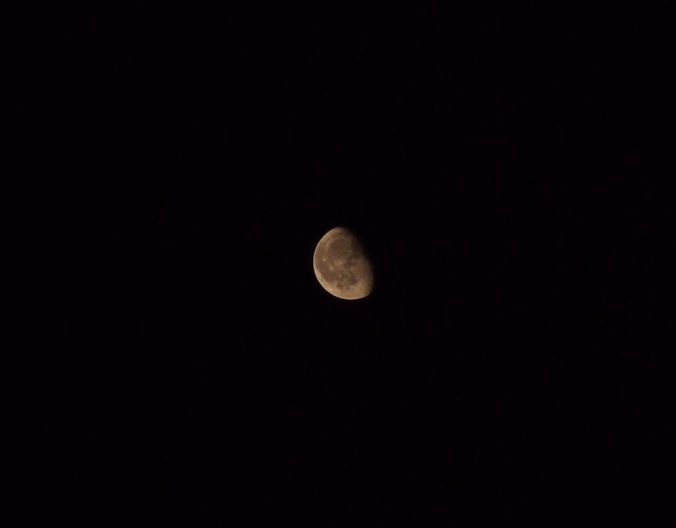
A waning gibbous Moon, photographed near Abriachan

I’m always snapping the waxing crescent Moon so here’s the waning gibbous Moon for a change. I took this on the trails above Abriachan around midnight on Friday, after a very wet and stormy evening in the camper van.

The word ‘wane’ is associated with weakness or sickness, and describes the diminishing aspect of the Moon after full. There’s a clear analogy of birth and death in the phases of the Moon that no doubt fascinated our forebears.

Astronomers often give the Moon a rough time due to its habit of spoiling dark skies, but it’s undoubtably one of the most mesmerising objects to look at. A complete world with the most incredible impact scars, recording the chaotic and violent formation of our solar system.

Observing the Moon each night is a dynamic experience as the terminator – the band where light meets dark – drifts back and forth across the lunar surface, revealing new features to contemplate.  In a telescope the terminator itself is a wonderful region to view, revealing kilometre long shadows from mountains and crater rims.  I like to imagine myself standing on the Moon in these regions, watching the Sun setting low on the lunar horizon.

Galaxy NGC 2841

Spiral-Galaxy-NGC-2841

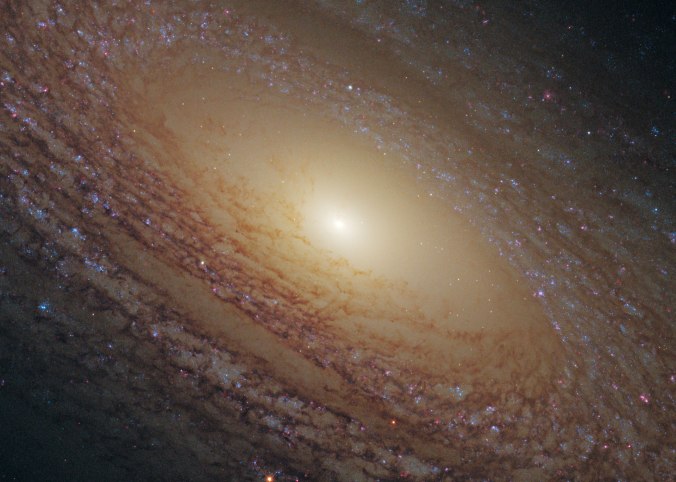
Galaxy NGC 2841. Imaged by Hubble nearly 50 million light years away in the constellation Ursa Major. This is an example of a spiral galaxy with no central bar, just a beautiful continuum of overlapping circular dust lanes.

It contains between 400 billion to 1 trillion stars, and like most galaxies outside our local group its receeding away from us, in this case at nearly 500 miles per second.

Autumn Equinox

42227757_2169060323330908_3632100907031724032_n

Temple of Kukulcan, Chichen Itza

Happy Autumnal Equinox – the official end of summer and start of autumn in the northern hemisphere!

The word equinox is latin for ‘equal night’, and marks the time when the Sun shines directly over the Earth’s equator, bringing 12 hours of daylight and darkness for nearly all inhabitants of planet Earth. It’s also the time when the Sun rises and sets almost directly East and West from our perspective.

Many ancient cultures recognised and marked the two equinoxes as the dividing points between each solstice in June and December. Perhaps none moreso than the ancient Maya of Central America, who aligned an elaborate temple in Chichen Itza in such a way that the body of a great serpent ripples down the steps on each equinox.

Today, thousands of people still gather on the equinoxes to mark this marvel of ancient construction, and the relentless passage of time.

Precise equinox time: 1.54am on Sunday 23rd September

The Milky Way

With Moonless skies at the moment it’s a great time to view the Milky Way running from South to North and cutting through the zenith close to midnight.  Look for the bright central regions close to the horizon near Sagittarius and up past the dark bands of dense galactic material around the constellations Cygnus.

Even if the weather’s looking patchy get out for that late night walk somewhere dark. You might be rewarded with tantalising glimpses during breaks in the cloud.  It’s these excursions when expectations are low that I often find the most rewarding when the sky finally opens up.

41091346_2161268987443375_7105273253718917120_n

“There’s something fascinating about our own home galaxy. Even if we still cannot look at it from above and gaze at the full span of its arms, the sideway view offers a quite a showdown.

To me the central part of the milky way is the most spectacular sight of the night sky. It’s something you can clearly see with the naked eye when you are away from city lights. It’s a sight that really brings your down to Earth and lets you wonder at how small we are, while comforting you in the thought that you are part of this Earth and the Universe.”Adrien Mauduit

Increasing Astronomical Darkness

Sunset_Scotland_(5805593910)

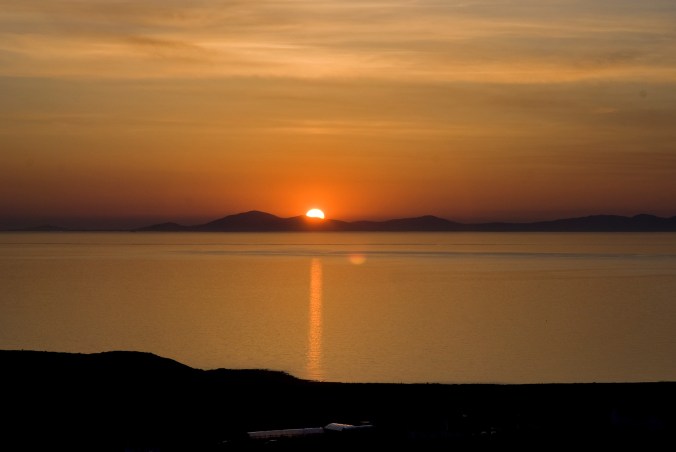
You might notice the nights seem to be pulling in quickly at the moment. This isn’t your imagination. We’re in a period of greater daylight change as we approach the Autumn equinox on September 22nd.

At the moment the Sun is setting around 20 mins earlier each week. Compare that to July when Sunset times were only changing by around 5 mins per week, and almost no noticable change over the summer solstice on June 21st.

Of course this is great news for stargazers, with astronomical twilight now kicking in around 9.50pm meaning your late night forays under clear skies will reveal increasing numbers of stars and fainter nebulae.

For seekers of dark skies this month’s new moon is September 9th so binoculars, cameras and telescopes at the ready.

Clear skies.