Here’s a video (with some voice over) I shot last night when out Moon gazing from my back garden.
I never ever regret the tiny effort and time investment involved in digging out my binoculars or telescope to have a look at the Moon.
Clear skies.
Here’s a video (with some voice over) I shot last night when out Moon gazing from my back garden.
I never ever regret the tiny effort and time investment involved in digging out my binoculars or telescope to have a look at the Moon.
Clear skies.
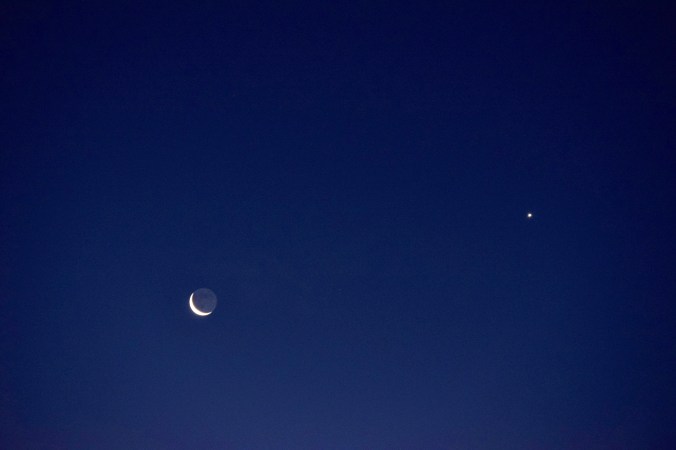
Waing crescent Moon next to Venus – Inverness
After blazing in the NW after sunset during the depths of lockdown, Venus has now completed its passage in front of the Sun (from our perspective) and now slowly emerging as a morning apparition.
At the moment you’ll need to rise very early to catch it due to very bright skies – binoculars or a telescope might be needed.
The morning of the 19th June is particularly special as both Venus and the wafer thin crescent Moon will sit very close to each other. In fact, later the same morning the Moon will occult (hide) Venus for around an hour.

A human henge – mid summer at Abriachan
Some good news regarding future face to face astronomy programs, delivered up in the Scottish Highlands. All of this is caveated on the assumption that live gatherings are legal and safe at the end of this year.
Next season (from November) I’ll be continuing to work with Caroline Snow to deliver our Urban Astronomy programme based out of the Friends Of Merkinch Local Nature Reserve in Inverness (with the Sea Scouts hall as our indoor base of operations). These events have been growing in popularity and we’re really glad they’re going to continue.

Merkinch Moon gazing
Star Stories will also continue from Abriachan Forest (Dark Sky Discovery Site) with Suzann, Clelland, Ronnie and the rest of Abriachan Communityteam. The STFC spark award funding is due to end this season, but the programme will continue on a sustainable footing with events (hopefully) starting in November. This whole programme has been a massive success and I look forward to completing my research report for STFC with dissemination for various astronomy publications.
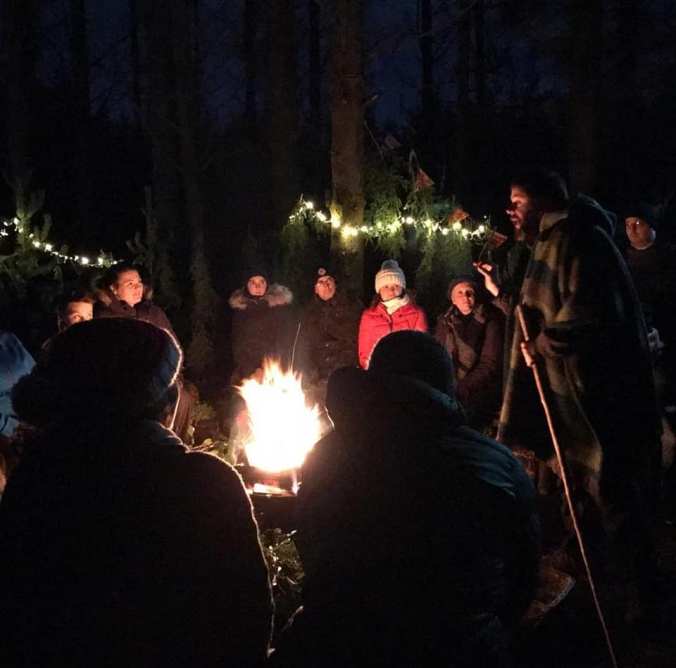
Clelland in action
I’ll also continue my hotel based outreach work for the likes of The Torridon and appearances at various festivals, whenever it’s safe and practical to do so.

Some future plans are also underway, including an outreach programme with much bigger scope that will involve various partners and potentially some innovative new technology.

Noctilucent clouds over the Isle of Lewis by Emma Rennie
Longer days and brighter nights mean less time under the stars, especially if (like me) you live in the far north of Scotland, when astronomical twilight vanishes completely from around late May.
One advantage to this, however, is increased opportunities to observe some of the highest cloud formations on Earth, so called Noctilucent clouds – or ‘night shining’ clouds.
These beautiful, wispy and wave like clouds sit around 50 miles overhead in a region of our atmosphere known as the mesosphere. The clouds themselves are composed of fine ice crystals and atmospheric dust, and can even be seeded from the disintegration of small meteors which burn up around the same altitude – called ‘meteor smoke’.
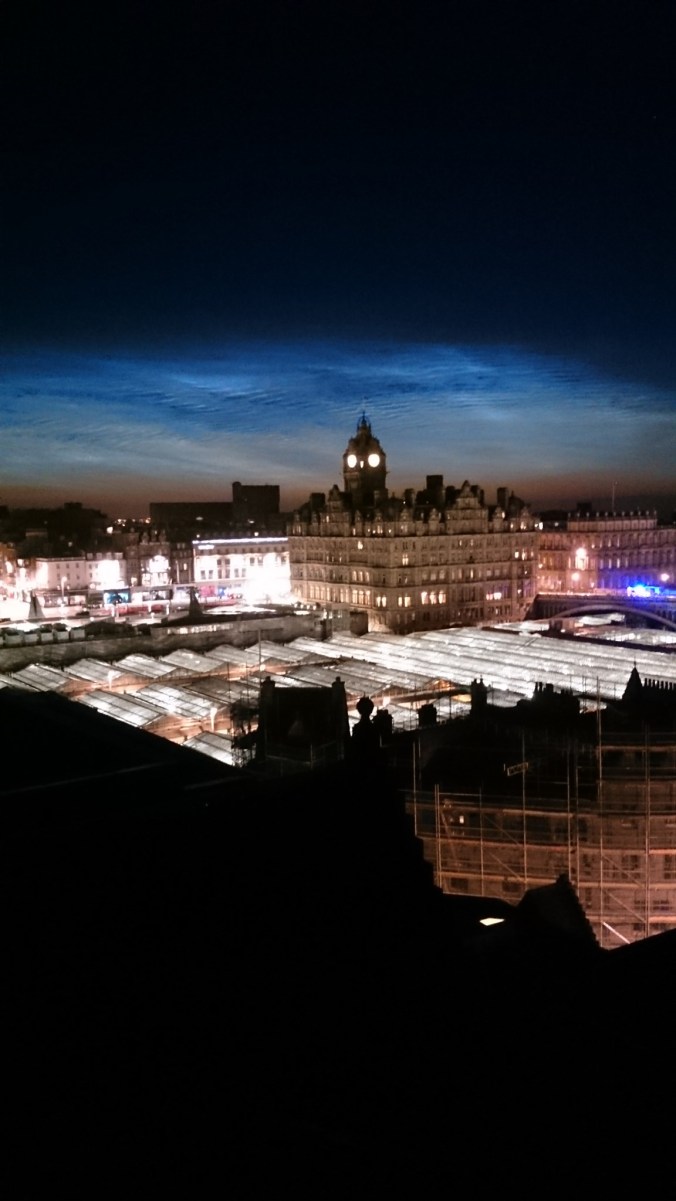
Night shining clouds from Edinburgh by Chris Cogan
Specific conditions are required to see these clouds, and the further north you live generally the better (roughly between latitudes 50 – 70 degrees).
The Sun must be below the horizon in such a way that its rays light up the clouds from below. Broadly speaking this can happen during a period known as nautical and astronomical twilight – when the Sun sits between 6 and 18 degrees below the horizon. This means noctilucent clouds are normally only visible from mid-May to mid August from the British Isles.
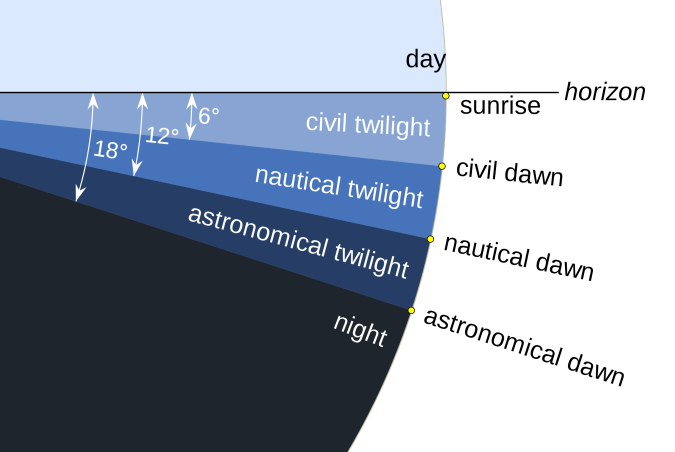
These clouds are normally only visible when the Sun sits within the nautical and astronomical twilight bands, between 6 to 18 degrees below the horizon.
Times vary depending on your latitude but here are the earliest times for nautical twilight at various locations. These times therefore represent the earliest you’re likely to be able to observe the clouds, although optimal times will likely be between 30 – 60 minutes after these times:
Shetland (60.5 degrees north) – 11.35pm
Inverness (57.5 degrees north) – 11.05pm
Glasgow (55.8 degrees north) – 10..45pm
Manchester (53.5 degrees north) – 10.15pm
London (51.5 degrees north) – 9.50pm
You might think these times suggest living further south affords you longer opportunities to observe them. This isn’t true as the further south you live the more likely you are to experience periods of actual darkness later on, when the Sun dips below 18 degrees – too low to illuminate the cloud base.
Good luck and please post some pictures on my Facebook blog if you capture any.

Captured by Gav Ross from Aberdeenshire

Comet SWAN update! ☄️ Comet SWAN is just starting to become viable for observation at northern European latitudes as it sails through the constellation Perseus. This one will be very tough to see due to its low altitude and lack of darkness 🌅 . In fact it may not be visible at all if you live too far north. However, if you’re up for a real challenge, grab your binoculars and read on.
Just like this week’s Venus and Mercury planetary conjunction 🪐 , SWAN will be visible towards the north 🧭. As the week progresses it will rise higher and higher in the sky so theoretically should become easier and easier to observe (see attached guide images). Unfortunately this will be countered by less and less darkness as May advances.
The absolute best instrument for spotting a comet is a pair of binoculars, or the widest possible eyepiece you have on a telescope. Scan the sky using my pictures and bright stars for reference. Don’t expect a huge streaking object like you’ll see in astronomy magazines (or the front image I’ve attached 😆 ) – If you’re very lucky you might detect a tiny and faint smudge.
The darker your surroundings and more dark adapted your vision the better 🌑 👀 , so stay away from bright street lights and mobile phone screens for at least 15 minutes. If you live under street lights 🌃 your chances of sighting the comet are far lower but don’t let that put you off. Comets can vary in brightness dramatically and can very occasionally brighten enough to be detected naked eye.
What’s great about this challenge is you can also look out for Mercury and Venus at the same time, as all the action takes place towards the same cardinal direction – North.
Good luck and clear skies.


A rare opportunity to observe a Venus and Mercury conjunction over the next few days.
From tonight (Monday) Mercury will appear progressively closer to Venus in the NW sky after sunset, leading to conjunction on Thursday and Friday night. An excellent chance to see Mercury in binoculars or observe the phase of both planets in a garden telescope.
Mercury is much dimmer and more challenging to see than Venus so my advice is to use Venus as a reference for finding Mercury in your binoculars or telescope. Those, like myself, living in the north of Scotland might need to wait a little longer after sunset to see the planets (due to pervading daylight). This makes it more of a challenge as both planets will be closer to the horizon by then.
Moreover, as both planets will only be around 10 degrees above the horizon at conjunction you’ll need to get away from tall trees or buildings that might obscure your view NW. Hopefully those pesky clouds stay away too.
Clear skies and good luck.


An example of gamification in one of my recent projects called Stellar Evolver (with audio voiceover). This is a fully VR ready experience and will enable players to interact with and watch the evolution of star systems using the visceral mechanics and feedback of a 3D based shooter.
Stellar systems can evolve from simple proto-planets up to red dwarfs and larger giant stars, eventually culminating in the formation of neutron stars and black holes.
Clearly the overall dynamics, scale and time is being exaggerated here for playability. I hope to demonstrate a working multiplayer prototype at the 2021 Hebridean Dark Sky Festival.
Developed by Mackintosh Modelling & Data Simulations
modulouniverse.com
 | Modulo | Universe