Moon Formation

Modelling suggests the Earth came very close to having a pair of smaller Moons.

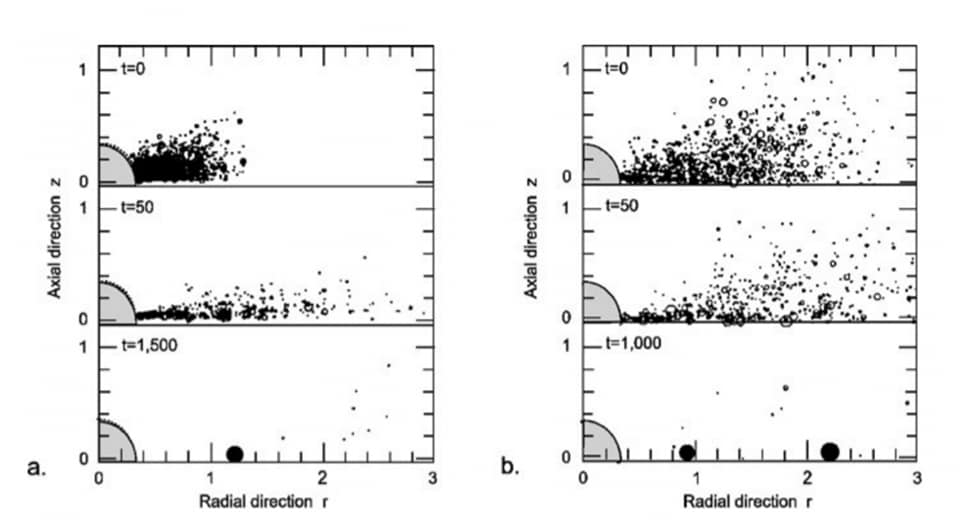
According to simulations by Canup and Ida (2014) the Earth came very close to hosting two smaller Moon’s (right) rather than the large single Moon we ended up with (left).

This fascinating ‘what if’ modelling is based on the giant impact hypothesis. A faster rate of rotation of the post impact disk is the main requirement for a two Moon system to take hold.

Of course multiple moon system are very common. Saturn for example has an abundance of them, with the most recent count totalling 82 orbiting bodies.

Colour Image: Artist’s impression of an alien world with two moons by Angela Harburn.

Mercury and Maximum Elongation

I hope you enjoy this short video about the planet Mercury, which you can currently see during late evening, low on the NW horizon. Mercury is also approaching its maximum evening elongation on the 17th May.

Joining me once again is Steve Owens, astronomer at Glasgow Science Centre and author of Stargazing For Dummies.

In this video podcast we discuss:

1. Tips for observing Mercury safely.

2. Mercury’s phases.

3. The surface geology of Mercury and how this reveals tantalising hints about its history and formation.

Stargazing Guide to April Skies

This took way more time than I anticipated to edit but it was great fun putting together with my friend Steve Owens. I hope you enjoy this more conversational style look at the stars.

It’s a good 30 minutes long so best grab yourself a brew or beverage of choice and get comfortable for this one.

Discussions in this episode include:

1. A farewell look at Orion and nearby stars and clusters

2. The crescent Moon in mid April

3. Planet Mars

4. Leo and the double star Algeiba

5. Northern skies and Polaris

6. The M81 and M82 galaxies

Happy April skywatching and stargazing!

Stargazing Looking North

If you live in mid northern latitudes there’s an undeniable familiarity to your night skies when facing north. One of the most prominent constellations is Ursa Major with its bright asterism known as The Plough, or Big Dipper. I call this collection of stars the Swiss Army Knife for stargazers, and for good reason. Please watch to find out why.

Music used with permission from Rising Galaxy (Cosmicleaf records, Greece)