I hope you enjoy this conversational deep dive into the great globular cluster in Hercules. Joining me once again is Steve Owens, astronomer at Glasgow Science Centre and author of Stargazing For Dummies.
In this video podcast we discuss:
1. Finding M13 and what to expect when observing. 2. The physical scale and composition of this vast cluster. 3. What the night sky might look like from within M13. 4. Could life emerge and survive within these ancient and densely packed stellar environments. 5. What can globular clusters tell us about our position within our own Milky Way.
Music by Rising Galaxy, Cosmicleaf Records , Spain.
The Torridon is a location with exceptional darkness in the remote western Highlands of Scotland. You can see a preview of my stargazing experience on the BBC’s Amazing Hotels. Near the end I take Giles and Monica out for an excursion under the stars.
Fingers crossed both my community based stargazing programmes will be up and running again by October (at Abriachan Forest and the Merkinch Nature Reserve).
A visualisation of how extreme gravity can distort the light paths close to binary black holes. The blue and red halos are the accretion disks surrounding the black holes (material super heated close to the event horizon). The blue disk represents a black hole some 200 million times the mass of our Sun. The red one is a smaller black hole half this mass.
Gravitational lensing like this is a real and measurable consequence of general relativity and astrophysicists are now using sophisticated modelling techniques to make incredible predictions. One amazing application of gravitational lensing is predicting when duplicated but delayed images from the same supernovae will appear, allowing astronomers to study exploding stars in real time.
This happens when a single event – like a supernova – is projected into multiple copies of itself by a large intervening galactic mass, with each copy delayed due to different light paths through spacetime.
I wanted to share some images with you that had me transfixed when I was a young boy (and still do to this day). I recall first seeing them in a hardback book of my father’s called Cosmos (which presumably accompanied the TV series that was being broadcast at the time).
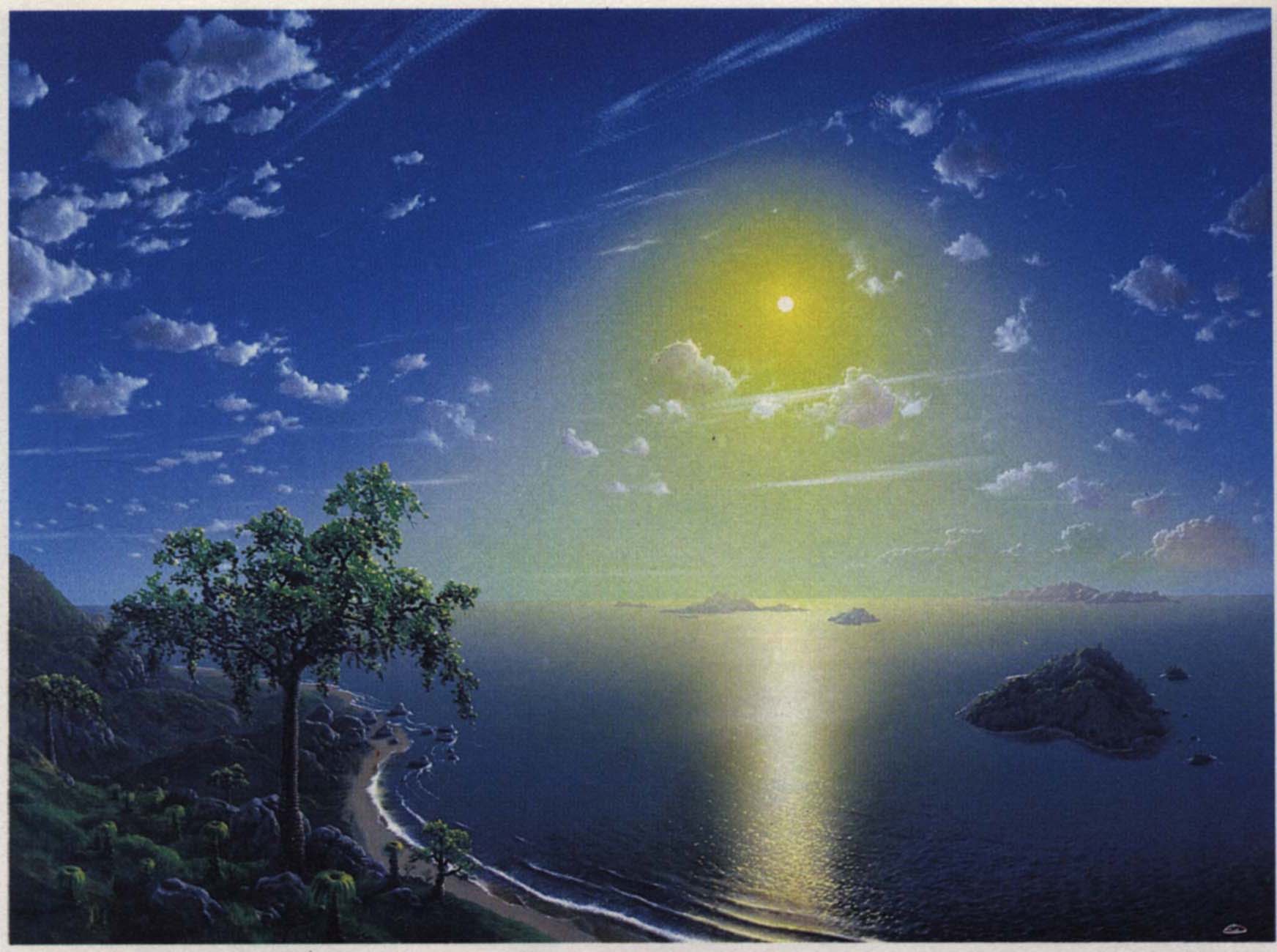
The images depict the fate of our planet as the Sun transitions into a red giant star, at the very end of its life, some 4-5 billion years from now.
As the temperature of the Sun slowly increases, the oceans recede and our precious atmosphere is stripped away. Eventually the whole horizon is overwhelmed by the Sun in a bloated distended form, with the final image showing the Earth completely barren and parched.
I remember wondering at the time – where would all the people and animals be? Would we perish or find some new star to call our home? I think it was the first moment I glimpsed the immensity of stellar time scales and how tiny human lives and endeavours appeared to be next to these vast physical processes.
This is still what fascinates me most about astronomy and cosmology, and it’s amazing how something as natural and simple as looking up at the stars is a gateway into these incredible realms of the imagination.
Anyway here are the images, including their original captions. I was also pleased to find out that Adolf Shaller is still producing amazing art. Try an image search on Google with his name and enjoy.
‘The last perfect day’‘The waters recede and most life is extinguished as the sun starts to swell and its luminosity rises.’‘The oceans have evaporated and the atmosphere has escaped into space’‘The sun, now a red giant, fills the sky over a dead planet. As we see in the next section, the red giant will eventually throw off its outer layers and become a white dwarf.’
This took way more time than I anticipated to edit but it was great fun putting together with my friend Steve Owens. I hope you enjoy this more conversational style look at the stars.
It’s a good 30 minutes long so best grab yourself a brew or beverage of choice and get comfortable for this one.
Discussions in this episode include:
1. A farewell look at Orion and nearby stars and clusters
This is Bode’s galaxy (M81), an easily accessible island universe in Ursa Major that’s visible all year round from mid to high northern latitudes. It contains approximately 250 billion stars.
It lies over 10 million light years away and has a relatively close galactic companion – the M82 Cigar galaxy. Both of these galaxies can be framed in a low power telescopic eyepiece, and you can even see them very faintly in binoculars if your skies are suitably dark.
I thought I’d use this galaxy to highlight how astronomers use the full electromagnetic spectrum of light to study galaxies and their evolution. Pictured below, therefore, are images of M81 viewed in different wavelengths of light – from X-rays to radio waves (spanning short to long wavelengths). I’ve provided a very brief description of some of the galactic features revealed by each band of light.
X-rays: a central bright patch is revealed, suggestive of a supermassive black hole within the galactic nucleus. The other bright patches correspond to X-ray binary systems.
Ultraviolet: highlights young hot stars and therefore areas of active star formation within the spiral arms of the galaxy.
Optical and Infrared: Shows the bulk of the stellar population and areas of obscuring dust and nebulosity that will seed ongoing star formation.
Radio: Reveals supernova remnants and large H2 regions of ionised gas in the vicinity of very active stellar populations.
As humans our eyes have evolved to see a very narrow band of the full EM spectrum. This evolution is tied to the fact our particular star (the Sun) releases its peak energy in these wavelengths. I always like to imagine how other species, perhaps evolving next to giant sources of x-rays, might have sensory apparatus totally blind to visible light.
Here’s a look at some of the binoculars I use for stargazing and astronomy, both hand held and tripod mounted.
I’d say 90% of my observing is done with binoculars over telescopes due to their versatility and speed of use. This is especially relevant if you live anywhere with changeable weather, when sometimes brief openings appear in the sky.
If you enjoyed this video and found it useful please let me known and if you feel like buying me a coffee I’d really appreciate that too (link below).
Please note this video is not sponsored by Olympus, these just happen to be the binoculars I use. Any pair of 8×40 or 10×50 binoculars should serve you very well.




 | Modulo | Universe