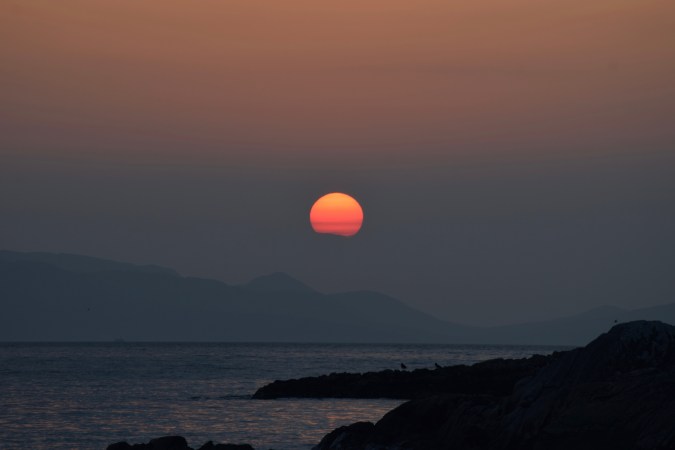
Solstice Sunsets

Video from the shores of Bunchrew looking over Ben Wyvis, panning from the north west to north east

The sunsets in the Highlands of Scotland are some of the best in the world when conditions are right, especially around the solstice when the setting Sun grazes just 8 degree below the northern horizon producing mesmerising night long sky glow.

On June 22nd I camped out at the Bunchrew shoreline with my daughter Violet and managed to capture some video and still images of the sunset looking north towards Ben Wyvis.  Footage captured around 10.45pm.


This slideshow requires JavaScript.


Star Stories – Solstice at the Shielings

This slideshow requires JavaScript.

Solstice celebrations up at Abriachan tonight. We had a nature walk and talk up to the Shieling above Loch Ness, with Suzann, Christine and Clelland imparting plant and flower lore at various points up the trail.  From the top we learnt all about Shieling life, dairying and got to sample some simple crofting fare.

I then presented a short talk on the Solstice and its astronomical significance, culminating in a human henge to illustrate the changing seasons, rising and setting Sun points and how the ancient Celtic people marked off their Wheel of Time.

We just managed to catch a lovely sunset from the top of the hill before making the trek back down.

The Star Stories events will be resuming in October with another event in collaboration with the Highland Archaeology Festival.  Look out for programme details as they emerge.

Happy Summer Solstice

DSC_0201.jpeg

Happy Solstice! Official time off the solstice today is at 3.54pm GMT when the north pole of the earth is maximally inclined towards the Sun.

In the north of Scotland we currently experience over 18 hours of daylight and no true night at all, as the Sun dips a mere -8 degrees below the horizon at its lowest point at 1.20am.

Official sunset time today is 22.20pm when the Sun will be at its greatest setting extremity towards the North.  This is where the term Solstice comes from, Sol -Sistere, or Sun Standstill.  The point when the Sun reaches its maximum declination in the sky or its furthest rising and setting points north of east and west on the horizon.

The situation is reversed for out friends in the Southern hemisphere of the planet who are currently marking the winter solstice.

Clear skies if you head out to take in the setting Sun!

Summer Solstice at the Shielings

Screenshot 2019-06-10 at 15.00.33.png

Come and join us for an outdoor walk and talk to the Sheilings above Loch Ness. Learn about summer plant lore and old dairying activities from Abriachan’s Suzann and Christine as we walk up the hill.

Once we reach the Shieling local astronomer Stephen Mackintosh will give a talk on ancient astronomy and how many cultures would mark the solstices in days gone by.

Some traditional refreshments will be available at the top after the walk (30 mins uphill).

Meet: Friday 21st June after the Abriachan Highland Games at 8.30pm.

Park at the fank carpark NH559348. For detailed directions please advance email abriachanforest@gmail.com or call 01463 861236. All ages welcome.

Tickets available via Eventbrite.

Due to the outdoor nature of this event it may be cancelled due to very poor weather. Please check the ‘Abriachan Community ‘or ‘Highland Astronomy’ Facebook pages for details on the day. This event is part of the Star Stories Astronomy and Storytelling programme, part funded by the STFC (Science and Technology Facilities Council).

Event image rights: Karl Normington.

https://www.flickr.com/photos/36266724@N06/

Night Shining Clouds

1024px-Helkivad_Ööpilved_-_Noctilucent_Clouds_(1)_copy-2

A few weeks either side of the summer solstice is the best time to observe ‘noctilucent’ or ‘night shining’ clouds.

These wispy collections of ice crystals are the highest clouds on Earth, located in the mesosphere up to 50 miles overhead. They’re too faint to be seen in daylight and best observed when the Sun is between -6 and -12 degrees below the horizon.

At the moment at Highland latitudes this gives you an approximate window between 11.30pm and 3am in the morning.

Clear skies.

Scotland – Land of the ‘almost’ Midnight Sun

DSC_0187

A stunning sunset captured over the Isle of Rum

In the north of Scotland we’re about four days away from losing all astronomical twilight and entering a period of sustained ‘nautical twilight’.

During this time the centre of the Sun’s disk never dips more than 12 degrees below the horizon, rendering our clear night skies a dark azure blue, with only the Moon, planets and brightest stars visible after midnight.

This will continue until mid July when astronomical twilight finally reappears.

Contrast this with London, where astronomical twilight continues right through mid summer, producing much darker night skies, but arguably less beautiful and prolonged sunsets.

Clear skies.

Inverness

We’re leaving astronomical twilight behind for several months here in the north of Scotland

London

Significantly darker night skies persist through mid summer in southern England.  Here’s the contrasting data for London.

ISF Talks – Island Universes

I’ve recently finished delivering two public lectures on Galaxies at this year’s Inverness Science Festival.

The theme of my talks was ‘Island Universes’, telling the tale of when and how we discovered our Milky Way isn’t the only galaxy, and how the teeming multitudes of spiral nebulae, hitherto believed to be collapsing dust clouds, were in fact individual galaxies.

The talk started with some observational astronomy, before discussing the great debate of 1920 between Harlow Shapley and Heber Curtis.  The main unresolved issue here was the distance to the spiral nebulae, particularly Andromeda, which was unknown.  This lead us into pulsating stars and the work of Henrietta Swan Leavitt, who systematically analysed and determined the period luminosity law for cepheid variable stars.

Finally we discussed Edwin Hubble and the ramifications of his observations on the red shift of distance galaxies, and how this has informed our current understanding of the history and future dynamics of the universe.

I’ll let some choice slides do the talking from here on.
Screenshot 2019-05-13 at 16.04.47

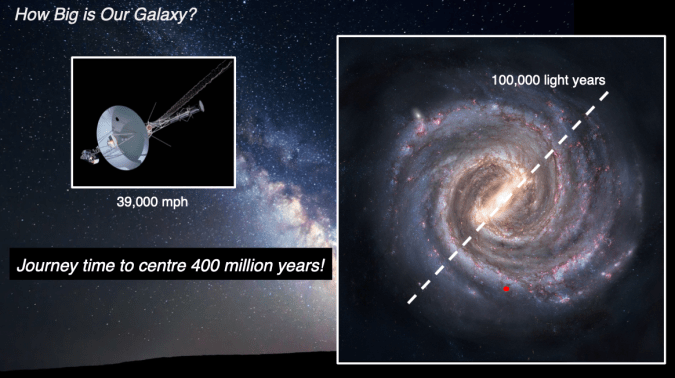
Our own galaxy ‘The Milky Way’ is big.  If you tried to travel from our position to the galactic nucleus at the speed of the Voyager spacecraft it would take you over 400 million years.

Screenshot 2019-05-13 at 16.13.00.png

A 1900s image of the Andromeda nebula.  Back then the consensus was these spirals were large collapsing dust clouds, a bit like the star forming Orion nebula.  The idea that they could be separate galaxies like our Milky Way seemed inconceivable, yet that’s where the evidence eventually lead in the 1920s.

Screenshot 2019-05-13 at 16.05.51.png

Determining the distance to spiral nebulae (as they were known pre 1900) required a new way of determining distance from so-called ‘standard candles’.  Leavitt’s law was invaluable when Hubble turned his attention to Andromeda in 1922.

Screenshot 2019-05-13 at 16.06.33

Hubble discovered the galaxies were all rushing away from us.  However this phenomena is actually a metric expansion of space itself, and therefore has no intrinsic centre.  Some of the most distant galaxies are receding away at faster than the speed of light – again due to the expansion of space itself, which has no speed limit imposed.

Screenshot 2019-05-13 at 16.06.49

There were lots of questions on M87, the giant elliptical galaxy whose black hole was recently imaged by the Event Horizon telescope.

Q&As are always lively after astronomy and space talks, and the younger audience members always surprise me with their amazing knowledge and frank curiosity.  Some choice sample from the two evenings below.  Answers on a postcard please .

1. Is the singularity at the end of a black hole the size of the Planck length?

2. If a giant hole suddenly appeared in the Earth how many Pluto’s could you fit inside it?

3. Do supermassive black holes continue to grow until they devour the host galaxy?