Part 3 of my series of Stargazing articles for the Muir Matters magazine, this time concentrating on the abundance of galaxies observable within the Spring constellations Leo and Virgo.
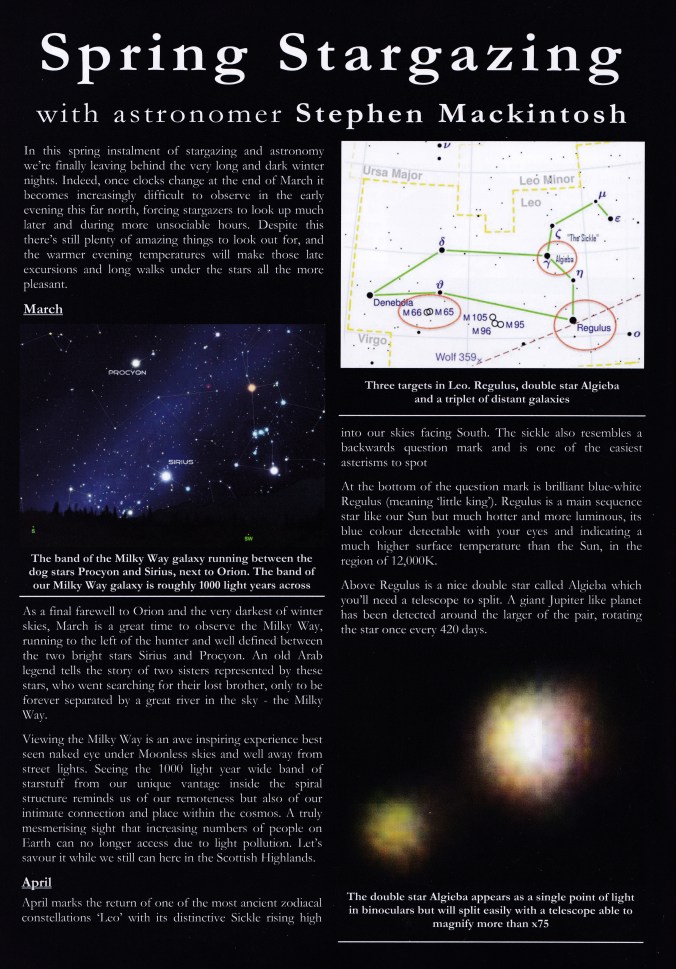

Part 3 of my series of Stargazing articles for the Muir Matters magazine, this time concentrating on the abundance of galaxies observable within the Spring constellations Leo and Virgo.
I hope you enjoy this video I’ve put together highlighting some of the most mesmerising images of planetary nebulae captured by the Hubble space telescope.
“Planetary Nebulae are some of the most eerily beautiful objects in the universe. But what are they and how do they form?”
With thanks to Robert Hundt at Glitchy.Tonic.Records for accompanying musical score.
Image credits: NASA / Hubble.

Gazing Moonward from the grounds of the Sea Cadets Hall, Inverness
We had a very successful Merkinch astronomy evening last Thursday, the second I’ve hosted from our new base at the Sea Cadets Hall on Kessock Road. All available tickets were allocated in advance and we had a healthy gathering of over 50 people in the end, along with some of the sea cadets. Caroline had also secured a large consignment of 8×40 binoculars for this and future events, which we put to good use later in the evening.
I kicked proceedings off with a projector based talk on buying a first telescope, offering some recommendations for good beginner scopes that won’t break the bank. Afterwards, we headed out into the carpark beside the hall for some projections of the Moon. Despite high cirrus clouds the Moon was still very clear and we had workable views via video telescope, allowing us to discuss the infinitely enthralling topic of lunar geology.
A few stars popped out later on but not enough to warrant a walk over to the nature reserve – which was the original plan if skies were clearer.
The next event takes place on February 28th when I’ll discuss deep sky observing – including star clusters, nebulae, galaxies and supernova remnants – how to observe them and some of the incredible astrophysics behind them. Links to this event here.
The International Space Station returns to Scotland’s skies on January 25th. I’ve put together a short informative video on the station linked below. Please also find the first few flyby times. I’ll be posting live prompts on my Highland Astronomy FB page when I can.
List of the first few bright ISS passes:
Despite cloudy skies up at Abriachan Forest we had a fantastic evening of astronomy and storytelling on Saturday 12th January with special guest Steve Owens, aka Dark Sky Man.
Steve is the author of the popular Stargazing for Dummies book. He was presented with the Federation of Astronomical Societies 2010 award for Outstanding Achievement in Astronomy, and the Campaign for Dark Skies 2010 award for Efforts in Dark Sky Preservation.
Due to the weather the evening was split into two streams – an indoor talk on dark skies with Steve, and storytelling with Clelland in the forest. Since I was off the hook I managed to capture some film and compiled a short vide of the evening below.

A view of Orion from the Merkinch Nature Reserve at a previous event. Credit Simon Garrod
I’m delighted to be continuing the urban astronomy initiative with the Merkinch Nature Reserve this year, in partnership with project manager Caroline Snow.
Going forward we now have a base of operations to host our astronomy gatherings, after a successful trial last year at the Inverness Sea Cadet hall on Kessock Road. The venue allows us to host indoor talks and activities and is only a ten minute walk from the nature reserve itself, giving us the option to stargaze during open skies.
The first event planned for 2019 is an Introduction to Observing and Moon Night, where I’ll present a beginners guide to astronomy – what to consider buying to get started and what to potentially avoid. We’ll take a break from proceedings to observe the gibbous Moon and stars if conditions are clear. All booking enquiries should be directed to Caroline, who’s email is in the event link above.
We have plans to roll out further events as part of a larger 2019 programme. Stay tuned here or on the Merkinch Facebook site for details as they develop.
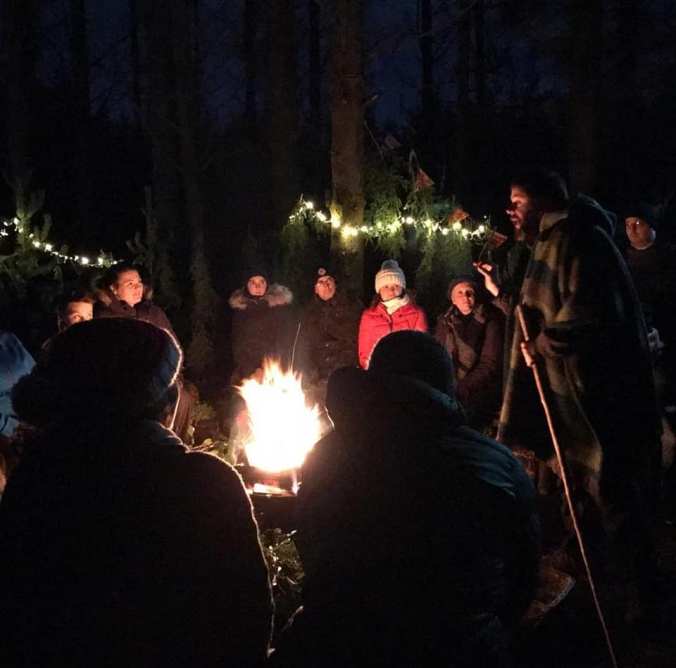
A captivating Clelland in full swing over the fire
Following the fantastic summer solstice gathering last June we decided to add an astronomy themed winter solstice event to the Star Stories programme up at Abriachan.
Instead of stargazing the event was billed as a ‘Solstice and Moon night’, as I quickly realised the almost full Moon would be prominent in the sky and wash away significant views of the Milky Way and fainter galaxies and clusters.
As it was the evening was a fantastic success, with a bright mid winter Moon powering through some scattered light clouds and offering us lovely views of its surface via binoculars and video telescope.
Before the Moon observing I presented a short indoor talk on the cultural and observational significance of the solstice, linking in various older mid winter traditions such as Saturnalia and Yuletide and outlining the folk connections with modern Christmas.
We also examined the importance of mid winter markers for the ancient settlers of high northern latitudes, where pitifully short days and long winters no doubt motivated a collective and religious celebration of the ‘turning point’ of the Sun’s midday altitude and its rising and setting points. We followed this with a look at various solar aligned prehistoric monuments like Stonehenge and, much closer to home, the wonderful Clava Cairns which I visited recently with my family on Christmas Eve.

Presenting my solstice talk before we stepped outside to observe the Moon
After the talk we moved outside to observe the Moon in binoculars and video telescope, with the aid of an outdoor projector and screen I had setup earlier. The giant screen allowed everyone to see some of the striking features on the lunar surface up close and personal, like Tycho’s crater, the Apennine Mountains and various seas including the famous Sea of Tranquility where the first Apollo astronauts landed.
Meanwhile, Clelland took the second group into the forest for some dramatic campfire storytelling. This evening he told a solstice inspired Celtic tale involving the mythological hero figure King Arthur, who some think may be connected with Welsh folk legend. Participants also gathered up and tied together clumps of herbs to burn in the fire as they made new year wishes, another old winter tradition practiced in the Highlands and further afield.
Feedback on this one has been great and we may well followup with a March Equinox event. We’re also seeing many returning families and enthusiastic youngsters, which is fantastic. Going forward Suzann and I will endeavour to capture some film interviews from some of the keenest young astronomers, recording their thoughts and feedback on their learning experience for future dissemination.
All pictures in this piece (aside from the Moon picture) are courtesy Abriachan Forest Trust.
 | Modulo | Universe