STFC Support for Astronomy Outreach

24900062_1994723217431287_4261072682509033538_n

I received some fantastic news this week. The Science and Technology Facilities Council (STFC) are supporting our continued programme of astronomy outreach at Abriachan Forest Trust, via a SPARK award.  The news was published in the BBC Highlands & Islands website here.

STFC council members were impressed with the successful pilot events delivered over the winter, bringing together astronomy, science and culture through the medium of stargazing and storytelling.

The released funds will be invested in observing equipment, landscape astronomy props, and transportation costs to help families without vehicles access future events.  They will also help us deliver another 12 events out at Abriachan over the next year and into 2019.

I’d like to personally thank the following individuals for their formal letters of support on the bid:

Suzann Barr – Learning Coordinator at Abriachan Forest Trust

Martin Hendry – Professor of Gravitational Astrophysics & Cosmology and Head of the School of Physics & Astronomy, University of Glasgow

Steve Owens – Dark Sky Consultant and Author of Stargazing for Dummies.

Elizabeth Barron-Majerik – Project Development Manager, School of Forestry, Science, Maths and Aquaculture, UHI

But most of all thanks to everyone who have attended the Abriachan stargazing sessions so far, during clear and wild weather.   Keep a look out for the future list of events.

STFC logo - web quality jpg - large (colour on white)

Astronomy Guiding at Scapa Festival

31894544_832835000237043_995368678121799680_o

I had a fun two days of astronomy guiding at the newly launched Scapa yoga festival near Loch Fyne.  One of the perks for the job was a family ticket for the festival so I decided to take the camper van and family along too.

The drive from Inverness was pretty arduous, but when we arrived it was a lovely setting and ended up being one of the most peaceful and chilled out festivals we’ve been to.  Numbers were kept at reasonable levels so that toilets and open spaces were jostle free and relaxing.

The astronomy work ran for two days late in the evening and was in partnership with the Wild Things! group.  The original plan was for a late night constellation walk to the beach but as the clouds rolled in we instead elected for an atmospheric campfire, with a general discussion about the stars.

This format worked out very well with lots of interested folk dropping in to participate in what became a very vibrant Q & A, covering topics as far reaching as star navigation, astrology, shooting stars, black holes and stellar evolution.  On the Saturday evening some people stayed for the whole two hours, transfixed by the discussions.  Astronomy is a subject with the power to transport people back into a state of childhood wonder!  It’s undoubtably the most accessible and mind-blowing of all the sciences.

By all accounts the festival was a great success and I wish the organisers lots of luck with Scapa 2019.

Wild Astronomy – Inverness Science Festival

milky way

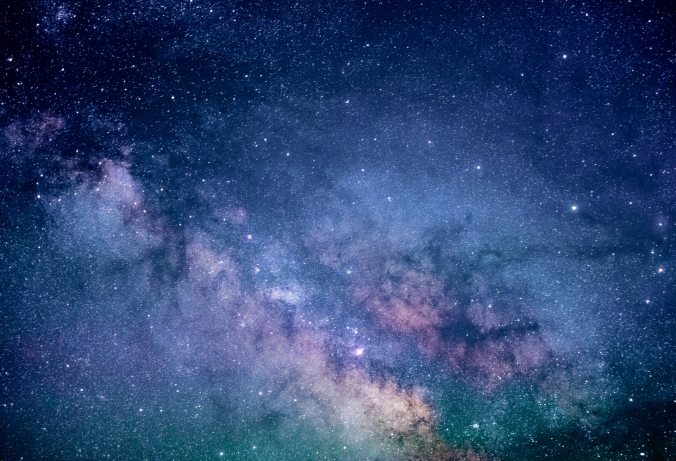
I’ll be giving a public lecture at the Inverness Science Festival on May 11th 2018.  I’d love to use some images from local astro photographers, particularly night sky photos taken in the Highlands or north of Scotland.  If you’d like your images used I’ll fully credit you in the talk.  Please PM me for details.

Talk Title: Wild Astronomy

Description: The Highlands of Scotland have some of the darkest skies in Europe but how often do we escape our back gardens and ‘get out there’ to appreciate the night sky?

In this talk astronomer Stephen Mackintosh discusses what makes our Highland skies so special, the sights and objects we should look for, and how a backpack and a pair of binoculars is all you really need to open up the wonders of the night sky.

Time and Location:  May 11th, 7-8pm at University of the Highlands and Islands STEM Hub, An Lòchran, Inverness Campus, Inverness

The Crab Nebula

crab

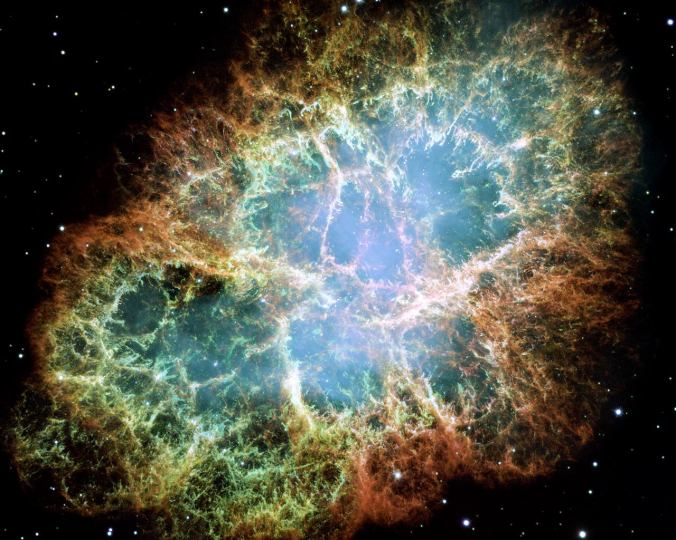
In 1054AD Chinese astronomers recorded a bright new star suddenly appear in the constellation Taurus the bull. It brilliantly out shone all other stars and was visible in broad daylight. After a year or so its light faded and it vanished.

The event was a supernova explosion – the dramatic explosion of a massive star. Today we can see the remnants left behind from this violent event – the Crab Nebula. An expanding shockwave of recycled stellar material. The above amazing image is from the Hubble space telescope.

You can see the Crab Nebula in a modestly sized amateur telescope, and as always the darker the skies the more detail you’ll see.  With a 150mm scope or larger you should be able to trace out the overall mottled shape of the nebula.  Use averted vision and see if you can pick out extra detail and structure.

Finding the Crab is relatively straightforward as it sits just beside the lowest horn of the constellation Taurus the bull, which sits above and right of Orion during evening skies at the moment.


Locate Crab.png

Next Abriachan Astronomy Dates

I’m excited to be hosting two more astronomy events alongside the Abriachan forest team in March and April 2018.  Details and ticket links below.

Star Cluster Special – March 10th (moved from Feb 10th) 7pm-9pm

Hyades_and_Pleiades_l

The Hyades and Pleiades Star clusters

Explore the great winter open clusters under moonless dark skies with campfire stories to follow. Outdoor binocular guiding under clear skies. Indoor talk, astronomy activities and virtual guiding in the classroom in the event of poor weather. Refreshments provided.

Ticket link: https://www.eventbrite.co.uk/e/dark-sky-observingwith-a-sta…

Solar Special and the Life of Stars – April 14th 2pm – 4pm

2443850489_145df6ce2f_b

A typical G-type main sequence star – locals have dubbed this one ‘The Sun’

A Sun special exploring our nearest star and the life of giant stars. Outdoor sun projections and activities, with illustrated talk and refreshments. Suzann even has plans for a solar pizza oven!

Ticket link: https://www.eventbrite.co.uk/e/some-sunny-science-and-the-l…

All stargazing events organised in collaboration with the Abriachan team, astronomer Stephen Mackintosh and learning coordinator Suzann Barr. Campfire tales delivered by forest ranger Clelland.

For group bookings please email: abriachanforest@gmail.com

Mesolithic Stargazing at Abriachan

22426210_1967492143521452_847001827927214917_o

Stargazing at Abriachan – Photo by Ken Armstrong – Castlehill Photography

A fantastic night of stargazing was had at Abriachan community forest last Friday.  The night was dubbed ‘Mesolithic Stargazing’ and was delivered as part of the Highland Archaeology Festival.

Abriachan is an excellent location for dark sky observing, being both well elevated in the high moors above the Great Glen and miles away from urban light pollution.  Its southern skies are particularly stunning.

Interest in the event far exceeded expectations, with a Facebook event erected in August achieving a shared reach of over 35,000 people!  The Sky at Night magazine even got in touch, wishing to highlight the event in the ‘What’s On’ section of the print magazine.   Because of this, a late request for email bookings had to be enforced by Abriachan to control numbers.  This left lots of folks disappointed but ultimately ensured the event ran smoothly.

There were two elements to the evening which people could move between – stargazing and mesolithic campfire stories.  I was set up to host the stargazing component out in the open above the forest classroom, while ranger Clelland built a hearty fire in the woods for camp fire tales.  Meanwhile, Suzann and the Abriachan team prepared the site and classroom, marking out paths with glow-sticks to help people negotiate safely in the dark.  They also readied hot drinks, soup and snacks to serve from the Camanachd Cabin beside the classroom.

22339539_1967492146854785_2618210020068064211_o

Mesmerising colours – Photo by Ken Armstrong – Castlehill Photography

Around 7pm folks started arriving, just as an ominous bank of clouds rolled in.  I needed some extra time to decide if the stargazing would go ahead at this point, so Suzann helpfully escorted the first group of folks down to the campfire for stories.  Meanwhile, lots more people were arriving and a call had to be made soon on whether to abandon the stargazing, and instead present an indoor talk I’d prepared on ‘Ancient Astronomy’.

Thankfully the shifting skies soon made that decision easy.  The clouds began melting away revealing a lovely evening sky peppered with brighter stars.  By the time I escorted my first group to the appointed observing spot the skies were ablaze with stars, and a beautiful Milky Way soared overhead.  After that, conditions got better and better, and to top it all off a mesmerising display of northern lights materialised, distracting everyone from the stargazing as it ebbed and rippled high in the northern sky.

22550250_10212016817554704_4954357475780222596_o

The Summer Triangle and the Cygnus Rift, captured by photographer Claire Rehr

In rough order, the stargazing tour covered the following:

  • Ursa Major and the Big Dipper asterism
  • Ancient navigation and time keeping using Polaris and circumpolar constellations
  • Properties of Polaris
  • Cassiopeia – the 1572 Tyco Brahe supernova
  • Perseus – the Merfak group, the double cluster and the ghoul star Algol
  • Andromeda – the stunning M31 galaxy.
  • The story of Perseus, Andromeda, Pegasus and the sea monster Cetus
  • The summer triangle – Vega, Deneb and Altair
  • Cygnus – the galactic disk, the Cygnus rift and the Kepler exoplanet survey
  • Lyra – Vega and the double double
  • The unique properties of the blue-white giant Vega
  • Delphinus and Sagitta – the coat hanger asterism
  • Meteor storms and large impactors

The tour was largely naked eye and with binoculars.  I had hoped to get some telescope time in with the 200mm auto tracker, but the groups were too large to make that a practical option.  However, some folks who stayed behind after the tours did see some pleasing views of Andromeda and the double cluster in the eyepiece.

22384178_10212016817074692_458967045017273053_o

More stunning aurora, captured by photographer Claire Rehr

Overall the evening was a big success with lots of positive feedback.  The addition of a stunning display of northern lights made the experience all the more memorable.  By all accounts the story telling was very well received too, with Clelland recounting a Celtic tale about Ursa Major, including the ghoul star ‘Algol’ in Perseus, which we’d surveyed earlier in the sky tour.

A followup event is planned for November 18th.  Please check the Facebook site for details.


Globular Cluster M3

Globular clusters are some of the best deep space objects to view with a video telescope setup.  These tightly bound swarms of stars orbit our Milky Way at a distance of 100,000 lights years or more and contain many more older stars than open clusters.  The density near the core of these stellar globules is very pronounced indeed, such that any inhabitants of a planet deep inside one would see a night sky peppered with incredibly bright stellar neighbours.  This artist impression from William Harris and Jeremy Webb illustrates the point beautifully.

glob inside

What the sky might look like inside globular cluster ’47 Tucana’ where nearly 600 thousand stars jostle within a volume of space only 120 light years across.

I planned to video the famous M3 globular tonight after seeing its relative high altitude and fortuitous position in SkySafari, and noting with some relief how clear and enticing the moonless sky looked.

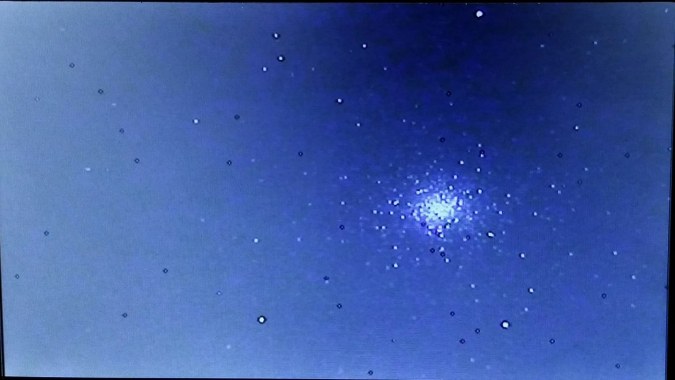
After very little effort, and with a short 3 second integration time, I was able to watch this spectacular sight slowly materialise in the video monitor

M3

M3 contains over 500 thousand suns at a distance of 34 thousand light years from earth.

This image is incredibly bright and vibrant compared to naked eye views of M3 and is only slightly marred by a few visual artefacts due to the sensor technology.  The bloated white dots at the widest periphery of the image are not stars but hot spots due to the video chip heating up during long exposures.  Despite this I’m sure you’ll agree the view is a triumph of video observing, readily revealing the awesome density and structure of the cluster.

There are over 150 of these satellite clusters orbiting our Milky Way galaxy and their formation is the topic of excited debate.  The fact they harbour such a high proportion of older stars suggests they were some of the first stars to evolve within the overall galactic neighbourhood.

As far as the question of technological life existing within these systems, the chaos from closely interacting stars (on average only 1 light year apart) might prove an unfavourable environment.  Stars and planets in such a system would be under constant perturbation from nearby neighbours imparting gravitation ‘tugs’, resulting in unstable planetary orbits.