Comet A3 Tsuchinshan–ATLAS

Comet A3 spotted and photographed naked eye from Sicily.

I’ve recently posted guides on observing the bright comet A3 Tsuchinshan–ATLAS from northern latitudes in mid October. As it happened I was travelling in Sicily during the initial (evening) observation window but wasn’t holding out much hope of seeing it given likely sky brightness and the comet’s relatively low elevation above the western horizon

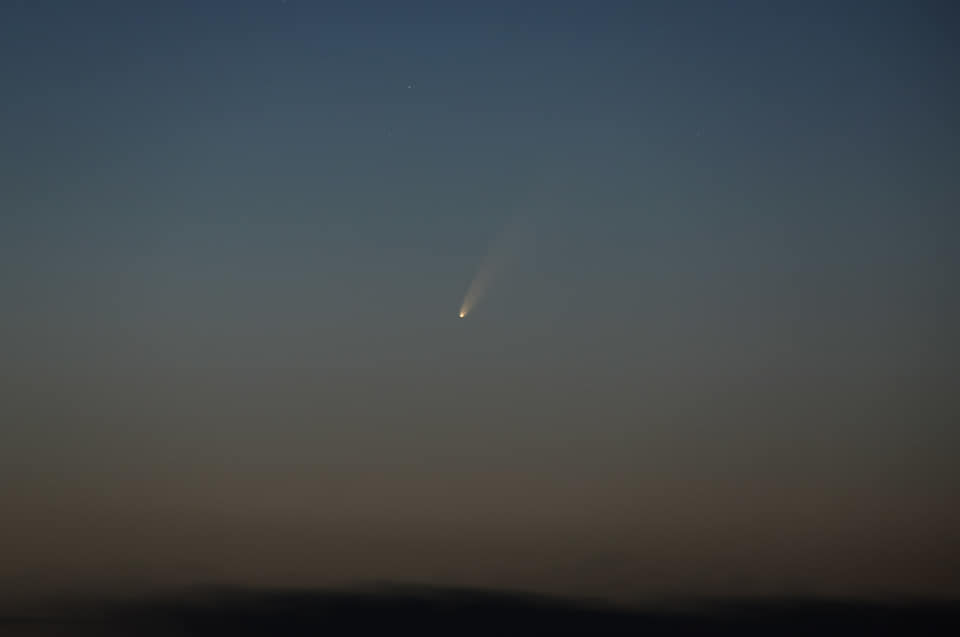
I was however delighted to see and photograph it during very clear naked eye visibility on the evening of October 13th, near Noto in southern Sicily. The comet was so bright I could actually see it through the front windscreen of my car when travelling along a quiet farm road, and promptly pulled over for better views, capturing these images with my mobile phone.

In the first image Venus is the bright planet to the left and comet A3 is clearly visible with nucleus and tail extending in a pronounced vector away from the location of the Sun (below the western horizon).

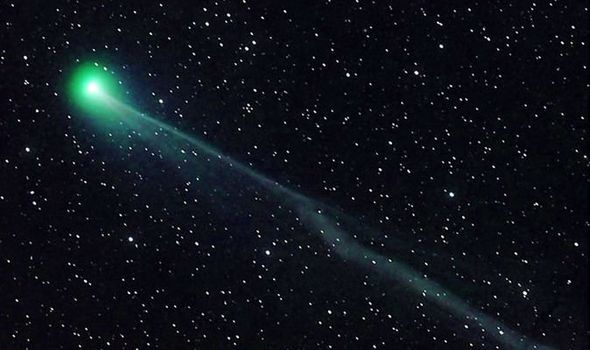
The tail of a typical comet is absolutely enormous (sometimes stretching tens of millions of miles back from the nucleus), and comprises an ionic dust cloud of diffuse material blasted away from the comet by the intense solar radiation of the Sun.

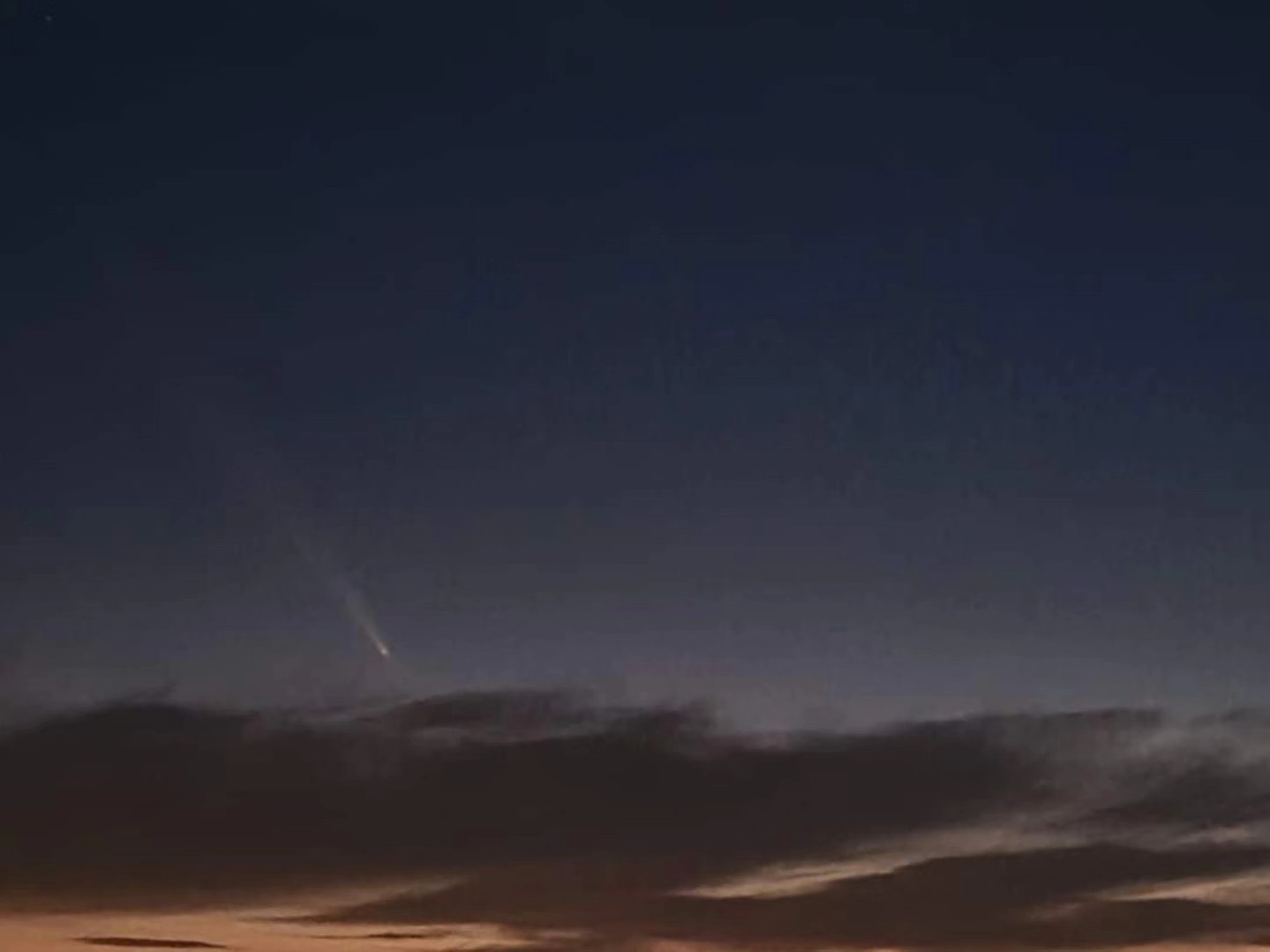
Meanwhile, back home in Scotland, some followers also spotted and photographed the Comet. Below are two such samples captured by Howard Taylor in Dumfries & Galloway (1st image below) and Caroline Hay outside Carluke (2nd image below).

To see the comet for yourself look towards the western horizon after sunset, as skies darken to an azure blue. The comet will rise higher in altitude going into late October but may unfortunately lose brightness as it recedes back whence it came to the still and dark fringes of the Oort cloud.

If you miss A3 this time you’ll need to be cryogenically frozen for a good 80,000 years before it makes a repeat return to Earth’s night sky.
Comet NEOWISE

Bright comet alert. Comet NEOWISE has caught many skywatchers by surprise. There’s now naked eye reports of it in early morning skies across much of northern Europe and north America. This image was snapped a few mornings ago by Paul Sutherland @suthers from Walmer on the SE tip of England.

piccomet

NEOWISE imaged by Paul Sutherland @suthers from Walmer, England

Or check out this incredible time-lapse of sunrise with Comet NEOWISE (with Noctilucent clouds) by Martin Heck (Insta @martin_heck) from Bayern, Munich

Observing Guide

A quick guide to locating Comet NEOWISE, valid for northern Europe and north America.

Time: You’ll need to stay up late or rise early and ideally be in position between midnight and 3am. Too early and the comet will be too low on the horizon. Too late the Sun will have risen too much, washing the comet out.  At the moment of writing 2am is probably a good optimal time to aim for, although this will change over the coming days and weeks.

Direction: The direction you need to look in from direct N (around midnight) to NNE (in early dawn skies). If visible you could use the bright star Capella in Auriga as a rough reference.

Equipment: Many observers in Europe claim to have see the comet naked eye. This might be possible but your best chance will be with binoculars. Any pair will do, they don’t need to be fancy astronomy binoculars. Low power and wide field is always best for viewing comets.

Clear skies and good luck.

neowise

Comet SWAN Update

99084782_2604616006442002_1385934557135503360_n

Comet SWAN update! ☄️ Comet SWAN is just starting to become viable for observation at northern European latitudes as it sails through the constellation Perseus. This one will be very tough to see due to its low altitude and lack of darkness 🌅 . In fact it may not be visible at all if you live too far north. However, if you’re up for a real challenge, grab your binoculars and read on.

Just like this week’s Venus and Mercury planetary conjunction 🪐 , SWAN will be visible towards the north 🧭. As the week progresses it will rise higher and higher in the sky so theoretically should become easier and easier to observe (see attached guide images). Unfortunately this will be countered by less and less darkness as May advances.

The absolute best instrument for spotting a comet is a pair of binoculars, or the widest possible eyepiece you have on a telescope. Scan the sky using my pictures and bright stars for reference. Don’t expect a huge streaking object like you’ll see in astronomy magazines (or the front image I’ve attached 😆 ) – If you’re very lucky you might detect a tiny and faint smudge.

The darker your surroundings and more dark adapted your vision the better 🌑 👀 , so stay away from bright street lights and mobile phone screens for at least 15 minutes. If you live under street lights 🌃 your chances of sighting the comet are far lower but don’t let that put you off. Comets can vary in brightness dramatically and can very occasionally brighten enough to be detected naked eye.

What’s great about this challenge is you can also look out for Mercury and Venus at the same time, as all the action takes place towards the same cardinal direction – North.

Good luck and clear skies.


2020 Lyrids Meteor Shower


The annual Lyrids meteor shower is underway with peak activity on the evening of April 21st.  With no Moon to spoil the party conditions will be ideal for observing them this year assuming those pesky clouds stay away.  The best times to view the shower are as late as possible, close to midnight or in pre-dawn skies when the Lyra radiant is at its greatest elevation.  However, you don’t need to look at the radiant to see shooting stars as they’ll appear to come from all directions.

What Causes a Meteor Shower

Meteors are the fine dust and particulates left over from comets and large asteroids which stray into our solar system.  Some of these are on predictable orbits and as they whizz around the Sun they melt and shed some of their material into space.  The Earth then travels through these large dust trails as it orbits the Sun, producing predictable meteor showers.  The Lyrids are generated by Comet Thatcher, which has a 415 year orbit.

Screenshot 2020-04-21 at 09.33.54

Observing the Lyrids

You don’t need any special equipment to view a meteor shower, in fact binoculars or telescopes will just narrow your field of view. Grab a deck chair or camping mat and (if it’s cold) a warm blanket, prepare a hot drink and lay out under the darkest conditions you can find. It’s an excellent activity to do alone, with family and friends, or if you have children they’ll love an excuse to get outside for some after dark play.

Put away any lights or bright mobile phone screens and simply look up and wait. Remember it takes up to 30 minutes for your eyes to fully dark adapt and any exposure to bright lights will start the process all over again. If you need a light, red LEDs or touches are best for preserving you night vision.

For optimal viewing, head out late at night or in the darkness of the pre dawn sky., when the radiant is highest in the sky.

Don’t Expect Too Much

You need to be patient with meteor showers.  Sometimes you’ll see many and other times very few or none at all.  Think of it as a great excuse to get out under the stars and breath in some fresh air.  Even if you don’t see much you probably won’t regret heading out and looking up.  Very rarely meteor showers can erupt into storms, like the Leonids in 1833 when over 100,000 shooting stars criss crossed the night sky.

Photographing the Lyrids

688x300_NightSkyCCD_ELMA_NPS_JeremyWhite

If your have a DSLR camera and tripod, or a suitable phone app like NightCap, you could try capturing some meteors with this rough guide.

  1. Firmly attach your camera or phone to the tripod.
  2. Disable autofocus and manually focus on some bright stars (make them as small and pin point as possible in your viewing screen)
  3. Set an ISO range somewhere between 1000-3000 depending on the capabilities of the sensor.  Mid 1000s is a good middle road.
  4. Turn off noise reduction or you’ll get big delays between each shot.
  5. Point your camera at a high and clear part of the sky.
  6. Shoot long exposures ranging from 10s to 30s, or simply use a remote shutter to take long manual exposures.  Note:  don’t go crazy with very long exposures or you’ll get amp glow from the sensor.
  7. Take lots and lots of shots and be patient!

If your camera has a time-lapse feature you can automate the shooting process and tell the camera to continually shoot 30 second exposures over a long interval.  Just watch out for dew forming on the lens if conditions are cold.  Some hand warmers stuffed into a sock wrapped around the lens will solve this particular issue.

Good luck and clear skies!

Christmas Wirtanen Sighting

DSC_0007.jpg

Comet Wirtanen to the left of bright Capella, above Bunchrew, Inverness

I’m almost always rewarded in some form when I head out to observe, even in less than perfect conditions.  As it happened I knew comet Wirtanen was in a favourable position over Christmas and close to the 6th brightest star Capella.  I posted about it on Facebook here.

Despite the unfavourable early rising of the Moon and some patchy skies on Christmas eve I decided to take a short walk in the woods over Bunchrew, in the off chance I might catch the comet.

When I was sufficiently well away from the western lights of Inverness I looked up, and there was the comet faintly visible in binoculars.  Not the clearest I’ve seen it this year, but probably under the darkest conditions.

The took the picture above before I continued my walk, with the comet and Capella sitting above the trees.

Happy comet hunting!

Comet Hunting – 46P/Wirtanen

This month brings the excitement of a comet hunt, as Wirtanen 46P reaches closest approach on December 16th.  This is a relatively small comet (1.5km across) with a period of just over 5 years.  However Wirtanen is known to produce a relatively large tail for its stature, so it’s definitely one to look out for.  In mid December it’ll be positioned between the Pleiades star cluster and red giant star Aldebaran in Taurus, so will be relatively easy to locate in the night sky.

Reports of naked eye sightings and some photographs are already emerging online despite the current low altitude of the comet at high norther latitudes.  However its vantage will steadily improve as we head into mid December, although Moon conditions will become less favourable then, so time your hunt well.

Wirtanen should be observable in a wide-field telescope or binocular view, and possibly naked eye under very dark conditions.  You could also try locating it by taking a 10-30 second exposure in your DSLR camera.

I’ve put together a short video to help you locate it over December.   Clear skies!