Space Camp in Thurso

67268006_924191647926600_1725629361731665920_o

Some photo highlights from the Summer Space Camp up in Thurso’s band new Newton Room.  I had a great time delivering Mars and astronomy based workshops on day 2.  We covered the observational history of Mars, its surface geology, the night sky, the life and death of stars and spectroscopy.  Interactive sections included Mars cratering, galaxy frisbees, star cluster balloons and DIY spectrascopes.

Picture rights Skills Development Scotland.

Solstice Sunsets

Video from the shores of Bunchrew looking over Ben Wyvis, panning from the north west to north east

The sunsets in the Highlands of Scotland are some of the best in the world when conditions are right, especially around the solstice when the setting Sun grazes just 8 degree below the northern horizon producing mesmerising night long sky glow.

On June 22nd I camped out at the Bunchrew shoreline with my daughter Violet and managed to capture some video and still images of the sunset looking north towards Ben Wyvis.  Footage captured around 10.45pm.


This slideshow requires JavaScript.


Summer Solstice at the Shielings

Screenshot 2019-06-10 at 15.00.33.png

Come and join us for an outdoor walk and talk to the Sheilings above Loch Ness. Learn about summer plant lore and old dairying activities from Abriachan’s Suzann and Christine as we walk up the hill.

Once we reach the Shieling local astronomer Stephen Mackintosh will give a talk on ancient astronomy and how many cultures would mark the solstices in days gone by.

Some traditional refreshments will be available at the top after the walk (30 mins uphill).

Meet: Friday 21st June after the Abriachan Highland Games at 8.30pm.

Park at the fank carpark NH559348. For detailed directions please advance email abriachanforest@gmail.com or call 01463 861236. All ages welcome.

Tickets available via Eventbrite.

Due to the outdoor nature of this event it may be cancelled due to very poor weather. Please check the ‘Abriachan Community ‘or ‘Highland Astronomy’ Facebook pages for details on the day. This event is part of the Star Stories Astronomy and Storytelling programme, part funded by the STFC (Science and Technology Facilities Council).

Event image rights: Karl Normington.

https://www.flickr.com/photos/36266724@N06/

Stargazing at Roseisle

55924259_2273889659514640_3969822139795636224_o.jpg

Starry skies over the Moray coast

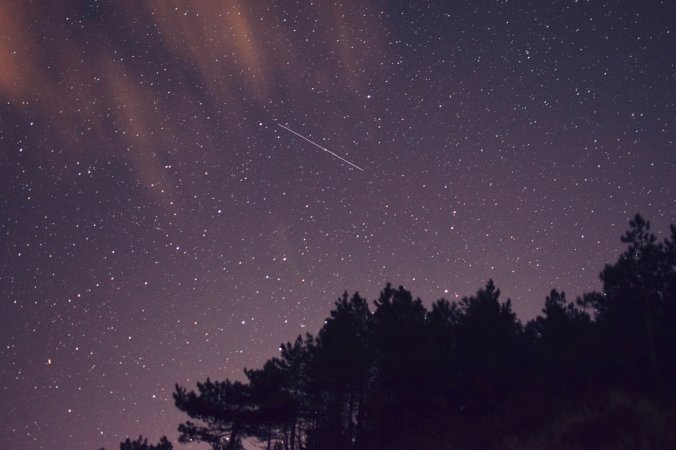
Amidst a very busy schedule last month I managed to head out to Roseisle (along the Moray coast) for some observing and a wild camp.  My original mission was to try and catch a geomagnetic storm predicted by the MET office space weather forecasts.  As it happened the promised aurora didn’t arrive but I did manage to get some photos of the starry skies that opened up on Saturday night, starting with the International Space Station.

55615864_2277317779171828_3913720705744633856_n.jpg

Not the most fantastic ISS shot but I only had about 20 seconds to set up after running down the dunes to capture the pass!.  The station is actually travelling from west to east here, towards Sirius (bright star on left)

From there I took a number of pictures hoping to capture some aurora, but instead imaging the crisp starry skies.  I’ll let the photos do the talking from here – please read the caption notes.

55575693_2273889382848001_4589512154545127424_o.jpg

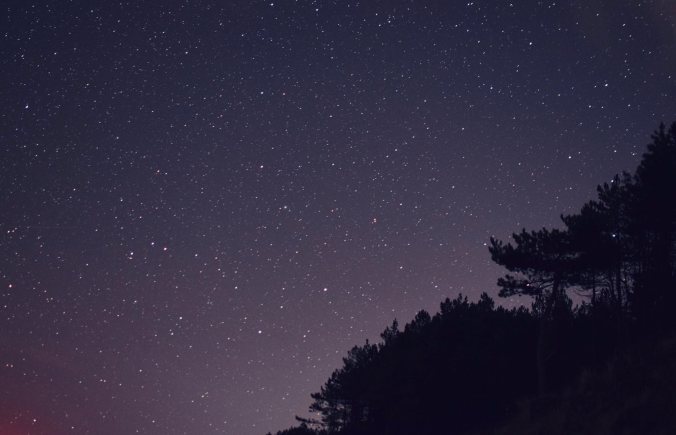
This image of the Plough (minus Alkaid) was snapped while I was still under the trees, on my approach to the beach.  You can clearly see the naked eye double star Mizar-Alcor at the bottom of the image.  The main stars in the Plough are roughly 100 lights years away.  Our Sun would not be visible naked eye if placed this far away which tells us something about the scale and luminosity of these titan stars.

54798041_2273889622847977_7869519356412035072_o.jpg

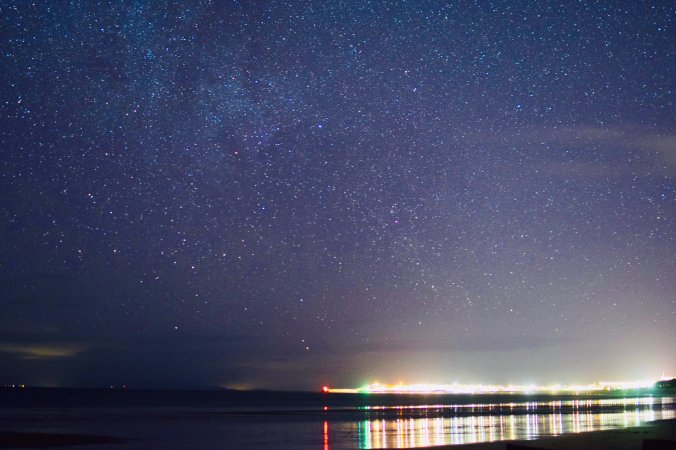
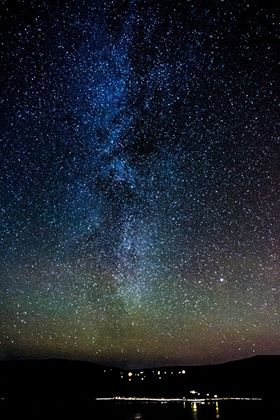
Looking north towards Burghead where I hoped to capture some aurora.  Instead I picked up the rich star fields within the Milky Way near Cassiopeia.

55551339_2273889702847969_369990786642608128_o.jpg

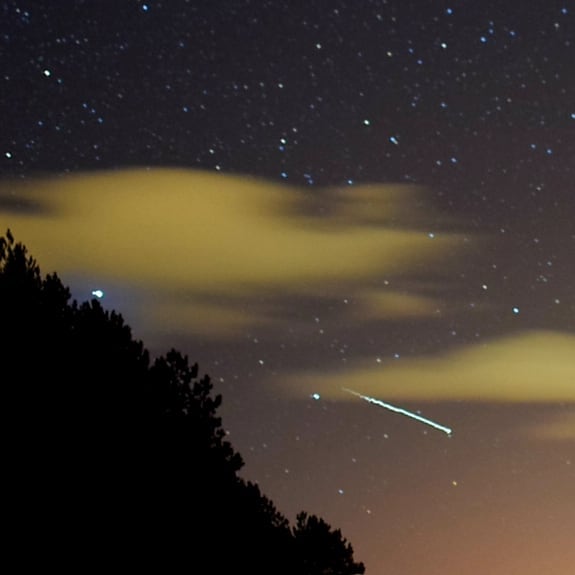
One of many passing satellites.

54524758_2273889786181294_1681336390505201664_o.jpg

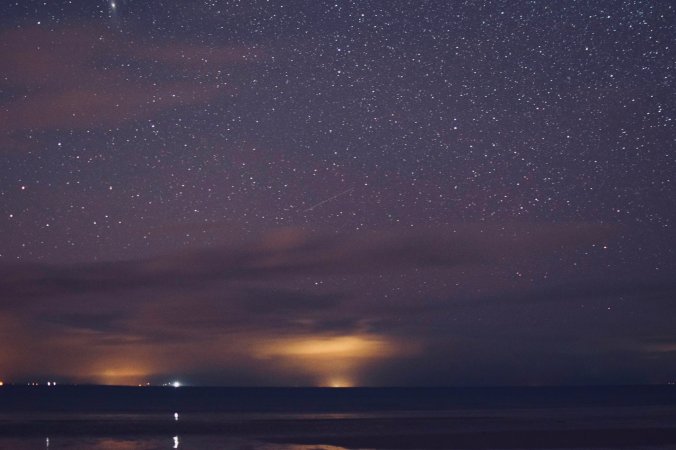
An interesting shot looking north west.  The bright white light is the Portmahomack lighthouse and the orange light pollution on the right is likely from Helmsdale.  Perhaps the most interesting feature in this photo is the faint smudge of light in the top left.  That’s the Andromeda galaxy – a separate spiral galaxy (larger than our Milky Way) over 2.5 million light years away.

Milky Way

In the Scottish Highlands we’re blessed with many dark locations from which to view the Milky Way, the band of diffuse light revealing our place within a giant spiral galaxy.

Even if you live in a busy city like Inverness, a short drive is all that’s needed to escape to relatively dark skies. Regrettably, in many parts of the UK and central Europe this important connection with our home galaxy has been rubbed out due to light pollution.

Looking up at the Milky Way lets us connect with something vast and far bigger than ourselves – an important check on our own sense of self importance.

More needs to be done to curtail unnecessary outdoor lighting and to educate people on the basics of dark sky preservation.  Retaining access to our night skies needn’t be an economically crippling ideal.  There are simple practical steps people can take that make dramatic differences.  Please see this excellent guide on the International Dark Sky Association website for tips on how you can help.

I’ve made a short video celebrating our views of the Milky Way and how overwhelmed our position is amidst an estimated two trillion other galaxies in the observable universe.

South Loch Ness Tourist Guide

28052742_2023393321230943_1175060706_n

Starry Skies over Loch Ness by Claire Rehr

Here’s a small piece I wrote for the South Loch Ness tourist website on stargazing in the Highlands.

South Loch Ness Tourist Site – Night Sky

Excerpts:

“For me stargazing is about reconnecting people with the night sky, not just the raw science which is fascinating enough, but also the star lore, mythology and human connections with it.  That’s something we’ve undoubtedly lost in recent times not only in terms of light pollution but also our tendency to inhabit virtual spaces within our phones and gadgets.  As a people we seem to be increasingly looking down rather than up! 

 ‘In the Highlands we’re still fortunate to have access to some of the darkest skies in Europe, and it’s something I hope we’ll do our best to preserve for future generations.  Visitors from populated areas of England and the central belt of Scotland are always blown away by what they can when they get into the wilds under a moonless sky.  Under the right conditions you can see over 5000 stars out here, compared to just a few hundred from urban areas. ”

 “For visitors to the South Loch Ness area I recommend just heading out to some high vantage points, killing your lights and letting your eyes dark adapt.  You’ll be amazed when you look up.  You can also head up to Abriachan where there’s good access and parking for larger groups of stargazers”.  “When the moon is new you can see breathtaking views of the Milky Way galaxy soaring overhead – a humbling reminder that we’re just a tiny part of a giant spiral galaxy surrounded by billions of other stellar companions.” 

 “Because of our northerly latitude (57 degrees north) we also have the privilege of witnessing many circumpolar constellations – stars that are always above the horizon.  This lets us become more familiar with specific groupings like the two bears Ursa Major and Ursa Minor and rich constellations like Perseus, Draco, Auriga and Cassiopeia.  During the winter months the shorter days up here also lend themselves to extended opportunities for observing.  It’s a rewarding pastime that makes the cold and long winter nights much more inviting.’

 Screen Shot 2018-03-28 at 10.01.31


Mercury Opportunity

Mercury_in_color_-_Prockter07-edit1.jpg

Mercury is only 40% larger than the moon but very difficult to spot

The planet Mercury can be very tricky to observe.  It’s close proximity to the sun means we generally only have brief opportunities to observe it low on the horizon either before or after sunset.

Right now Mercury is approaching maximum eastern elongation (on March 15th to be precise) meaning the planet is up for longer after the sun sets.  The window is still pretty brief with only about 45 mins of useful time to work with after sunset.

Your best chance is to pick a clear evening and head out somewhere with a good unobstructed view to the West.  You don’t need dark skies as the Sun will still be producing a lot of light between 6 and 8pm.

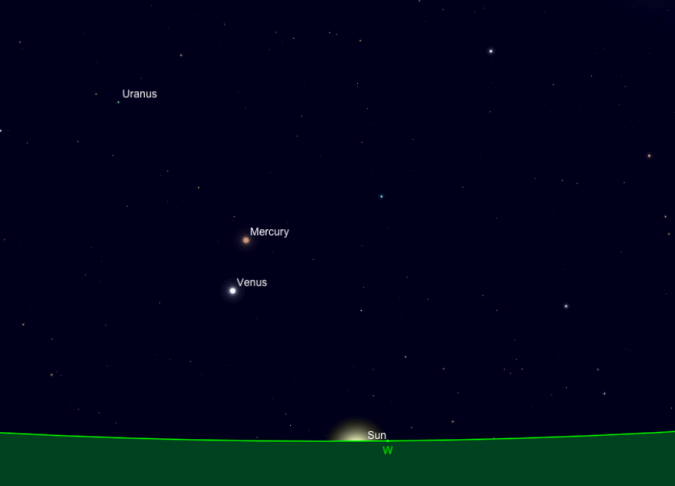
At the moment, and at Highland latitudes, the action starts about 6.30pm just after the Sun sets.  Wait a while then scan the western horizon and you should see Venus first, which will appear brighter.  Use this as a guide for finding Mercury which will sit slightly above it over the next few days.
Screen Shot 2018-03-14 at 13.42.14

6.20pm 14th March 2018, 57 degrees north

The longer you wait after the sunset the easier Mercury will be to see due to darkening skies but also harder due to it moving lower and lower towards the horizon, adding more atmospheric distortion to your views.

If you do see it take a note of its crescent phase.  We almost always see Mercury as a crescent because it would be too close to the sun to see it in a full or new aspect.  One exception to this is during a solar transit when Mercury crosses directly across the disc of the sun.  The next opportunity to witness this will be 11th November 2019, which gives you plenty of time to prepare a solar filter for safe observing of the solar disc.  Happy planet hunting meanwhile.

Screen Shot 2018-03-14 at 13.46.39

Transits reveal the true scale of the Sun