Feb 22nd – Stargazing at Abriachan – Scotland’s Night Sky Special
Join us up at Abriachan Forest (a Dark Sky Discovery site) for a stargazing and night sky photography special as we welcome guest astrophotographer Andrew Allan from Perthshire.
Andrew runs the widely followed community page Scotland’s Night Sky and is a prolific aurora chaser and Milky Way photographer. Andrew’s talk will include tips and tricks on how to photograph a wide range of celestial events, how to forecast the Northern Lights plus images and stories from Andrew’s adventures abroad to Iceland, Norway and Tenerife.
If conditions are clear astronomer Stephen Mackintosh will also be guiding you under the Milky Way class dark skies of Abriachan Forest (with a backup astronomy presentation if clouds roll in).
Due to site and classroom capacity, booking via Eventbrite is essential. Admission is free for under 16s with accompanying adults but please inform Abriachan of any large booking requests.
We had a wonderful evening of music and astronomy this Saturday up at Abriachan Forest.
The evening began with a unique premier – a live analogue synthesiser set from Nick Scroggie and Maarten De Vries of QRM, riffing beautiful melodies, sounds and effects in realtime against a montage of space and astronomy themed visuals I’d created for the evening.
Afterwards we had a virtual planetarium tour and talk on Supernovae, before finally getting some breaks in the cloud and heading out to see Jupiter and several nearby constellations and bright stars.
The development of the musical and visual concept is worth mentioning. Maarten and I discussed the idea of bringing astronomy visuals together with drone music about a year ago, but various other commitments got in the way of execution until earlier this year when Maarten and Nick agreed to test out the concept at Abriachan.
I developed a rough chapter outline for the visuals based on a journey of increasing scale through the universe. Beginning on Earth, then moving past our solar system into the distant stars, before finally arriving at the grandest realm of all – the galaxies. I sourced hundreds of images and video clips from NASA and other space agencies, downloading the highest resolution renders I could find.
During the visual editing process I used one of QRM’s ‘Drone Day’ sets for musical inspiration, timing the fades, pans and transitions to match the general pacing and atmosphere of the music. After a first draft I handed the visuals over to Nick and Maarten who then used it to develop some very rough musical concepts, split into acts to match the visual chapters .
It should be stressed that Maarten and Nick’s music was not in any way pre-recorded. The whole performance was live, with melodies, drums and base lines setup and generated on the fly via analogue synthesisers as they watched the visual footage. The only samples used were some spot effects Nick either recorded locally or sourced from BBC repositories.
I’ve put together footage of the event on Youtube and embedded it above for your enjoyment. Feedback from the audience was incredibly positive and we have tentative plans to deliver something similar in the future..
The next Star Stories event will be mid December. Look out for details appearing soon.
Comet A3 spotted and photographed naked eye from Sicily.
I’ve recently posted guides on observing the bright comet A3 Tsuchinshan–ATLAS from northern latitudes in mid October. As it happened I was travelling in Sicily during the initial (evening) observation window but wasn’t holding out much hope of seeing it given likely sky brightness and the comet’s relatively low elevation above the western horizon
I was however delighted to see and photograph it during very clear naked eye visibility on the evening of October 13th, near Noto in southern Sicily. The comet was so bright I could actually see it through the front windscreen of my car when travelling along a quiet farm road, and promptly pulled over for better views, capturing these images with my mobile phone.
In the first image Venus is the bright planet to the left and comet A3 is clearly visible with nucleus and tail extending in a pronounced vector away from the location of the Sun (below the western horizon).
The tail of a typical comet is absolutely enormous (sometimes stretching tens of millions of miles back from the nucleus), and comprises an ionic dust cloud of diffuse material blasted away from the comet by the intense solar radiation of the Sun.
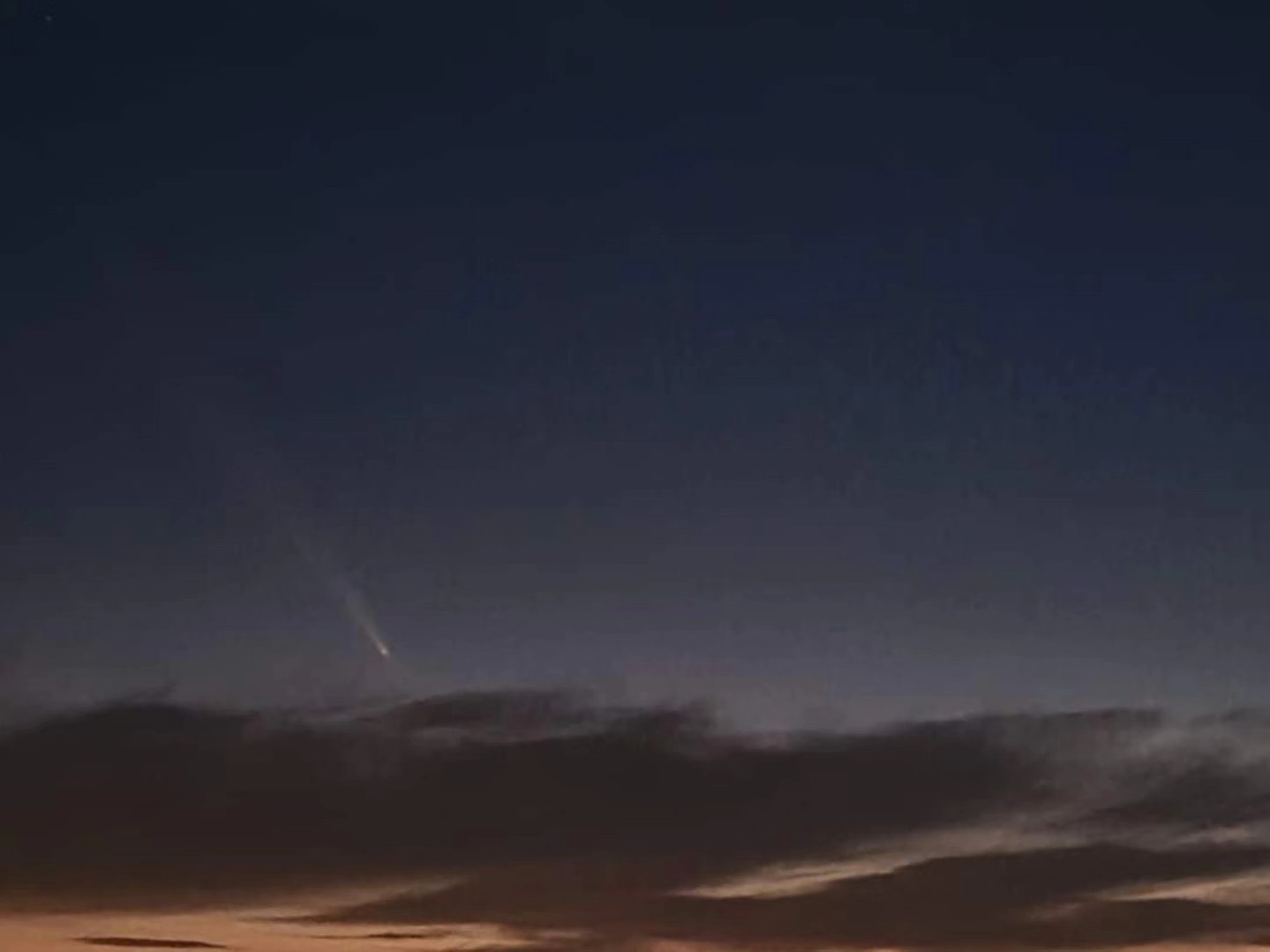
Meanwhile, back home in Scotland, some followers also spotted and photographed the Comet. Below are two such samples captured by Howard Taylor in Dumfries & Galloway (1st image below) and Caroline Hay outside Carluke (2nd image below).
To see the comet for yourself look towards the western horizon after sunset, as skies darken to an azure blue. The comet will rise higher in altitude going into late October but may unfortunately lose brightness as it recedes back whence it came to the still and dark fringes of the Oort cloud.
If you miss A3 this time you’ll need to be cryogenically frozen for a good 80,000 years before it makes a repeat return to Earth’s night sky.
Tickets are now up for the launch event of 2024 Astronomy season at Abriachan Forest. A special live synthesiser set from QRM will accompany the usual stargazing and astronomy.
“The new stargazing season at Abriachan Forest (a Dark Sky Discovery site) gets underway on November 2nd with a special musical themed event featuring local analogue synthesiser group QRM. In addition to the usual stargazing and astronomy, QRM will play a fully live synthesiser set against a backdrop of space and astronomy themed cosmic visuals.
Event format is weather proofed so please book with confidence. As well as our indoor synthesiser set from QRM we’ll have outdoor (or indoor) night sky guiding with astronomer Stephen Mackintosh plus possible telescopic views of visible planets.
Refreshments and home bakes available. Due to site and classroom capacity, booking via Eventbrite is essential. Admission is free for under 16s with accompanying adults but please inform Abriachan of any large booking requests.“
You can final all details and book your tickets here.
I’m delighted to announce the return of three excellent astronomers and guest speakers to Abriachan Forest this season.
On December 9th – Maarten De Vries (talking about Meteor Showers)
On January 20th – Steve Owens (joins me to Explore the Moon)
On February 10th – Martin Hendry (discusses Lord Kelvin and the Age of the Universe)
All guest speaker talks will be followed (or proceeded) by naked eye and binocular stargazing led by myself, or a backup indoor sky tour on planetarium software if clouds roll in. Plus storytelling and other activities led by the Abriachan team. Refreshments and home bakes provided.
Ticket links will go live roughly four weeks prior to each event so please stay tuned to my Facebook page for details as they do sell out very quickly.
The above montage shows six recent images of ‘potentially’ massive galaxies photographed by the James Webb space telescope, going back to epochs around 600 million years after the universe began.
If the six red dots are confirmed to indeed be large galactic structures, these examples contradict almost all known models of galaxy formation from the early history of the universe and would suggest stellar masses over 100 times greater than previously predicted in this early period. Existing models of galaxy formation predict large galaxies would require several billion years to form, so if true these findings will require extensive revisions to our understanding of the large structure evolution of the universe.
Truth told we still know very little about the formation of galaxies. Their evolution is still shrouded in deep mystery, for example what forms the large bars we see in the centre of most mature spiral galaxies, including our own Milky Way?
And of course their rotational dynamics have lead to the conclusion that clouds of invisible matter must surround them in giant halos (dark matter).
The star Earendel is located at the point of the arrow in the image above, surrounded by the light from diffuse and distant galaxies.
The NASA Hubble space telescope has imaged the most distant star ever detected at a staggering 12.9 billion light years away. The light captured from Earendel (dubbed the ‘Morning Star’) is a snapshot from an epoch when the universe was only 1 billion years old, making it significantly older than the previous furthest star detected by Hubble in 2018. (That star was dated to 4 billion year after the big bang).
Normally stars at such immense distances would be undetectable, but its discovery was aided by the gravitational distortion from distant galaxy clusters, magnifying the star and its host galaxy in a phenomena called ‘gravitational lensing.
An example of a distant galaxy, revealed by the distortion of space (and therefore light) near a closer area of high mass, in the form of a galaxy cluster.
Gravitational lensing is analogous to the refraction of light from a glass lens, magnifying and revealing objects that would normally be occulted by closer structures by the bending of space near areas of high mass – like galaxy clusters. Sometimes duplicate images of the same object can be seen, creating copies of the object along symmetrical arcs. The image below illustrates this effect on a star cluster which appears either side of Earendel.
A closer image of Earendel with a mirrored image of a nearby star cluster created by gravitational lensing
You might wonder how immense distances like this can be calculated given the complexity and uncertainty in pin pointing the distance to relatively close stars, let alone objects billions of light years away?
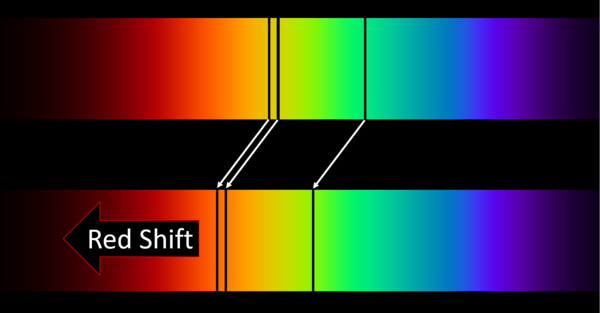
The principle tool used to measure these vast distances is an object’s spectral redshift – a measure of how much its light rays have been stretched (made longer) due to the fabric of space itself being stretched the further away we observe. Larger redshifts indicate objects that are further away – a relationship first accurately established by Edwin Hubble when cataloging the spectra from many distant galaxies.
A measured spectra shifted towards the red end of the spectra, signalling longer wavelengths and higher recessional speeds.
Given the redshift of an object we can calculate its recessional speed (related to the global expansion of the universe) and from this its distance can be determined using the Hubble’s constant Ho. These calculations can be set out very simply:
V (recessional speed) = Red-shift x Speed of Light
In the case of Earendel the detected redshift from its spectra was 6.2. Therefore:
V (Earendel) = 6.2 x 300 million m/s = 1860 million m/s.
It’s important to note that this speed is faster than the speed of light! How can this be? Well this is actually a measure of the speed that space itself is expanding. Light cannot travel faster than 300 million m/s – our cosmological speed limit – but there is no limit on the rate at which the fabric of space can expand. In fact for general relativity to work space must be permitted to expand at potentially unlimited rates.
From the recessional speed we then use Hubble’s law to find the distance to the star:
D (distance) = V (recessional velocity) / H0 (Hubble’s constant)
This gives our published distance to Earendel of 12.9 billion light years! A staggering distance taking us back to the earliest period of star formation when the abundance of atomic elements in the universe was very different to today.
We believe the very first population of stars emerged around 100 to 250 million years after the big bang, so Earendel formed only a few hundred million yeas after this. The new James Webb telescope will likely continue to study Earendel in the infrared, at longer wavelengths, potentially revealing the star’s temperature and luminosity and therefore its stellar classification.






 | Modulo | Universe