Stargazing at Abriachan – Scotland’s Night Sky Special

Feb 22nd – Stargazing at Abriachan – Scotland’s Night Sky Special

Join us up at Abriachan Forest (a Dark Sky Discovery site) for a stargazing and night sky photography special as we welcome guest astrophotographer Andrew Allan from Perthshire.

Andrew runs the widely followed community page Scotland’s Night Sky and is a prolific aurora chaser and Milky Way photographer. Andrew’s talk will include tips and tricks on how to photograph a wide range of celestial events, how to forecast the Northern Lights plus images and stories from Andrew’s adventures abroad to Iceland, Norway and Tenerife.

If conditions are clear astronomer Stephen Mackintosh will also be guiding you under the Milky Way class dark skies of Abriachan Forest (with a backup astronomy presentation if clouds roll in).

Due to site and classroom capacity, booking via Eventbrite is essential. Admission is free for under 16s with accompanying adults but please inform Abriachan of any large booking requests.

Eventbrite ticket links are here.

Ticket Links for Sounds of the Cosmos Abriachan Special

Thin waxing crescent Moon above Abriachan Forest

Tickets are now up for the launch event of 2024 Astronomy season at Abriachan Forest. A special live synthesiser set from QRM will accompany the usual stargazing and astronomy.

The new stargazing season at Abriachan Forest (a Dark Sky Discovery site) gets underway on November 2nd with a special musical themed event featuring local analogue synthesiser group QRM. In addition to the usual stargazing and astronomy, QRM will play a fully live synthesiser set against a backdrop of space and astronomy themed cosmic visuals.

Event format is weather proofed so please book with confidence. As well as our indoor synthesiser set from QRM we’ll have outdoor (or indoor) night sky guiding with astronomer Stephen Mackintosh plus possible telescopic views of visible planets.

Refreshments and home bakes available. Due to site and classroom capacity, booking via Eventbrite is essential. Admission is free for under 16s with accompanying adults but please inform Abriachan of any large booking requests.

You can final all details and book your tickets here.

The Age of the Universe and Lord Kelvin

Our 2023/2024 season of astronomy outreach at Abriachan Forest ended on a high note this Saturday with a visit from Martin Hendry, Professor of Gravitational Astrophysics and Cosmology. Since 2022 Martin has been acting vice principle at the University of Glasgow and was formerly head of the school of Physics and Astronomy.

Martin’s packed talk was broadly about the age of the universe, but touched on the age of stars, stellar classification, cepheid variables, rates of cosmic expansion, and the important work undertaken by female astronomers like Henrietta Leavitt, Annie Jump Cannon and Williamina Fleming, who were instrumental in helping us calculate the distances to star clusters and galaxies. A special tribute was also paid to Lord Kelvin on the 2024 bicentenary of his birth.

Alas, we were not graced with clear skies for open air stargazing, so following Martin’s talk we both hosted a virtual planetarium tour instead, referencing many of the clusters, galaxies and some stars mentioned in the main talk.

Thanks to Suzann for the Kelvin and Constellation witches fingers which captivated some of the younger audience members, and my wife Judith for the excellent home bakes. I look forward to announcing our new new 2024/2025 program in October. Stay tuned for details.

Calculations of the age of the universe using a variety of datasets and methodologies, including galactic red shifts and globular clusters have broadly placed the age of the universe at about 14 billion years old.

Guide to September Skies

What’s Up in September 2022 Night Sky Guide.

I hope you enjoy my short guide to September skies. Everything in this guide is calibrated to views around 11pm. Highlights include:

– Jupiter, Saturn and Mars

The Pleiades and Hyades open star clusters

– The Winter Triangle

– The Milky Way

– Lyra with the double double and ring nebula

– The Plough and its famous double star

Clear skies.

The Physics of Visible Star Light

Globular cluster NGC 6717. The colour of light from the stars is a general indicator of surface temperature.

The colour of a star tells us how hot it burns. From the dull red of Arcturus to the brilliant blue of Rigel, you can actually see these subtle colour differences with your own eyes when looking up at the night sky.

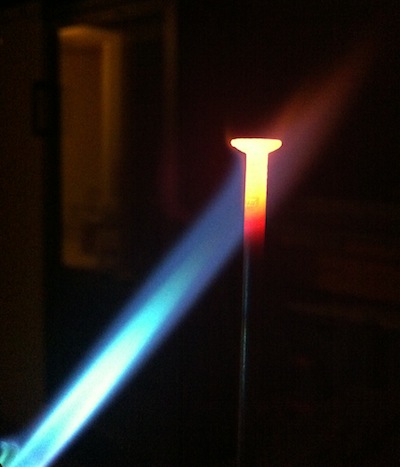
Just like an iron cast into the blacksmith’s forge, which slowly changes from red to white hot, stars emit light at different frequencies depending on their overall luminosity and energy output.

The same relationship between colour and temperature is noted when metal objects are heated.

The Planck-Einstein equation E = hf is a basic way of understanding this. E is energy, f is frequency and h is the famous Planck’s constant. Higher frequency light (blue) is more energetic than lower frequency light (red) and therefore hotter and more luminous stars tend to appear more blue. Meanwhile cooler stars whose external atmospheric envelopes has expanded (red giants like Betelgeuse) appear redder.

A simple way to highlight the colour of star light is to take your smartphone camera or DSLR and manually defocus it on a target star. This will emphasise the colour and you can even produce beautiful star trails like the one below by taking a movie or long exposure star trail.

Star trail image credit – Amanda Cross

Betelgeuse’s Great Dimming

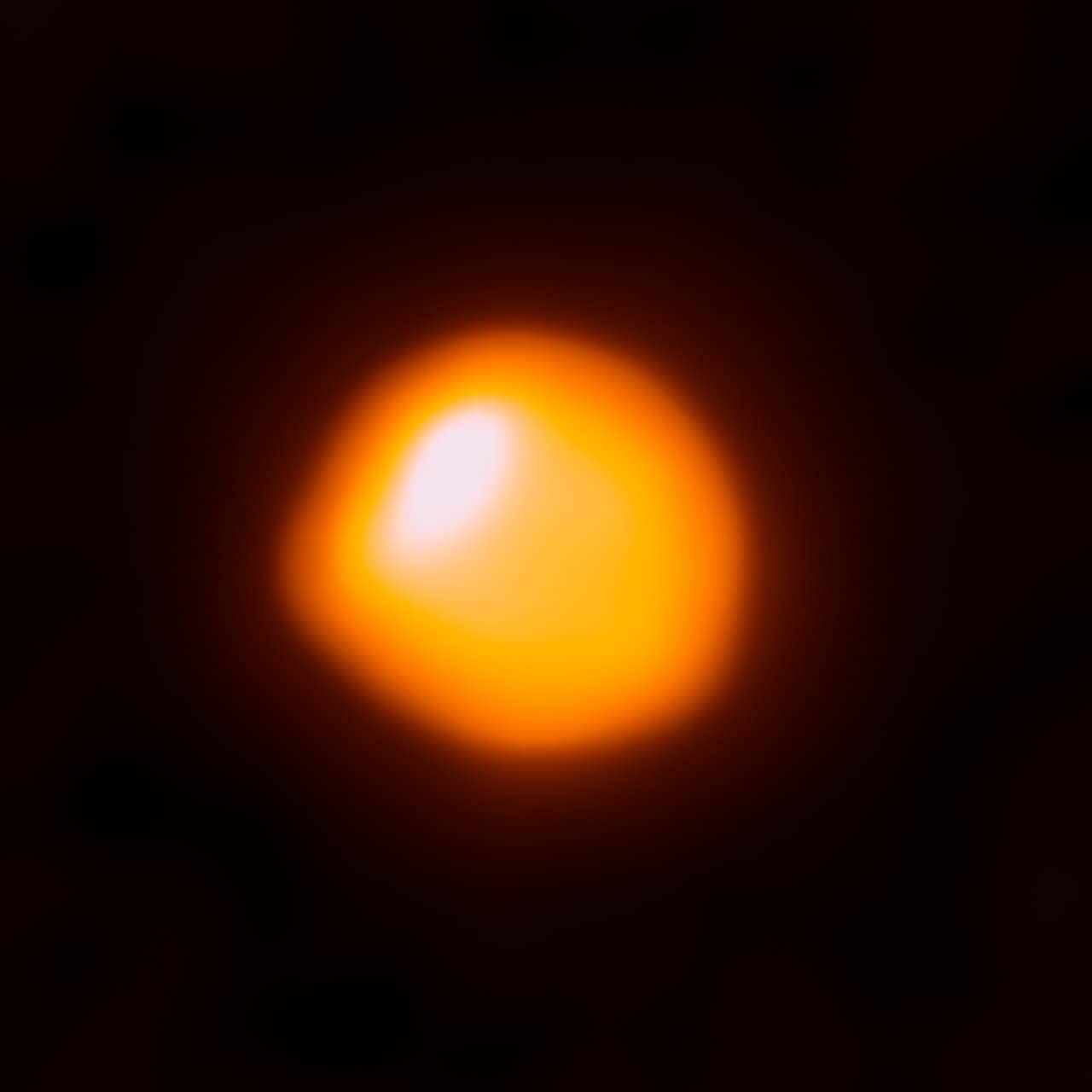
The mystery surrounding the dramatic dimming of red supergiant Betelgeuse, observed over a period of several weeks back in winter 2019, has finally been resolved. In astronomy circles this event is now known as Betelgeuse’s Great Dimming.

A paper published in Nature by a team based at the VLT (Very Large Telescope) has concluded that one part of Betelgeuse underwent a temporary convective cooling process on part of its photosphere, allowing a previously ejected cloud of stellar plasma to condense into a kind of opaque nebulosity, obscuring some of the light from the star over a period of time.

Enormous stars like Betelgeuse have highly turbulent and dynamic surfaces and this event has helped us better understand the periodic mass loss that red supergiants experience in their last stages of evolution, as they literally ‘puff away’ vast swathes of their extended atmosphere into space.

It’s fair to say we’re still at the very earliest stages of truly understanding the complex processes controlling these dying stars.

I feel very privileged and humbled to have witnessed this exciting event (with others) from the surface of a tiny world over 550 light years away, and by extension 550 years after it actually happened.

If you want a deeper dive I’ve included the nature paper link here.