New Comet Alert!

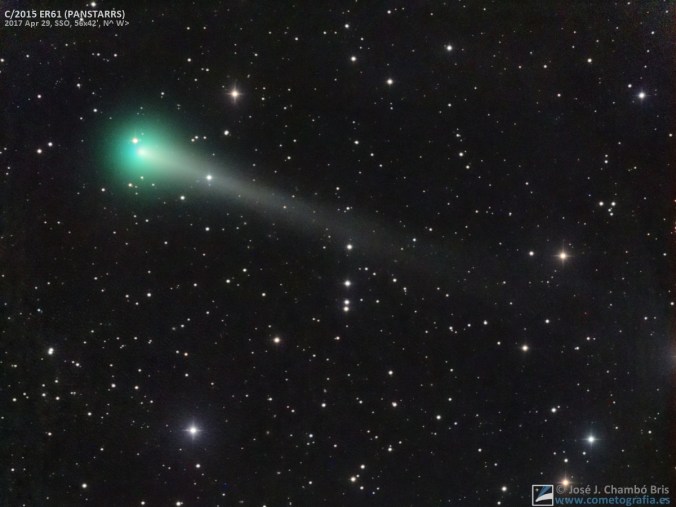
2015ER61_170429_1200

Look out for a new bright comet visible in night skies now and for the next couple of weeks.

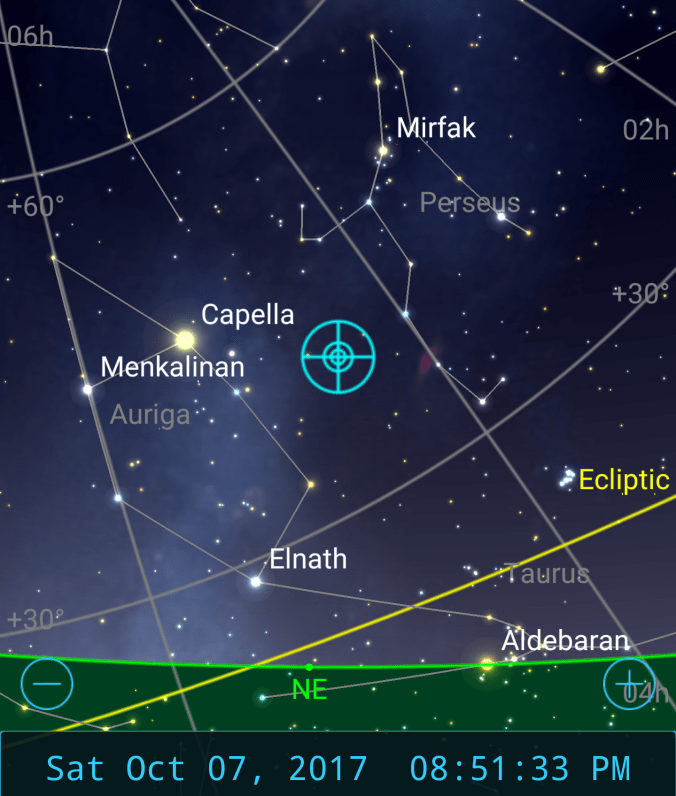
Comet C/2017 O1 ASAS-SN is presently sweeping its way between the constellations Auriga (The Charioteer) and Perseus (The Hero). Later in Ocober it will move into the boundaries of the faint constellation Camelopardalis.

At magnitude 7 or 8 a good dark site and binoculars will be essential for viewing.

Right now at Highland latitudes, Perseus and Auriga start the evening about 20 degrees above the hoizon in the NE before rotating higher and higher in the sky towards the East beyond midnight. Viewing opportunities will therefore get better as the night progresses.

With a calculated orbital period of 17.000 years this will be a rare viewing opportunity.  Happy hunting.

comet

Stargazing Essential Kit – Binoculars

Binos

Q. What’s the single best piece of astronomy equipment you can own, on a budget or otherwise?

A. Without any shadow of a doubt, binoculars.

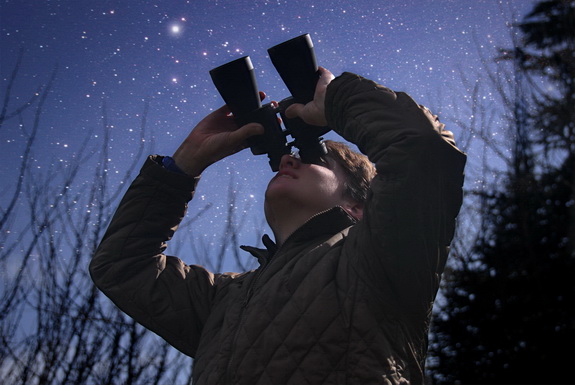
Portable, light weight, robust and with plenty of daylight applications, a good pair of low or medium power binoculars is probably the single best investment you can make for stargazing or astronomy.

Unaided your eyes can potentially pick out between 5000-7000 stars from a dark site. With a good pair of medium powered binoculars that figure jumps to a staggering 600,000 stars!

Although binoculars don’t give you the huge magnifications that telescopes do they make up for that with stunning wide field views of star fields and clusters. Objects like the Pleiades, the Perseus double cluster, Orion’s nebula, the Hyades, Comets, the Andromeda galaxy and the Moon look incredible through binoculars.

They’re also perfect for the rapidly changing weather in the Highlands. During less settled conditions you can grab your binoculars and head outside for short bursts of observing, avoiding the pain of setting up and packing away a large telescope.

If buying binoculars for the first time, my advice is to avoid big astronomy binoculars with large objective lenses. These have their applications but usually provide poor shaky views unless adequately mounted. And once you start mounting binoculars you’re straying into telescope territory.

Here are the three standard sizes of binocular I suggest for grab and go stargazing, with 8x40s being by preferred size in most situations:

7x35s Star reach: 450,000 Field of view: 9.3 degrees
8x42s Star reach: 600,000 Field of view: 8.0 degrees
10x50s Star reach: 750,000 Field of view: 6.8 degrees

The first number is the magnification and the second number is the objective lens diameter.  A large magnification without a decent sized objective will provide dim views.  Another type of binocular to avoid are zoom models which promise large magnifications but tend to produce inferior views and are often very fiddly to use in the field.  Simple is best.

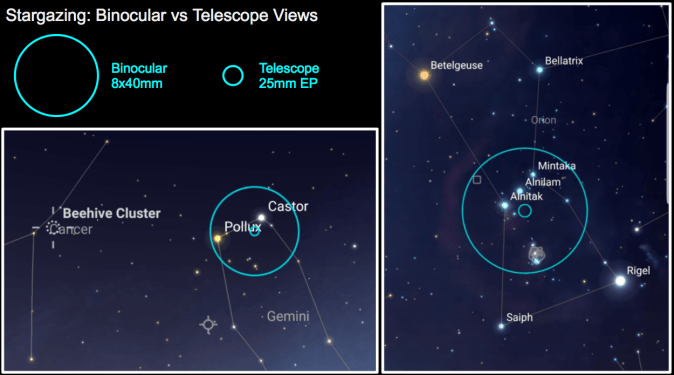
The image below gives a good average comparison between the field of view provided by a 8×40 binocular and a 25mm telescope eyepiece.  Notice all three main belt stars in Orion can be framed through the binoculars.  Perfect for learning the constellations and taking in broad sweeps of the night sky.

Screen Shot 2018-09-13 at 09.38.16.png


The Pleiades and Orion’s Return

Picture saved with settings embedded.

The Seven Sisters

The lovely Pleiades star cluster (Seven Sisters) is becoming a viable late night stargazing target for observers in northern Europe again.  Look up in the East after 11pm to see the distinct jewel like arrangement of stars.  Note the red supergiant Aldebaran (Abarbic for “The Follower”) trailing just behind and to the left.  Pick out a pair of binoculars to see the Pleiades at their best – telescopes reduce the field of view too much for objects like this.

The Pleiades is an excellent example of an open cluster.  These are relatively younger energetic stars still in close proximity to their siblings having all emerged from the same region of intestellar dust and gas.  Eventually these stars will move apart and join the general distribution of more widely dispersed stars.

If you’re awake after that, the hunter Orion will begin rising from the East around 1am. Grab your binos again and marvel at the star forming emmission nebula below the main three stars in the belt.  This is an active star forming region over 1000 light years away, where new stars are being born from dense clouds of hydrogen.  Train a telescope at moderate magnification on the Orion nebula and you’ll be blow away by the majesty of the extended dust clouds, energised and glowing due to the nearby influence of young hot stars.

aHR0cDovL3d3dy5zcGFjZS5jb20vaW1hZ2VzL2kvMDAwLzAyMy82Mzgvb3JpZ2luYWwvb3Jpb24tbmVidWxhLmpwZw==

The Orion Nebula

Planet wise, Neptune and Uranus can be observed almost all evening after darkness, but you’ll need a reasonably powerful telescope to resolve them as tiny blue-green disks.

All the best and clear skies!

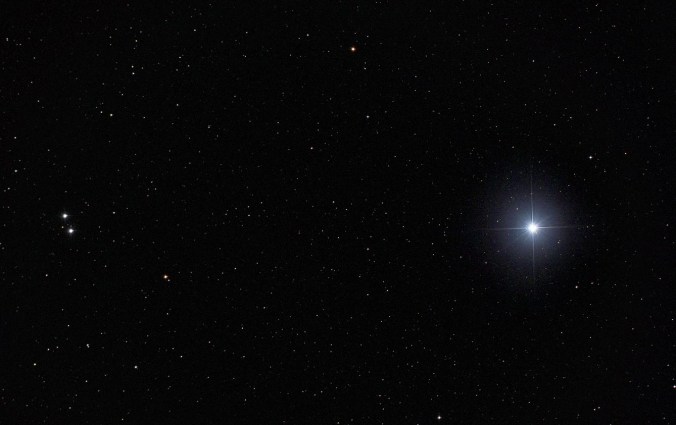
Elsilon Lyrae

epsilon lyrae

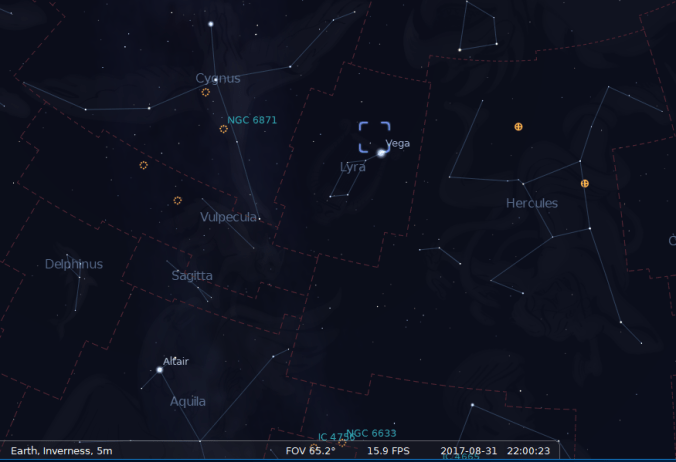
Epsilon Lyrae is a nice easy double star you can view in binoculars all year round in northern latitudes. It sits high in the southern sky very close to the bright star Vega, so is relatively easy to find.

Viewed with the naked eye, it’s just a normal looking 5th magnitude star, but point some binoculars at it and it splits into two clearly separated stars. Things get even more interesting if you train a telescope on the pair, as they’ll split again, revealing a pair of double stars!

The main pair are gravitationally bound and orbit each other every 1200 years with a separation of 160AU (or 160 times the distance from Earth to our Sun). The system is approximately 170 light years away.

Double star systems are the norm in our galaxy with over 60% of star systems containing double or multiple stars orbiting each other at various distances. Our Sun, so far as we know, is a lone wanderer.

Simulations of quadruple star systems suggest they’re relatively unstable, and easily disturbed from their rotating reels by the passing tug of galactic neighbours.

Double double.PNG

Neptune at Opposition

Neptune_Full

Neptune reaches opposition on September 2nd meaning it’s at its closest approach to Earth over the next while. It’s up almost all night in the southern sky within the constellation Aquarius, below and right of Pegasus.

You’ll need a good horizon to see it however as it’s very low on the horizon this far north, never getting higher than 27 degrees.

During opposition Neptune will be at a distance of 28.94 AU with a disk size of 2.4 arcsec. In a good telescope of 6 inches or more you should be able to see a tiny blue disk and perhaps its companion Triton.

Neptune was first observed in a telescope in 1846.  It’s existence was implied from solar system models rather than from direct observation.  Like Saturn and Jupiter, it’s a gas giant with an atmosphere largely composed of hydrogen and helium, but this far out it also contains some “ices” such as water, ammonia, and methane.  

Neptune also has some of the weirdest and wildest weather in the solar system, with recorded wind speeds as high as 2,100 kilometres per hour!  This is what drives some of the mesmerising cloud streaking witnessed during Voyager 2’s flyby.  It’s also an extremely cold place – its cloud tops have recorded temperatures as low as -220 C.  Not surprising given how far it is from the sun.