Stargazing in the Outer Hebrides

DSC_0056.jpeg

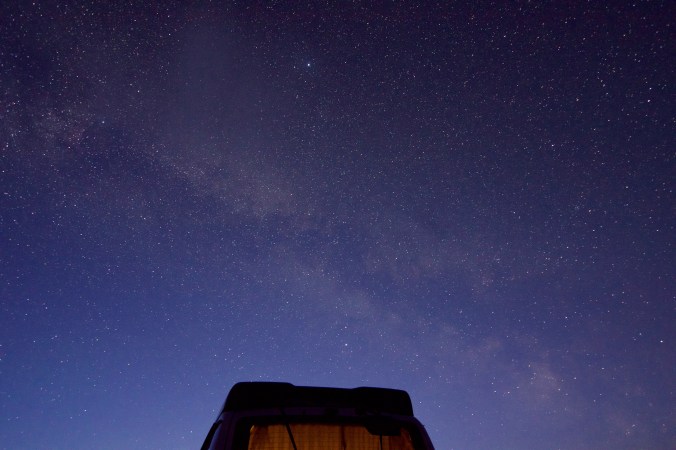
Pre dawn Milky Way on the Isle of Lewis, during the 2020 Hebridean Dark Sky Festival

As a family we’ve visited the Western Isles of Scotland during the warmer summer months, attracted by the wild open spaces, stunning beaches and abundant locations for camping.  Unfortunately the long summer days and short nights are too bright to stargaze, so I’ve never had the opportunity to sample the fantastic dark skies the island has to offer.  I therefore jumped at the opportunity of participating in this year’s Hebridean Dark Sky Festival, organised by An Lanntair and programmed by Andrew Eaton-Lewis.

My outreach involved delivering astronomy talks and stargazing events at community hubs across the island of Lewis.  Over three nights on the island I visited communities at Balallan, Comunn Eachdraidh Nis in North Lewis and the aptly named Edge Cafe over in the west at Aird Uig.

Despite some very wild weather both before and during the festival the three events were a big success, with starry skies materialising in some form at each session.  Skies, when clear, were astonishingly dark, with star clusters and galaxies clearly visible with the naked eye and a glorious sweep of Milky Way evident between the fast moving weather.

DSC_0058.jpeg

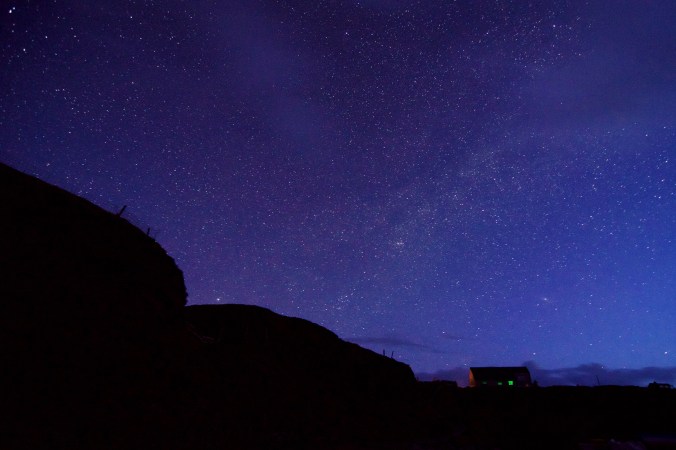
Starry skies from Ness Beach

When presenting my stargazing talks in Scotland I always try to persuade people of the merits of binocular and naked eye observing over telescopes when weather conditions are changeable.  This mantra was well demonstrated during these events, with the agility of binocular observing allowing us to quickly head in and out when breaks in the sky presented themselves.

Travelling to each event in my camper van and sleeping out in the wilds was also a memorable experience.  Wind, sleet, rain and hail all assailed me at various points during my wild camps, but I was always rewarded with frequent starry skies opening above me when I headed out for fresh air.

The people of the island are also some of the friendliest folk you could meet, with Highland hospitality well in evidence wherever I went.  Bounteous servings of tea and cake were never far away!

I very much look forward to participating in the festival again and encourage anyone with an interest in stargazing to consider the Outer Hebrides as a viable winter destination, particularly if you’re seeking some of the very best dark skies available.
DSC_0057.jpeg

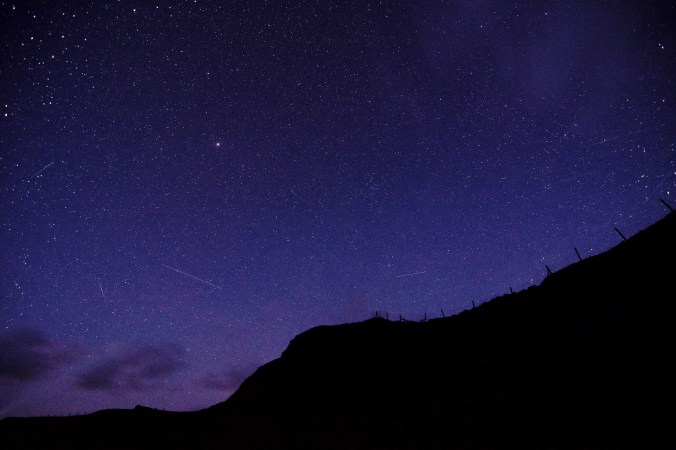
Satellites aplenty

Venus and Mercury

85024035_2842536592490527_233392740522524672_o.jpgThis is how low Mercury grazes the horizon at the moment. A superb shot of Venus and Mercury from Will Cheung this evening.

If you want to sight Mercury for yourself the best chance is right now in the early evenings just after sunset.  Using Venus as a guide, scan the low horizon with binoculars or naked eye.  An unobstructed horizon like the one in the picture above is essential.

Clear skies.

Crab Nebula Composite

84055277_2520165368220400_5095797449084108800_o.jpg

This is an amazing composite image of the Crab Nebula supernova remnant. It shows the neutron star at the center, superimposed over the shockwave nebula (whose outline can be observed dimly in a decent telescope).

This is what happens to high mass stars when they run out of fuel. The atmosphere of the star suddenly collapses inward and dramatically rebounds off the compressed neutron core.

Conservation of angular momentum makes the neutron star spin rapidly (a pulsar) and the rest of the star’s atmosphere expands into space releasing huge quantities of energy (a supernova).

This particular supernova was observed and recorded by Chinese astronomers in 1054 AD as a ‘guest star’, in the constellation Taurus.  It remained visible as a naked eye star for over a year before fading.

Dark Sky Burns

“Thou lingering star, with less’ning ray,
That lov’st to greet the early morn…”

After last night I’m convinced Rabbie Burns did all his stargazing with a delicious wrap of haggis in hand.

Haggis hand warmers and Clelland’s address from last night’s sellout Dark Sky Burns event. Big thanks to the Abriachan team for the Burn’s supper fare. 

Due to inclement skies the astronomy moved indoors I got to talk in some detail about the planet Venus and its harsh environment.  A fascinating place that surely deserves more attention in the future, not least for its potential to harbour microbial life in its more clement upper atmosphere.

Why not try looking at Venus through a telescope or a pair of stabalised binoculars? You should be able to make out its phase, just as Galileo did when he first gazed up at it back in 1610.

Aldourie Primary Astronomy Outreach

82611103_10221628353836795_8670613512545894400_o.jpg

One of the objects we observed was the star forming nebula in Orion’s sword, imaged here by local aurora hunter and photographer Chris Cogan.

I had a fun astronomy outreach session with pupils and parents from Aldourie Primary near Loch Ness on Friday evening. At 6pm kick off we saw some captivating glimpses of dazzling Venus before it set below the tree line.

Due to initially changeable weather we moved between my indoor presentation and outdoor stargazing, but ended up getting a brilliant spell under the stars mid session.

Despite its relative closeness to Inverness skies are dark enough out here to see the Milky Way very clearly. 

Lots of the youngsters (and parents) tried their hand at binocular stargazing for the first time, peering at open star clusters, double stars, the Orion nebula and Andromeda galaxy.

If you’d like to book an outreach session for your school please message me on my facebook site, Highland Astronomy.

Supernova night at Inverness Nature Reserve

Image may contain: night and sky

The main constellations were visible over the Merkinch nature reserve in the west of Inverness, and even a hint of Milky Way.

We had a great evening at the Merkinch Urban Astronomy gathering tonight.  Big thanks to Dr Anthony Luke for delivering a fascinating talk on the chemistry of stars and supernovas. We learnt all about the synthesis of elements and compounds forged in the heart of stars.

Afterwards we were rewarded with clear skies, so I led a group up to the nature reserve for a blustery stargazing session over the Beauly Firth.

Overlooking the water we had lovely views of Orion, the Pleiades and even a hint of the Milky Way and the Andromeda galaxy.

The next event is an Aurora Special on Feb 20th with guest Graham Bradshaw.

Highlands Astronomical Society Guest Talk

NGC_4414_(NASA-med).jpg

An Island Universe – or ‘galaxy’ as we more commonly refer to these vast stellar structures.

I’m looking forward to delivering my guest talk on Island Universes for the Highlands Astronomical Society on Jan 7th. This is a repeat of a talk I presented at the 2019 Inverness Science Festival.

Start time is 7.15pm at the Smithton-Culloden Free Church, Murray Road, Smithton, IV2 7YU. Open to all members of the public and free entry for new visitors.

Please find full event details here.

highlandsastro