Comet Hunting – 46P/Wirtanen

This month brings the excitement of a comet hunt, as Wirtanen 46P reaches closest approach on December 16th.  This is a relatively small comet (1.5km across) with a period of just over 5 years.  However Wirtanen is known to produce a relatively large tail for its stature, so it’s definitely one to look out for.  In mid December it’ll be positioned between the Pleiades star cluster and red giant star Aldebaran in Taurus, so will be relatively easy to locate in the night sky.

Reports of naked eye sightings and some photographs are already emerging online despite the current low altitude of the comet at high norther latitudes.  However its vantage will steadily improve as we head into mid December, although Moon conditions will become less favourable then, so time your hunt well.

Wirtanen should be observable in a wide-field telescope or binocular view, and possibly naked eye under very dark conditions.  You could also try locating it by taking a 10-30 second exposure in your DSLR camera.

I’ve put together a short video to help you locate it over December.   Clear skies!

Venus Morning Star

The planet Venus is a brilliant morning star at the moment. Catch it rising in the south east ahead of the Sun between 5.30am and 7.30am.

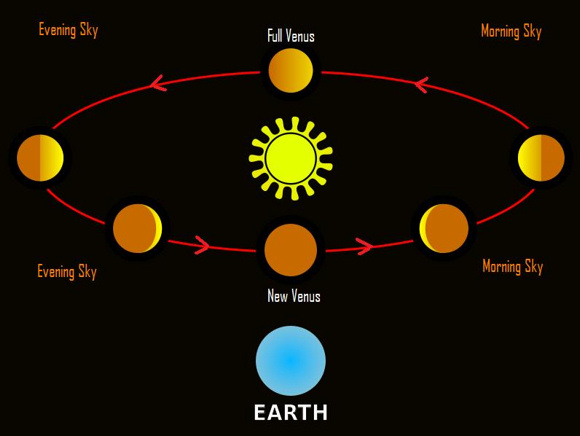
With keen eyesight and binoculars you should be able to discern Venus’s phase, currently a beautiful crescent. A telescope will make this much clearer as demonstrated by this video footage I shot last year, when Venus was ‘the evening star’.

Over the month of November Venus will get brighter as its phase waxes from a thin crescent to a 25% illuminated disc at month end.  Despite this brightening Venus is actually travelling away from us and after December 2nd its brightness will begin to diminish as it pulls further away from earth and its disc size shrinks .

Once Venus passes behind the Sun it will eventually reappear as an evening star around mid August 2019.

Clear skies!

phases-of-venus-illustration

Meteoric Start to New Star Stories

IMG_4079

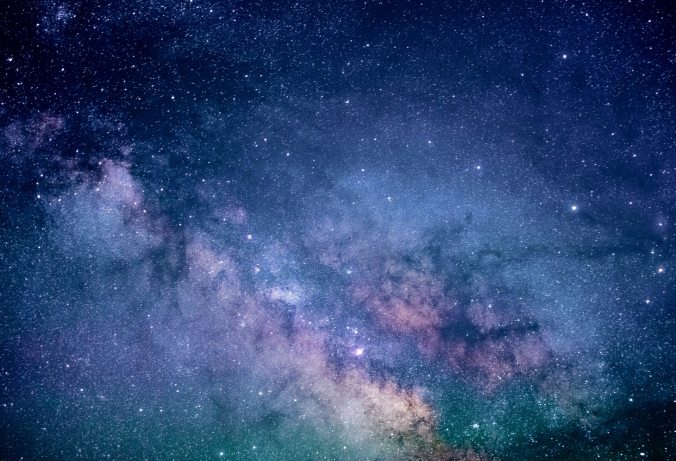
The Milky Way glows overhead between thin tendrils of cloud.  Deneb and Vega shine brightly next to the bright and dark lanes of the Cygnus Rift.  By photographer Claire Rehr

The new Star Stories astronomy programme for the 2018/2019 season got off to a great start up at Abriachan Forest Trust last Friday, with plenty of clear breaks in skies for Milky Way observing and binocular stargazing. This was despite very unsettled weather predicted by the MET office as storm Callum blew in from the west.

This first event was in collaboration with the Highland Archaeology Festival, and pitched on a loose Neolithic stargazing theme which I had worked into a backup talk in the event of cloudy skies.  As it happened we had enough clear conditions to stargaze all evening and the talk was parked for another occasion.

Due to the healthy turnout we split the night into two streams, with one group joining Abriachan’s Clelland for Celtic tales around an open fire, while the other group joined me under darkness for a laser pointer and binocular tour of visible constellations.  We then swapped over at half time.
IMG_4080

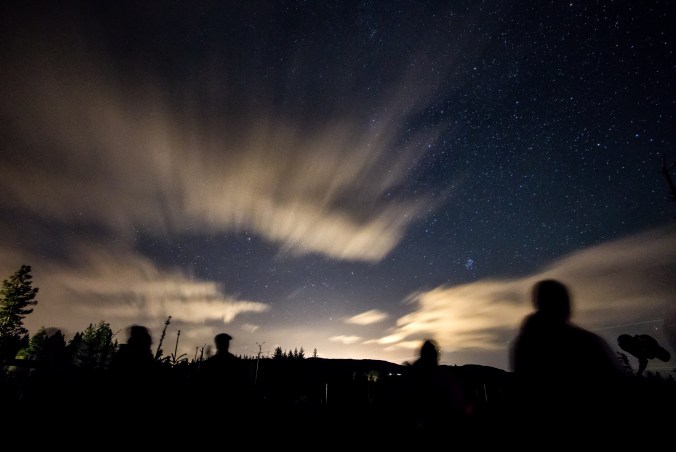
Some broken clouds looking East with the Pleiades rising next to Perseus.  By photographer Claire Rehr.

Both stargazing groups saw plenty of open sky despite fast moving cloud, and we were able to field test the new hand held binoculars funded by our STFC grant.  The Milky Way and summer triangle were on fine display in the south with bright lanes of glowing star fields high overhead.  We also saw most of the northern circumpolar constellations, including Ursa Major, and discussed Polaris at some length before sighting the Pleiades in the East and the rich clusters within Perseus and Cassiopeia.

But the most dramatic event was gifted to the first group of stargazers, when a spectacular burning meteor soared overhead towards the north, briefly lighting up the whole sky.  A subsequent discussion on social media prompted another observer in Lairg – Chris Cogan – to post a picture of a very bright meteor he also saw streaking north and lighting up an entire hillside.

chris cogan lairg

The tail end of a bright meteor lighting up Lairg’s skies.  Photo by Chris Cogan.

This generated a lively discussion and some investigation into how far away two observers can be situated and still see the same bright meteor.  It turns out pretty far!

Due to the high altitude meteors burn up in the atmosphere, about 40 – 60 miles overhead, it’s very possible for two observers hundreds of miles apart to see the same meteor.  The only requirement is they lie along the same approximate vector as the burning space rock.  In this specific case, Abriachan and Lairg are both in a rough line travelling north.  The time recorded on Chris’s picture also checks out with our observing time at Abriachan.  So, all told, reasonably convincing evidence we witnessed the same fireball, seventy miles apart.

Overall feedback on the night has been great so far and I’m already looking forward to the Leonids Special in November, when we will be joined by guest speaker Dr Anthony Luke of UHI, talking about the chemistry of stars and meteors.

Clear skies!

IMG_4073

The Milky Way against the backdrop of the wooded hills at Abriachan.  Brilliant Altair and the constellation Aquila sit middle left.  By photographer Claire Rehr.

44035787_1861588447230262_3187389204246036480_o

Clelland spinning more starry tales around the open fire.  Photo courtesy Abriachan Forest Trust

The night sky photographs for this piece were kindly donated by Claire Rehr .  Please visit her Instagram account ‘rehr_images’ to see more of her stunning pictures.


New Star Stories Events and Speakers

milky way

The winter Star Stories programme at Abriachan Forest is really coming together with loads of exciting talks and observing opportunities to look forward to in the months ahead. Booking links will be added as the Eventbrites go up:

12th October – Neolithic Stargazing – Dark sky observing, storytelling and talk on ancient stargazing from Stephen Mackintosh – EVENT SOLD OUT.
Eventbrite: https://www.eventbrite.co.uk/e/neolithic-stargazing-tickets…

16th November – Leonids Meteor Shower Special – With guest speaker Dr Anthony Luke, Lecturer of Natural and Applied Science at UHI, giving a talk on the chemistry of stars, meteors and comets. 60% of tickets already allocated.
Eventbrite: https://www.eventbrite.co.uk/e/stargazing-leonid-meteor-sho…

5th December – Evening with Professor Martin Hendry – A special guest talk from Martin Hendry, Professor of Gravitational Astrophysics and Cosmology at Glasgow University, entitled “Exploring the Dark Side of the Universe”
Eventbrite: https://www.eventbrite.co.uk/e/star-stories-with-martin-hendry-tickets-49979041659

21st December – Winter Solstice Special – Mark the shortest day under a full moon with an evening of moon and bright star observing and a talk on the winter solstice from astronomer Stephen Mackintosh.
Eventbrite: please check back

12th January – Audience with Dark Sky Man – Observing under a crescent Moon with guest talk from author of Stargazing For Dummies and On Tour Manager of the Glasgow Science Centre, Steve Owens.
Eventbrite: please check back

9th February – Dark sky observing and Photography special – With guest speaker Graham Bradshaw of Graham Bradshaw Photography. Graham is a local photographer who has taken some stunning landscape, aurora and night sky photos. Eventbrite: https://www.eventbrite.co.uk/e/star-stories-photography-special-tickets-49979762816

27th April – TBC

All evenings will include indoor and outdoor learning opportunities with Clelland, Suzann, Ronnie and the rest of the Abriachan team. Please check eventbrite links for full details.  More events, details and ticket links will appear on my Facebook site here.

STFC Support for Astronomy Outreach

24900062_1994723217431287_4261072682509033538_n

I received some fantastic news this week. The Science and Technology Facilities Council (STFC) are supporting our continued programme of astronomy outreach at Abriachan Forest Trust, via a SPARK award.  The news was published in the BBC Highlands & Islands website here.

STFC council members were impressed with the successful pilot events delivered over the winter, bringing together astronomy, science and culture through the medium of stargazing and storytelling.

The released funds will be invested in observing equipment, landscape astronomy props, and transportation costs to help families without vehicles access future events.  They will also help us deliver another 12 events out at Abriachan over the next year and into 2019.

I’d like to personally thank the following individuals for their formal letters of support on the bid:

Suzann Barr – Learning Coordinator at Abriachan Forest Trust

Martin Hendry – Professor of Gravitational Astrophysics & Cosmology and Head of the School of Physics & Astronomy, University of Glasgow

Steve Owens – Dark Sky Consultant and Author of Stargazing for Dummies.

Elizabeth Barron-Majerik – Project Development Manager, School of Forestry, Science, Maths and Aquaculture, UHI

But most of all thanks to everyone who have attended the Abriachan stargazing sessions so far, during clear and wild weather.   Keep a look out for the future list of events.

STFC logo - web quality jpg - large (colour on white)

Astronomy Guiding at Scapa Festival

31894544_832835000237043_995368678121799680_o

I had a fun two days of astronomy guiding at the newly launched Scapa yoga festival near Loch Fyne.  One of the perks for the job was a family ticket for the festival so I decided to take the camper van and family along too.

The drive from Inverness was pretty arduous, but when we arrived it was a lovely setting and ended up being one of the most peaceful and chilled out festivals we’ve been to.  Numbers were kept at reasonable levels so that toilets and open spaces were jostle free and relaxing.

The astronomy work ran for two days late in the evening and was in partnership with the Wild Things! group.  The original plan was for a late night constellation walk to the beach but as the clouds rolled in we instead elected for an atmospheric campfire, with a general discussion about the stars.

This format worked out very well with lots of interested folk dropping in to participate in what became a very vibrant Q & A, covering topics as far reaching as star navigation, astrology, shooting stars, black holes and stellar evolution.  On the Saturday evening some people stayed for the whole two hours, transfixed by the discussions.  Astronomy is a subject with the power to transport people back into a state of childhood wonder!  It’s undoubtably the most accessible and mind-blowing of all the sciences.

By all accounts the festival was a great success and I wish the organisers lots of luck with Scapa 2019.

Wild Astronomy – Inverness Science Festival

milky way

I’ll be giving a public lecture at the Inverness Science Festival on May 11th 2018.  I’d love to use some images from local astro photographers, particularly night sky photos taken in the Highlands or north of Scotland.  If you’d like your images used I’ll fully credit you in the talk.  Please PM me for details.

Talk Title: Wild Astronomy

Description: The Highlands of Scotland have some of the darkest skies in Europe but how often do we escape our back gardens and ‘get out there’ to appreciate the night sky?

In this talk astronomer Stephen Mackintosh discusses what makes our Highland skies so special, the sights and objects we should look for, and how a backpack and a pair of binoculars is all you really need to open up the wonders of the night sky.

Time and Location:  May 11th, 7-8pm at University of the Highlands and Islands STEM Hub, An Lòchran, Inverness Campus, Inverness