World Class Darkness at The Torridon

torridon_plough

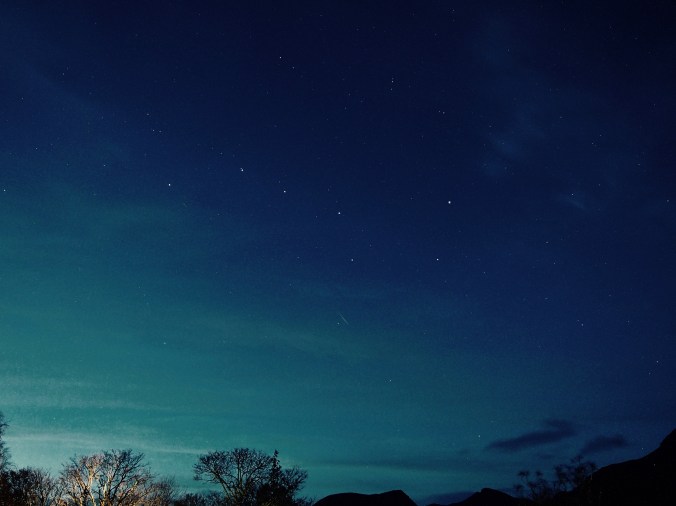
The Plough facing north from the grounds of the Torridon Resort

I had a great time with hotel guests at the Torridon Resort this weekend, stargazing under Bortle 1 class dark skies. We were clouded out on Friday evening but had spectacular skies on the Saturday, with galaxies in particular brighter than I’ve seen them before.

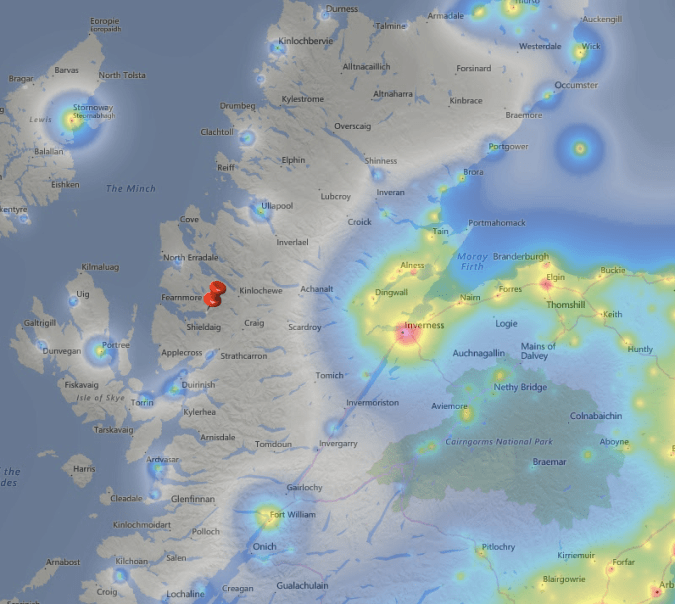
The Torridon Resort was the base of operations for this luxury astronomy break.  It’s situated in one of the most remote extremities of the Western Highlands, well within the Bortle 1 and 2 classifications for darkness.

OLYMPUS DIGITAL CAMERA

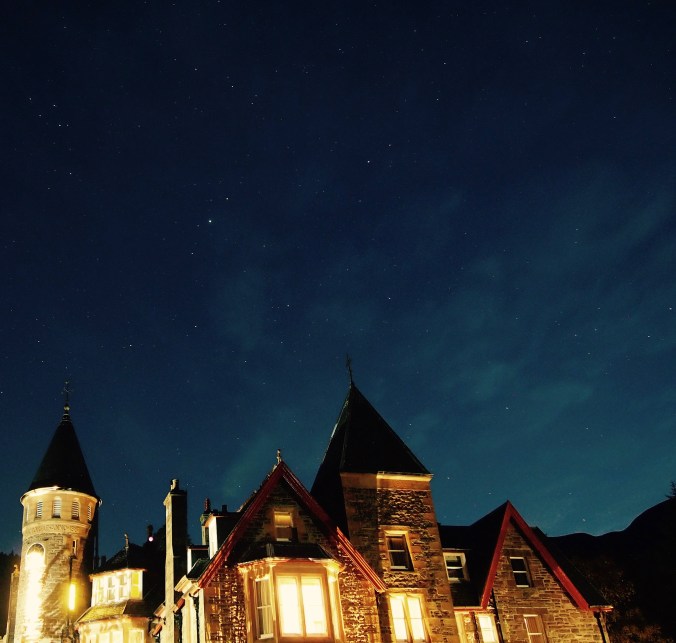
Stars appear at twilight, facing south from the grounds of the Torridon Resort

Our main excursions took us high above the hotel on the slopes overlooking loch Torridon, near Balgy.  On a previous scouting mission to find good observing locations I bumped into a nice chap called Nigel who owns self catering cottages in the vicinity, at ‘Baden Mhugaidh’.  He had kindly invited me to take the stargazing party onto his land over the weekend, and as we pulled the van up he joined us for some dark sky observing.

Although there were some thin clouds in the north and on the eastern horizon, overall sky quality and seeing was spectacular with the bright band of the Milky way on display overhead and vivid depth evident in the Cygnus region of the galaxy near Deneb and Vega.

Galaxies were popping with brilliant vibrancy in binocular views, with Andromeda showing bright lane detail and Bodes galaxy in Ursa Major clearer than I’ve ever seen it in field glasses.

We took in a tour of the main constellations, including the beautiful clusters in Perseus, the Pleiades and even some double stars, including Alberio which was easily split in the larger set of binoculars.

5566220103_9753103f4e_b

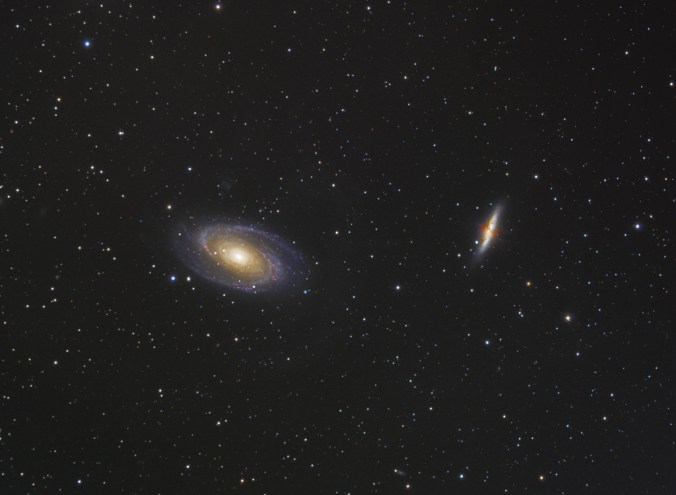
M82 and M83 in Ursa Major were the brightest I’ve seen them in binoculars.  They popped into view when scanning the star fields, like two nebulous lanterns

Good views were also possible back at the hotel grounds, and the staff kindly accommodated my request to kill the driveway lights a few times.  The hotel also let us commandeer the library for our meals, allowing me to present some power point talks during dinner on Friday and Saturday evening.  My guests were very friendly and interesting company, with questions and conversation flowing easily.

Unfortunately, I neglected to take my camera into the field, so only took a few snaps from the hotel grounds at sundown. Look out for more Torridon dates in the future.

Screen Shot 2018-11-12 at 10.21.12.png

The Torridon is situated under some of the darkest skies on earth.

Meteoric Start to New Star Stories

IMG_4079

The Milky Way glows overhead between thin tendrils of cloud.  Deneb and Vega shine brightly next to the bright and dark lanes of the Cygnus Rift.  By photographer Claire Rehr

The new Star Stories astronomy programme for the 2018/2019 season got off to a great start up at Abriachan Forest Trust last Friday, with plenty of clear breaks in skies for Milky Way observing and binocular stargazing. This was despite very unsettled weather predicted by the MET office as storm Callum blew in from the west.

This first event was in collaboration with the Highland Archaeology Festival, and pitched on a loose Neolithic stargazing theme which I had worked into a backup talk in the event of cloudy skies.  As it happened we had enough clear conditions to stargaze all evening and the talk was parked for another occasion.

Due to the healthy turnout we split the night into two streams, with one group joining Abriachan’s Clelland for Celtic tales around an open fire, while the other group joined me under darkness for a laser pointer and binocular tour of visible constellations.  We then swapped over at half time.
IMG_4080

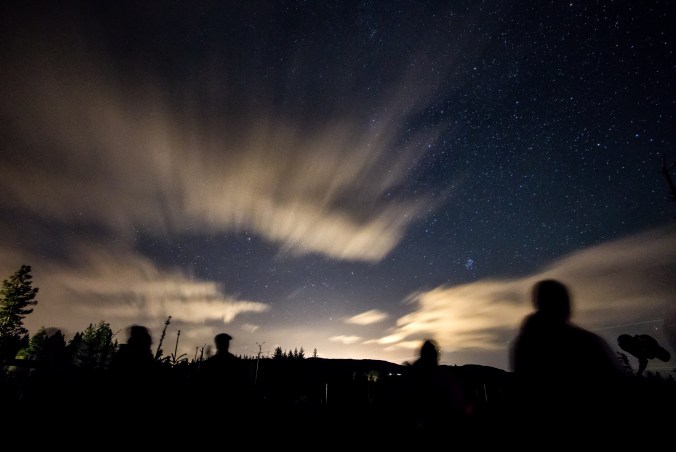
Some broken clouds looking East with the Pleiades rising next to Perseus.  By photographer Claire Rehr.

Both stargazing groups saw plenty of open sky despite fast moving cloud, and we were able to field test the new hand held binoculars funded by our STFC grant.  The Milky Way and summer triangle were on fine display in the south with bright lanes of glowing star fields high overhead.  We also saw most of the northern circumpolar constellations, including Ursa Major, and discussed Polaris at some length before sighting the Pleiades in the East and the rich clusters within Perseus and Cassiopeia.

But the most dramatic event was gifted to the first group of stargazers, when a spectacular burning meteor soared overhead towards the north, briefly lighting up the whole sky.  A subsequent discussion on social media prompted another observer in Lairg – Chris Cogan – to post a picture of a very bright meteor he also saw streaking north and lighting up an entire hillside.

chris cogan lairg

The tail end of a bright meteor lighting up Lairg’s skies.  Photo by Chris Cogan.

This generated a lively discussion and some investigation into how far away two observers can be situated and still see the same bright meteor.  It turns out pretty far!

Due to the high altitude meteors burn up in the atmosphere, about 40 – 60 miles overhead, it’s very possible for two observers hundreds of miles apart to see the same meteor.  The only requirement is they lie along the same approximate vector as the burning space rock.  In this specific case, Abriachan and Lairg are both in a rough line travelling north.  The time recorded on Chris’s picture also checks out with our observing time at Abriachan.  So, all told, reasonably convincing evidence we witnessed the same fireball, seventy miles apart.

Overall feedback on the night has been great so far and I’m already looking forward to the Leonids Special in November, when we will be joined by guest speaker Dr Anthony Luke of UHI, talking about the chemistry of stars and meteors.

Clear skies!

IMG_4073

The Milky Way against the backdrop of the wooded hills at Abriachan.  Brilliant Altair and the constellation Aquila sit middle left.  By photographer Claire Rehr.

44035787_1861588447230262_3187389204246036480_o

Clelland spinning more starry tales around the open fire.  Photo courtesy Abriachan Forest Trust

The night sky photographs for this piece were kindly donated by Claire Rehr .  Please visit her Instagram account ‘rehr_images’ to see more of her stunning pictures.


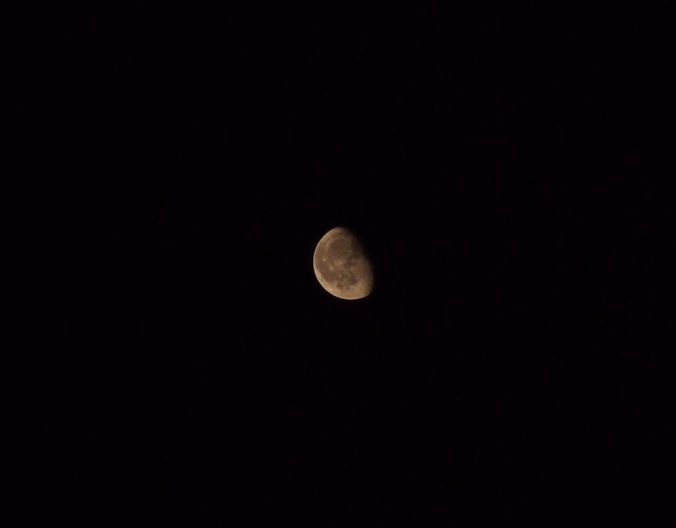
Waning Gibbous Moon

OLYMPUS DIGITAL CAMERA

A waning gibbous Moon, photographed near Abriachan

I’m always snapping the waxing crescent Moon so here’s the waning gibbous Moon for a change. I took this on the trails above Abriachan around midnight on Friday, after a very wet and stormy evening in the camper van.

The word ‘wane’ is associated with weakness or sickness, and describes the diminishing aspect of the Moon after full. There’s a clear analogy of birth and death in the phases of the Moon that no doubt fascinated our forebears.

Astronomers often give the Moon a rough time due to its habit of spoiling dark skies, but it’s undoubtably one of the most mesmerising objects to look at. A complete world with the most incredible impact scars, recording the chaotic and violent formation of our solar system.

Observing the Moon each night is a dynamic experience as the terminator – the band where light meets dark – drifts back and forth across the lunar surface, revealing new features to contemplate.  In a telescope the terminator itself is a wonderful region to view, revealing kilometre long shadows from mountains and crater rims.  I like to imagine myself standing on the Moon in these regions, watching the Sun setting low on the lunar horizon.

The Milky Way

With Moonless skies at the moment it’s a great time to view the Milky Way running from South to North and cutting through the zenith close to midnight.  Look for the bright central regions close to the horizon near Sagittarius and up past the dark bands of dense galactic material around the constellations Cygnus.

Even if the weather’s looking patchy get out for that late night walk somewhere dark. You might be rewarded with tantalising glimpses during breaks in the cloud.  It’s these excursions when expectations are low that I often find the most rewarding when the sky finally opens up.

41091346_2161268987443375_7105273253718917120_n

“There’s something fascinating about our own home galaxy. Even if we still cannot look at it from above and gaze at the full span of its arms, the sideway view offers a quite a showdown.

To me the central part of the milky way is the most spectacular sight of the night sky. It’s something you can clearly see with the naked eye when you are away from city lights. It’s a sight that really brings your down to Earth and lets you wonder at how small we are, while comforting you in the thought that you are part of this Earth and the Universe.”Adrien Mauduit

Increasing Astronomical Darkness

Sunset_Scotland_(5805593910)

You might notice the nights seem to be pulling in quickly at the moment. This isn’t your imagination. We’re in a period of greater daylight change as we approach the Autumn equinox on September 22nd.

At the moment the Sun is setting around 20 mins earlier each week. Compare that to July when Sunset times were only changing by around 5 mins per week, and almost no noticable change over the summer solstice on June 21st.

Of course this is great news for stargazers, with astronomical twilight now kicking in around 9.50pm meaning your late night forays under clear skies will reveal increasing numbers of stars and fainter nebulae.

For seekers of dark skies this month’s new moon is September 9th so binoculars, cameras and telescopes at the ready.

Clear skies.