Most Used Astronomy Apps

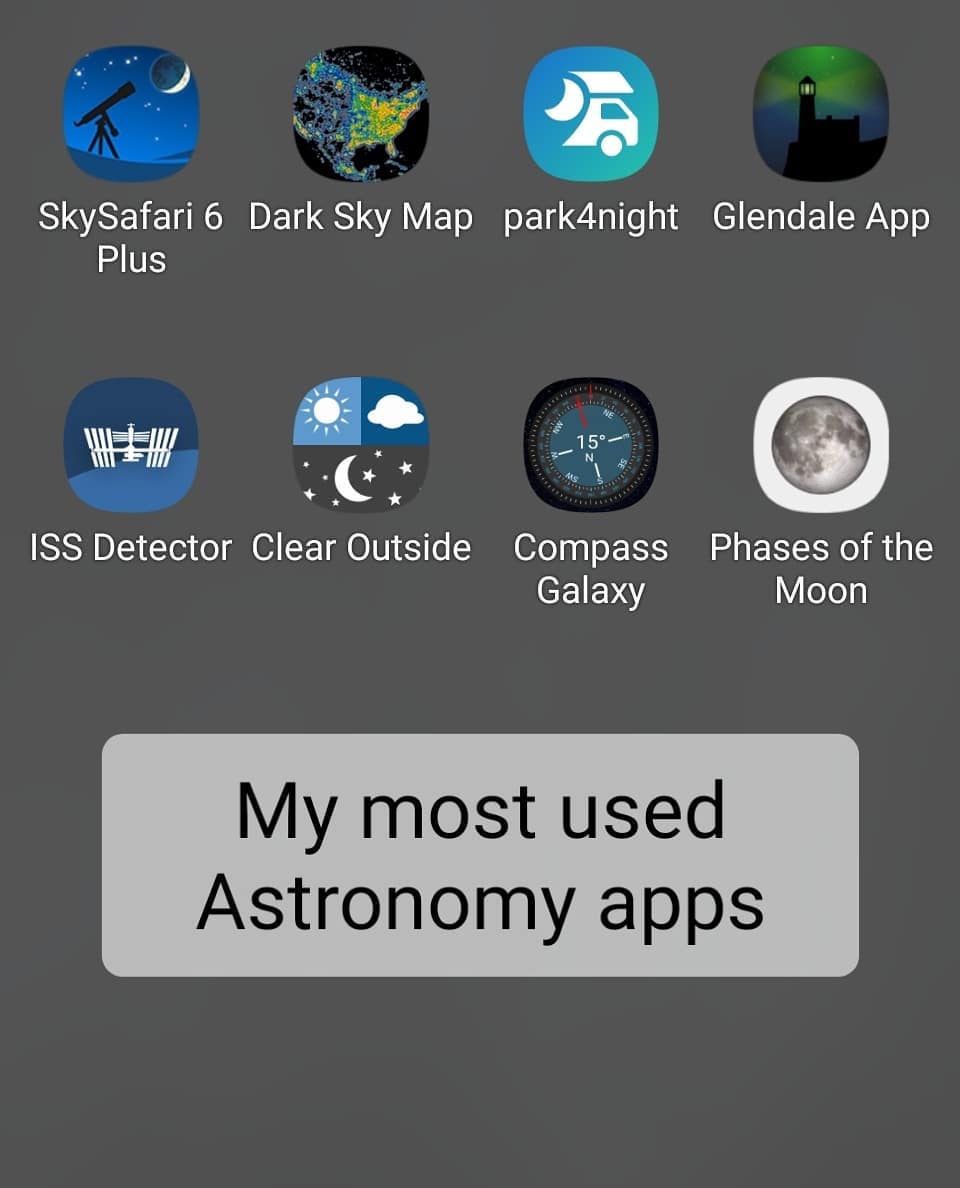
One of the most frequent questions I receive is which apps to use for stargazing and astronomy. Here’s my top 8 most used apps with a brief description of what I use them for.

SkySafari 6 – My main planetarium app that lets me see what’s up on a particular evening and plan my excursions under the stars. It also comes with useful telescope control functionality.

Dark Sky Map – Let’s me see areas of light pollution in my local area and further afield. Essential if you’re planning to stargaze somewhere you’ve never been before so you can guage darkness levels and avoid pesky light pollution.

Park4night – Once you’ve decided on a dark location getting off the road and parked can be a massive headache, especially where I live in the Highlands of Scotland where there’s plenty of dark areas but very little access. This app will show you lay-bys and parking spots for brief stops or overnight parks.

Glendale App – One of the best Aurora alert apps for tracking down the elusive northern lights.ISS Detector – My main app for seeking out and planning International Space Station passes. Works from your home location or anywhere in the world.

Clear Outside – One of the best weather apps aimed at stargazing. Summarises different altitudes of cloud cover, Moon brightness, wind and precipitation and provides you with a simple traffic light system for each night.

Compass Galaxy – I have a Samsung phone but any compass app will do to help you find north out in the field.

Phases of the Moon – The presence of the Moon is a huge deal. For Milky Way observing and deep sky astronomy you want to avoid the Moon and this app will quickly tell you the phase and rise and set times at your local position.

I should add that I’m in no way affiliated with any of these apps or software companies. This is just an honest peek into what I use to help me enjoy the night sky. I hope you find it useful.

The Veil Nebula

Around 15,000 years ago a star 20 times more massive than our Sun dramatically exploded in a region of space within the constellation Cygnus the Swan.

Since then the shockwave and expanding envelope of ejected stellar material and ionised gas has been racing apart, creating a nebulous structure over 130 light years across. This image, captured by Katie Hughes, from her home in Loch Lomond, is all that remains of this event (a supernova remnant) in visible light.

Thank you very much for sharing the stunning image Katie. Katie has recently started an Instagram page with more of her images. Please visit it here.

Venus & Mercury

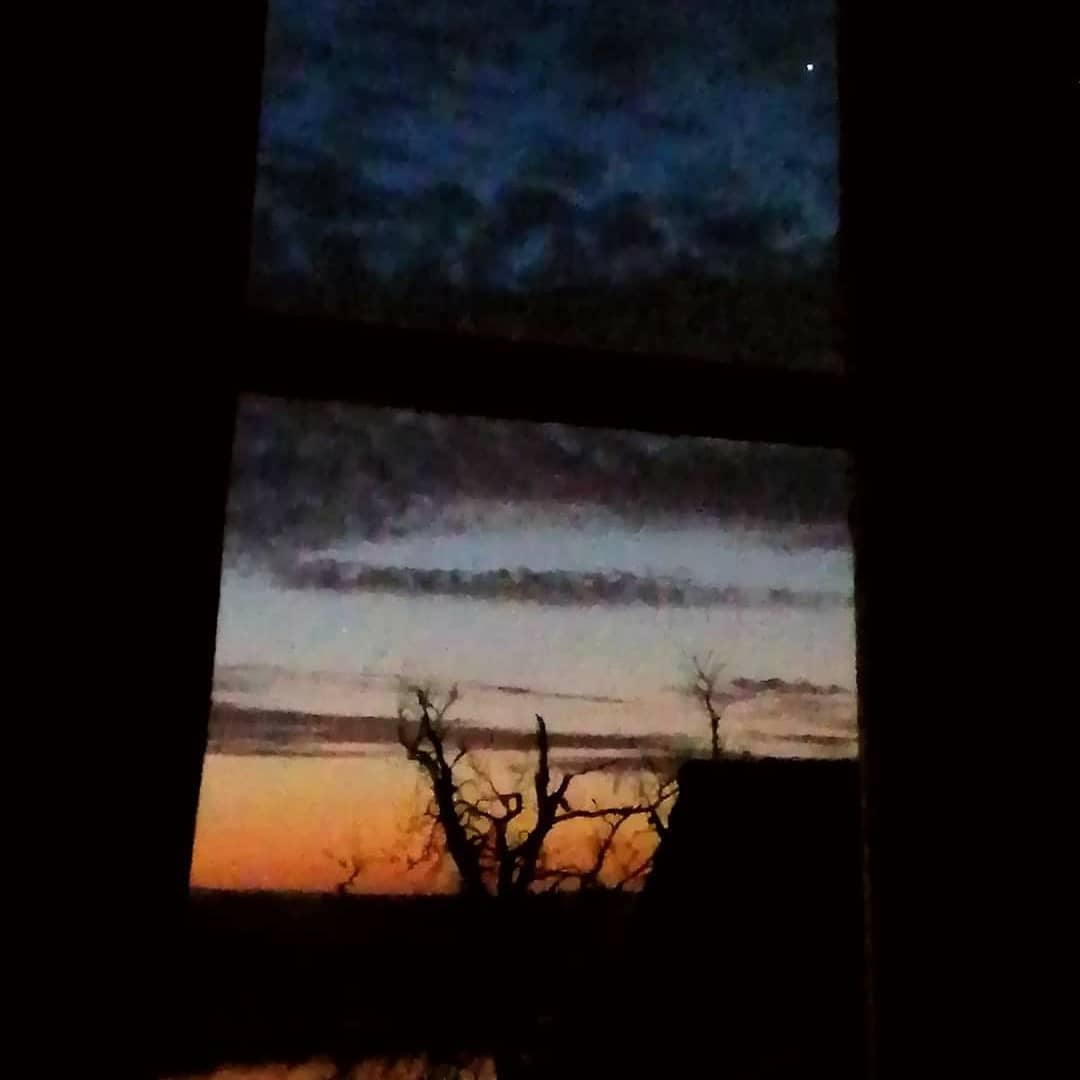
While I shivered this morning trying to find Mercury amidst a blanket of freezing cold mist, Lynsey Gibson fortuitously snapped it from the cozy confines of her bed.

The bright object in the first image is actually the planet Venus, her intended target, but if you zoom in Lynsey’s phone snap has also picked up Mercury. See the second image which I’ve annotated.

This is a great example of how much fainter Mercury is compared to Venus (I usually use binoculars to help locate it) and the power and versatility of smartphone cameras.

Thanks for the share again Lynsey and clear skies everyone.

New Information on Betelgeuse

Betelgeuse, shown here as the top left star in the shoulder of Orion

Some interesting new information has emerged on Betelgeuse, the red supergiant that marks the left ‘armpit’ of Orion the Hunter.

In summary:

1. It’s still burning Helium in its core so unlikely to go supernova until around 100,000 years.

2. It’s not as massive as previously thought. Earlier studies had shown its radius would extend to the orbit ofJupiter if placed in our solar system. This new data suggests its real radius is 60% of this.

3. It’s closer to Earth than previously measured, at 530 light years. This is 25% closer than we previously thought.

New data published in the Astrophysical Journal. Further reading here.

2021 Hebridean Dark Sky Festival

I’m very much looking forward to a return to the inky dark skies over the Isle of Lewis next February for the Hebridean Dark Sky Festival. The full lineup and details are available from organisers An Lanntair.

I’ve been reminiscing about last year’s festival, when I toured Lewis delivering outreach to a collection of remote communities under some of the best dark skies you’ll find anywhere. You can read my short account from last February on my blog page here. I look forward to more of the same in 2021, travelling to some new locations on the island.

“Watch the skies! The Hebridean Dark Skies Festival is to return to the Isle of Lewis in February 2021. The two-week programme will include an exhibition by astronomy-inspired artist collective Lumen; music by Kathryn Joseph and Renzo Spiteri; talks by award-winning TV presenter Dallas Campbell and renowned climate scientist Tamsin Edwards; stargazing with Highland Astronomy; a night swim with Immerse Hebrides; and lots more to be announced. Find out more by reading our news story. Thanks to CalMac Ferries and Outer Hebrides LEADER for their continued support, and to festival partners/supporters Lews Castle College UHI, Callanish Stones & Visitor Centre, Stornoway Astronomical Society, Outer Hebrides, VisitScotland, Gallan Head Community Trust, Hebridean Hopscotch Holidays and Loganair.Please note that An Lanntair has put in place stringent systems to help mitigate risks from COVID-19 in its building and across its activities to keep staff and the public safe. Details can be found at https://lanntair.com/visit-us-safely/. A Coronavirus Risk Assessment specific to the Hebridean Dark Skies Festival will be in place for the event. Stornoway Gazettewelovestornoway.comEVENTS: what’s happening in Lewis + Harris

Mars at Opposition

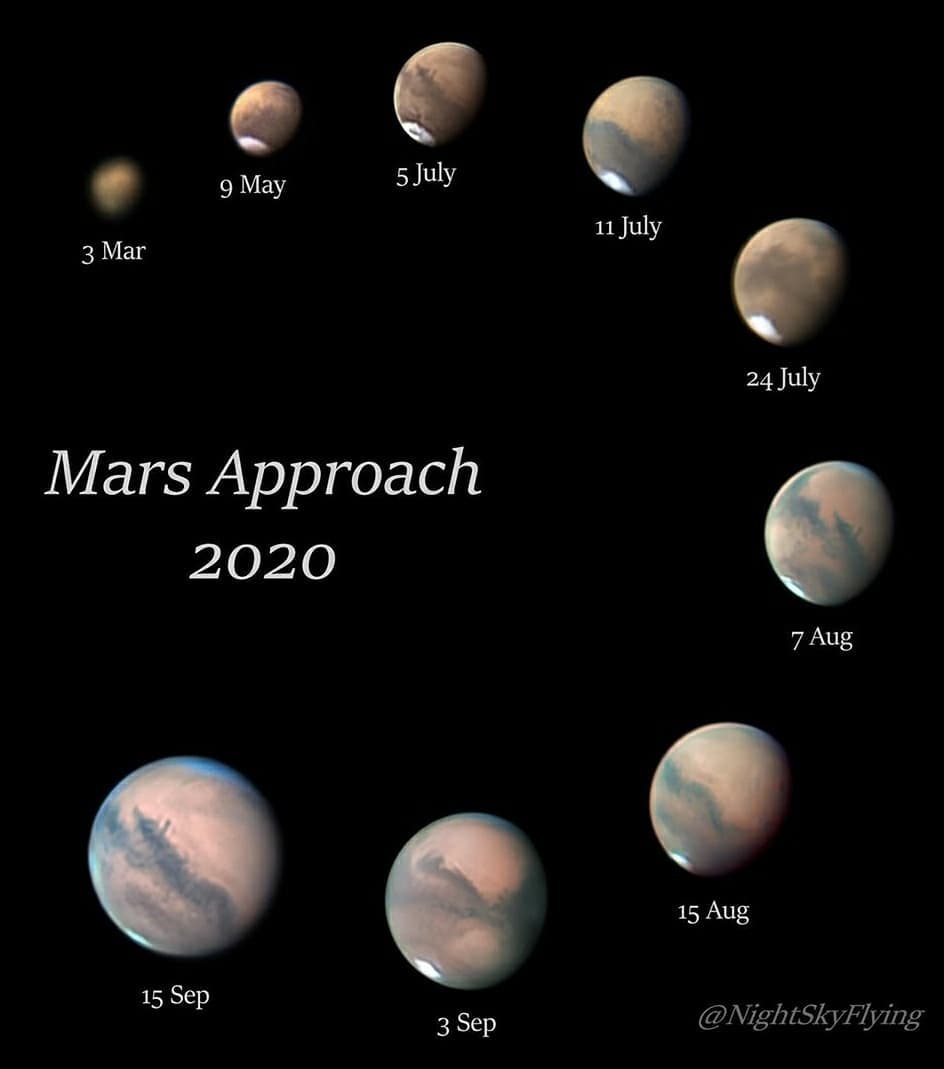
Collage by Instagram’s @NightSkyFlying

Have you noticed the dazzling red star high in the East during late evening? That’s the planet Mars and it’s now nearing opposition on October 13th, offering some of the best naked eye and telescopic views possible.

Opposition is when Mars and Earth reach their closest approach to each other with respect to their independent orbits around the Sun. For Mars and Earth, this happens every 2 years and 2 months.

With the planet’s relatively high altitude and closeness around opposition, current views of the planet even with moderately powerful telescopes should be striking, perhaps revealing dim surface features and polar caps.

These images from Instagram’s @nightskyflying show the dramatic size and clarity change of Mars over a period of many months. If you don’t have a telescope it’s still worth looking up to appreciate the brightness of Mars as a naked eye planet at the moment.

Image by @NightSkyFlying

Milky Way Images

117816607_2674469136123355_8845601533957390690_n

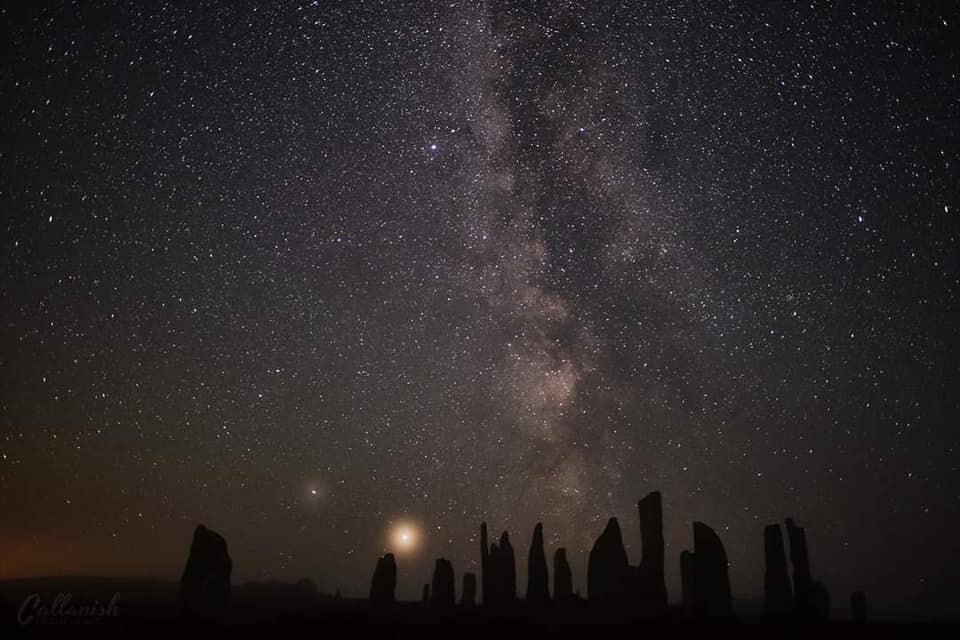
The Milky Way over the Callanish Stones on the Isle of Lewis.  Jupiter and Saturn can be seen in this shot low above the horizon. By Emma Rennie of Callanish Digital Design.  www.callanishdigitaldesign.com

117707107_2674469192790016_589110737947079557_n

Another stunning Milky Way shot by Christopher Cogan taken from Muie in Sutherland in the far north of Scotland.

Two stunning Milky Way images taken last night from the Scottish Highlands (and Islands). Both show the bright region of the Milky Way in the vicinity of the Summer Triangle, looking south.

If you imagine our Milky Way as a vast disk of stars, these views are peering further ‘into’ the disk, where the density of stars and stellar matter is greater, and hence brighter. Contrast this with the fainter regions we see in Winter near Orion, when we peer ‘out’ of the galactic disk.

The dark lanes you can see are part of the Cygnus Rift – a region containing vast clouds of dust that obscure some of the light from the billions of stars in the background.

With the Moon well out of the way and proper darkness returning late at night, now is a great time to go out and see the Milky Way for yourself.