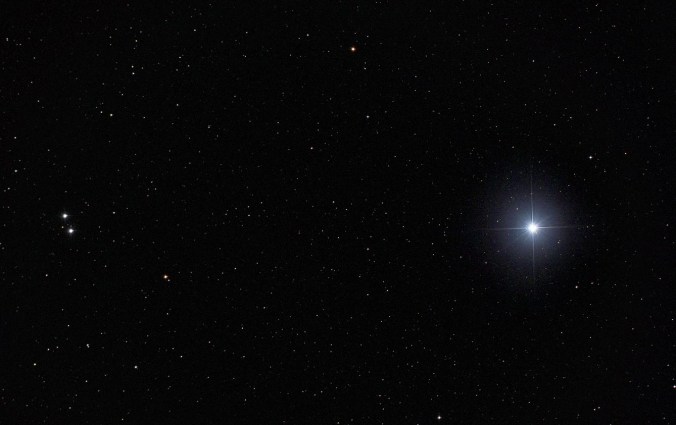
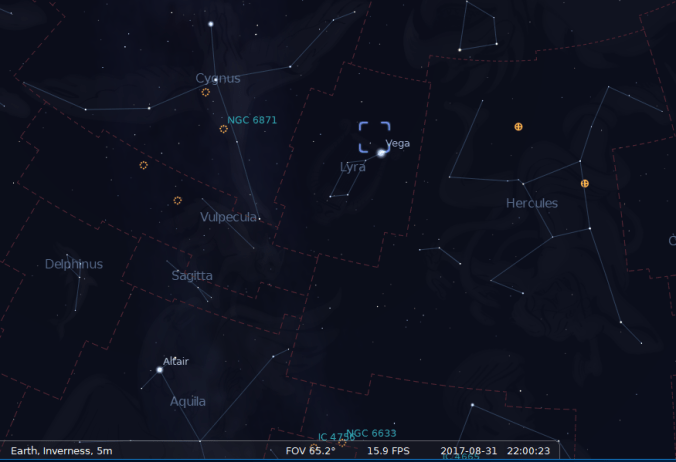
Epsilon Lyrae is a nice easy double star you can view in binoculars all year round in northern latitudes. It sits high in the southern sky very close to the bright star Vega, so is relatively easy to find.
Viewed with the naked eye, it’s just a normal looking 5th magnitude star, but point some binoculars at it and it splits into two clearly separated stars. Things get even more interesting if you train a telescope on the pair, as they’ll split again, revealing a pair of double stars!
The main pair are gravitationally bound and orbit each other every 1200 years with a separation of 160AU (or 160 times the distance from Earth to our Sun). The system is approximately 170 light years away.
Double star systems are the norm in our galaxy with over 60% of star systems containing double or multiple stars orbiting each other at various distances. Our Sun, so far as we know, is a lone wanderer.
Simulations of quadruple star systems suggest they’re relatively unstable, and easily disturbed from their rotating reels by the passing tug of galactic neighbours.
Neptune reaches opposition on September 2nd meaning it’s at its closest approach to Earth over the next while. It’s up almost all night in the southern sky within the constellation Aquarius, below and right of Pegasus.
You’ll need a good horizon to see it however as it’s very low on the horizon this far north, never getting higher than 27 degrees.
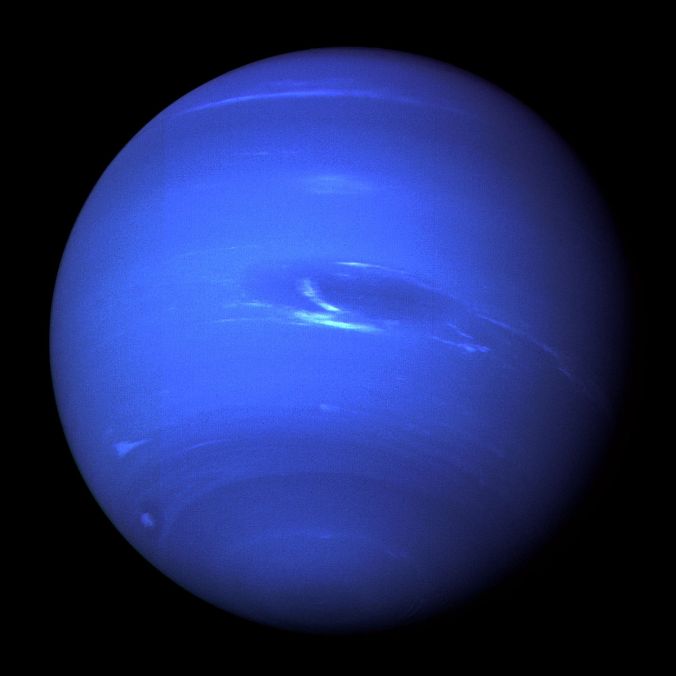
During opposition Neptune will be at a distance of 28.94 AU with a disk size of 2.4 arcsec. In a good telescope of 6 inches or more you should be able to see a tiny blue disk and perhaps its companion Triton.
Neptune was first observed in a telescope in 1846. It’s existence was implied from solar system models rather than from direct observation. Like Saturn and Jupiter, it’s a gas giant with an atmosphere largely composed of hydrogen and helium, but this far out it also contains some “ices” such as water, ammonia, and methane.
Neptune also has some of the weirdest and wildest weather in the solar system, with recorded wind speeds as high as 2,100 kilometres per hour! This is what drives some of the mesmerising cloud streaking witnessed during Voyager 2’s flyby. It’s also an extremely cold place – its cloud tops have recorded temperatures as low as -220 C. Not surprising given how far it is from the sun.
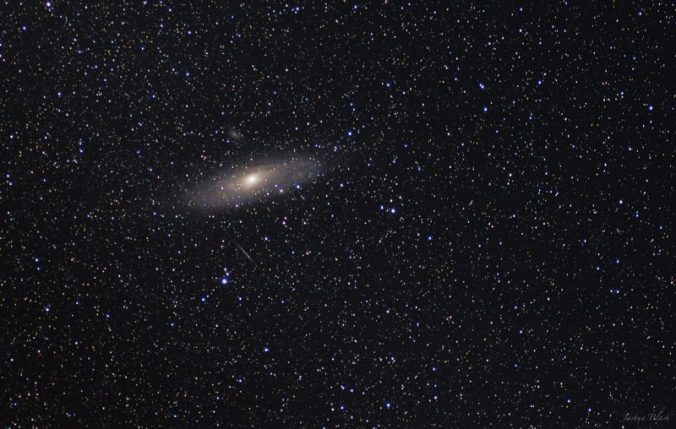
Why not try looking at another galaxy? M31, our nearest companion galaxy, is well placed in northern skies, sitting in the East between the W shape of Cassiopeia and the great square of Pegasus.
Under dark skies and away from significant street lighting, you might just be able to see an oval smudge unaided, but pull up a good pair of binoculars and you’ll see much more. A definite central core and perhaps suggestions of surrounding gas and dust lanes.
Although fuzzy and indistinct the appeal of viewing an object like this is the sheer enormity of the distances and time involved. Andromeda is over 2.5 million light years away, and home to billions and billions of stars and companion worlds.
To find it follow the chart below. From the star Mirak in the constellation Andromeda, simply follow a line upwards in the direction of Cassiopeia. As you sweep this area of the sky in binoculars a bright fuzzy patch should glide into view – that’s M31.
Spotting it for the first time can be tricky, so don’t get too frustrated. It might take you a few attempts over several nights.
We’re finally emerging into some periods of significant darkness in the north of Scotland. Tonight marks approximately 1.5 hours of true astronomical darkness at latitudes 57 degrees north.
Astronomical darkness is defined as the sun being more than 18 degrees below the horizon, which it will tonight between 12.30am and 2.13am. Notwithstanding the waning crescent moon rising after midnight, conditions should be pretty good for general observing. Local weather reports indicate clear skies from about 7pm too.
Star profile: Vega (Arabic for “the swooping Eagle”)
Vega sits above the little diamond of starts in Lyra
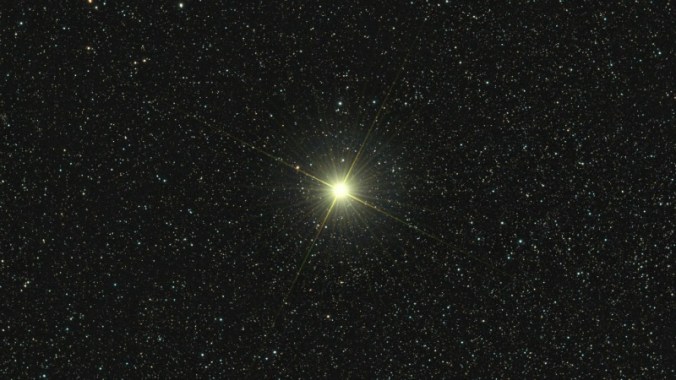
After midnight look south west and directly up, almost towards the zenith. The bright blue-white gem you might see shining above will be Vega – the 5th brightest star in northern skies. Vega sits above a lovely little diamond shaped constellation comprised of four moderately bright stars (within the constellation Lyra).
Vega has been studied comprehensively by astronomers and has some unusual properties. One is its incredibly rapid rotation which causes its mid drifts to bulge out fantastically, yielding very large equitorial radius measurements. If Vega rotated only another 7% faster its would rip itself apart due to incredible centrifugal forces.
Vega is also big and young as far as stars go – with a mass of 2.3 Suns and 37 times more bright. Because of its size and energy Vega won’t survive as long as our Sun and will remain in a stable state for only a fraction as long as our home star (perhaps 500 million years).
The rule of the Cosmos as far as stars are concerned appears to be “burn bright and die young…”
This weekend is peak activity for the annual Perseid Meteor Shower. Below is a quick guide for successful viewing under northern skies.
Guidelines for Viewing
You don’t need any special observing equipment, just your eyes and a good clear horizon away from as much street lighting as possible.
It’s much more enjoyable viewing meteor showers in a relaxed state, so why not get an old deck chair or picnic rug to lie down on? Meanwhile avoid any hand torches or mobile phone use as it’ll destroy your dark adaption.
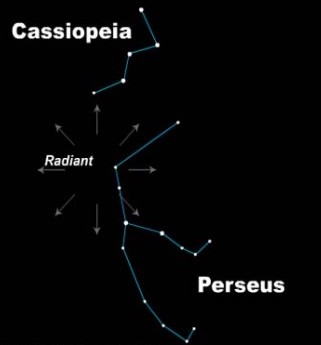
After 11.30pm on Friday, Saturday or Sunday, look North East. The constellation Perseus will be about 30 degrees above the horizon, below the distinctive W shape of Cassiopeia.
This is the area of sky from which the meteor activity will originate. At peak (probably after midnight) up to 100 shooting stars per hour could be seen, although its worth pointing out that a waning gibbous moon will begin rising in the east around the same time, which could blot out some activity.
These shooting stars are remnants from the comet Swift-Turtle which last hurtled around our sun back in 1992, but left a trail dust and ice particles which impact our atmosphere at a whopping speed of 135,000 mph.
Capella
While you wait for meteors why not contemplate the very bright star ‘Capella’, sitting just left and below Perseus. Capella appears to be one star but is actually a binary system – composed of two giant stars orbiting each other at about 70% the distance of our Earth from the Sun (you’d need a very powerful telescope to see both). These giant stars have exhausted their hydrogen stores, and cooled and swollen, moving off the main sequence towards red giant oblivion.
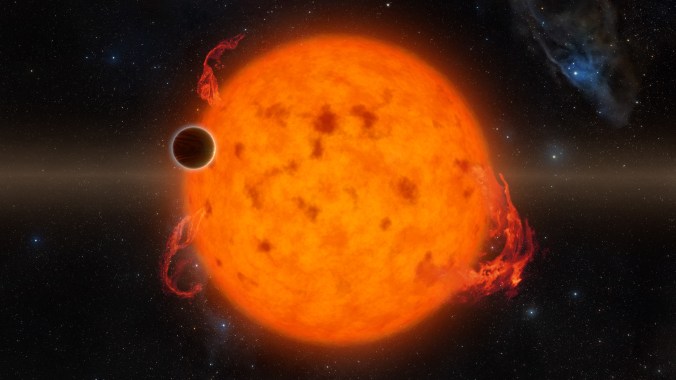
Artists impression of a giant exoplanet occulting part of its parent star.
Recent advances in telescope and sensor technology have finally allowed us to start answering one of the great unknowns of the 21st century – how many habitable worlds are there in our Milky Way galaxy?
Until recently it was simply assumed that a fairly high fraction of stars ‘probably’ contained planets, and that some further fraction of those would be in the so-called habitable zone. These assumptions were based from simple extrapolation from our own solar system (along with some inconclusive inferential data gathered in the 1990s). But as has been painfuly demonstrated with the hunt for life in our solar system, assumptions like this need careful confirmation, and extrapolating from a sample size of one is seldom convincing. Often, what we want to believe is, regrettably, not compatible with reality. The video link from the late Carl Sagan at the end of the piece will give you a flavour for what people ‘guessed’ in the 1980s.
The good news is we now have concrete evidence that an abundance of other planets are out there orbiting other suns – in fact roughly 70% of all stars are accompanied by other worlds. How do we know this? There are two simple detection methods which I’d like to explain in more detail, which both ‘indirectly’ detect the presence of other planets. These are:
Transit Photometry
Radial velocity
Transit Photometry
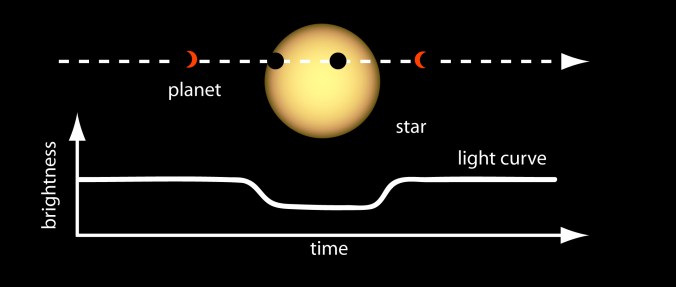
The first method involves closely observing a star over a period of time with a photometer, looking for any subtle changes in its brightness. Any dip in brightness which is periodic and cannot be explained by general stellar dynamics is then assumed to be a large body passing between us and the star.
Incredibly, even amateurs with 12 inch backyard telescopes have been able to detect these illumination changes for very large planets, producing crude light curve plots that have later been verified by professional astronomers.
As the exoplanet passes in front of the host star the number of photons reaching the objective lens of the telescope drops in a characteristic way.
This method of detection works out to distances of several thousand light years, and allows an approximate calculation of the planet’s size, or radius. Additionally, for certain nearby stars (if clear spectra can be obtained), drops in light from specific elements can be detected, telling us about the possible composition of the planet’s atmosphere. For example, if the planet contained a Nitrogen rich atmosphere, we might detect a dip in the intensity of the spectrum corresponding to the wavelength of Nitrogen – this process is called ‘absorption spectrometry’.
The main disadvantage of the transit method is that it relies on a nearly perfect edge-on view of the planet-sun ecliptic from our earth bound position. Otherwise we simply would not detect any occultation. Thankfully, we can calculate roughly how often this orientation occurs and account for it statistically. There’s no shortage of candidate stars out there with systems well aligned for detection.
Radial Velocity
The second method is similar, but instead focuses on the relative motion of the star. Despite the huge difference in mass between a star and its satellites, as a planet orbits it will impart enough of a gravitational tug to make the star rotate about a small local axis – tiny but detectable. The larger the planet the bigger this wobble will be.
An exaggerated illustration of how a large star will rotate about a local axis due to the gravitational influence of a planet.
To detect this regular movement we can look at the light emanating from the star over time and try and detect if its spectra is being shifted by tiny amounts. By the doppler effect, if the wavelengths of the star’s spectra appear shifted towards the red it must be moving away from us, and the opposite if the spectra is shifted towards the blue. In this way the sun’s speed and local orbital radius can be calculated, and from that a determination made of the mass of the orbiting planet.
As a quick example, the Sun moves by about 13 m/s due to the influence of Jupiter, but only about 12 cm/s due to Earth. Incredibly, velocity variations down to 1 m/s or even less can be detected with modern spectrometers, such as the HARPS. The major limitation of this method is distance. At the moment it’s generally only useful for star systems up to 200 light years away.
Bringing both methods together, however, lets us form a picture of an exoplanet’s size and mass, and therefore it’s overall density. From that, inferences can even be made about the internal structure of the planet. All this information without even observing the planet!
The Complete Picture
So what do these methods tell us, so far, about the likely number of habitable or earth like planets in our Milky Way galaxy? The answer is absolutely staggering.
Based on Kepler mission data, as many as 40 billion earth like planets in the habitable zone could be orbiting around red dwarf and sun-like stars. Taking away the red dwarfs leaves an upper calculation of 11 billion around Sun like stars. Just think about those numbers for a moment.
That’s as many as one earth-like planet in the habitable zone for every 10 stars in our local galaxy! A stupendously high number of candidate worlds from which life may have originated.
But here again, we must be cautious. 11 billion is 11×10^9. But what if the probability of life forming on rocky planets within the habitable zone was actually as low as low as 11 x 10^-9, or even 11 x 10^-99? Then there might only be one or no candidate planets containing life. A depressing possibility, but one we should never allow our natural bias to discount. The lesson here is that any large number can quickly be diminished in stature by an equally small probability.
At the moment we simply don’t know what this probability of emergent life is. Some biologists are more optimistic and consider it relatively high for simple single cell life, but other figures, for more complex multi cellular organisms, are much more pessimistic. But when we do know this figure, calculating the number of planets on which life has arisen will be comparatively simple, and Frank Drake’s famous equation for estimating the number of ‘technical civilisations’ will be one step closer to a final solution.
How did we view the question of ‘other planets’ in the context of life outside Earth in the 1980s. Watch the late Carl Sagan to find out.
Globular clusters are some of the best deep space objects to view with a video telescope setup. These tightly bound swarms of stars orbit our Milky Way at a distance of 100,000 lights years or more and contain many more older stars than open clusters. The density near the core of these stellar globules is very pronounced indeed, such that any inhabitants of a planet deep inside one would see a night sky peppered with incredibly bright stellar neighbours. This artist impression from William Harris and Jeremy Webb illustrates the point beautifully.
What the sky might look like inside globular cluster ’47 Tucana’ where nearly 600 thousand stars jostle within a volume of space only 120 light years across.
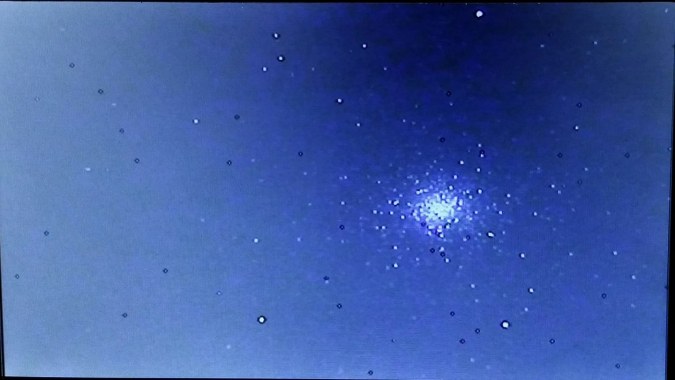
I planned to video the famous M3 globular tonight after seeing its relative high altitude and fortuitous position in SkySafari, and noting with some relief how clear and enticing the moonless sky looked.
After very little effort, and with a short 3 second integration time, I was able to watch this spectacular sight slowly materialise in the video monitor
M3 contains over 500 thousand suns at a distance of 34 thousand light years from earth.
This image is incredibly bright and vibrant compared to naked eye views of M3 and is only slightly marred by a few visual artefacts due to the sensor technology. The bloated white dots at the widest periphery of the image are not stars but hot spots due to the video chip heating up during long exposures. Despite this I’m sure you’ll agree the view is a triumph of video observing, readily revealing the awesome density and structure of the cluster.
There are over 150 of these satellite clusters orbiting our Milky Way galaxy and their formation is the topic of excited debate. The fact they harbour such a high proportion of older stars suggests they were some of the first stars to evolve within the overall galactic neighbourhood.
As far as the question of technological life existing within these systems, the chaos from closely interacting stars (on average only 1 light year apart) might prove an unfavourable environment. Stars and planets in such a system would be under constant perturbation from nearby neighbours imparting gravitation ‘tugs’, resulting in unstable planetary orbits.




 | Modulo | Universe