Merkinch Astronomy Evening

I was delighted to be approached by Caroline Snow, who manages the local Merkinch Nature Reserve, to host an astronomy evening in March.  Our mutual friend Russel Deacon introduced us via Facebook and after some informal chat we agreed enough of an initial proposal for Caroline to begin promoting the event on social media and some local papers.

From a dark sky perspective the area isn’t perfect as there’s a fair bit of light pollution facing south and east back towards Inverness.  But it’s a beautiful location overall with lovely clear views north and west and perfectly acceptable dark skies in those directions.  It was also a good compromise between darkness and accessibility for the people we hoped to attract from the local area and beyond.

We initially planned the tour for Friday 24th of March but the weather was a bit patchy and looking better the following day.  So after some further discussion Caroline and I decided to go for for the clearest night possible, and delayed the event until Saturday.

The next day was sunny and clear as forecast and when twilight fell I headed over to the reserve to setup an hour or so early.  This was the lovely scene as the sun set over the observing site.

sunset

Sunset at Merkinch Nature Reserve looking North West.

My first challenge arose when unloading the telescope beside the picnic benches at our chosen spot. I realised I had some company next to me in the form of a few local teenagers who were blaring out Johnny Cash and Elvis from a brightly flashing ghetto blaster!  I approached them to say hello and explain what I was doing here, and in return was offered a swig from a Buckfast bottle!  After declining and explaining I had my van with me, one of the party lurched towards me and gave me a giant bear hug, which was a lovely welcoming gesture but threatened to unbalance me and the large bag of astronomical equipment I was carrying!  Dusting myself down, I thanked them and invited them to join the tour when it got underway.  I then continued with my astronomical setup, calmed by the soothing melodies of ‘Love Me Tender’ drifting through the darkness.
elvis_presley_stars_background_wallpaper_-_1280x960

Elvis performing in front of a large comet.

The plan for the evening was a naked eye and binocular constellation tour, focusing on some interesting targets I’d prepared to discuss in advance.  The telescope would serve to give more detailed views of a few select objects we’d be looking at.  At this stage I was only expecting perhaps a dozen people to turn up but I severely underestimated Caroline’s promotional skills; over the course of the evening about 30-40 people appeared.  This was obviously fantastic but meant individual telescope time was going to be limited.

As the tour started the next challenge arose.  Both laser pointers we’d taken down with us failed, producing a pitiful beam only I could see.  An audience member came to the rescue and offered me his laser pointer, but incredibly that failed too!  The result was that only a few of the more experienced stargazers really knew what I was pointing at.  The only real way out of this pinch was to use the telescope to track to each object in turn and invite people over to the eyepiece.  This let everyone know the rough direction I was pointing at and afforded them a great view of each target.  Phew!

Eventually the pens warmed up and the party really kicked off when people started asking questions – really interesting ones.  What were supernova?  How large is the universe?  Why are stars different colours?  Where does the plane of the milky way sit?  The list was impressive and resulted to some great crowd chat and one to one conversations.  Some of the best questions came from the younger members of the audience, some of whom were so small they had to be lifted up to the eyepiece to see through the telescope (note to self:  bring a step next time).

In rough order our stellar tour took us through the following:

  • The Plough (Mizar/Alcor double, Alkaid) 
  • Plaeides cluster 
  • Aldebaran (the follower)
  • Hyades cluster
  • Orion (Rigel, Betelgeuse and the great Orion nebulae)
  • Double Cluster in Perseus
  • Beehive Cluster
  • Auriga (M37 and Capella)
  • M3 Globular
Simon Garrod

Simon Garrod took this nice image of Orion from our observing position at the Merkinch Nature Reserve.

Highlights?  The Orion nebulae and the M3 globular cluster were real crowd pleasers in the scope.  M3 looked great in the eyepiece despite being in the light polluted eastern sky, its densely speckled core in clear evidence.
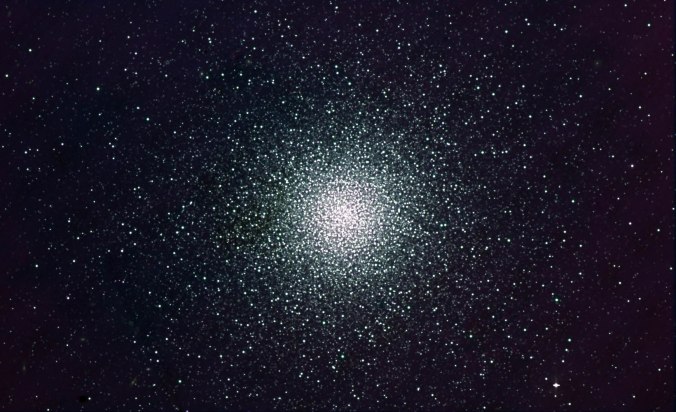
m3.jpg

The M3 globular cluster is a fantastic target even with moderate light pollution.

After an hour or so people began to filter off home but the stragglers were rewarded with Jupiter just beginning to rise in the East.  Despite a view impinged by a tree the telescope did a great job of bringing Jupiter and its moons in for some closeup action.  There was general gratitude and thanks all round, leaving Caroline and myself thoroughly rewarded by a successful night.

If you’d like more information on the Merkinch Nature Reserve and all the events Caroline’s coordinating visit their Facebook page at Friends of Merkinch Local Nature Reserve and look out for another astronomy evening later this year.

Galaxy NGC 2903

Why this galaxy on this particular night?  Simply because it was a relatively bright object that was high in the sky within Leo and facing south, the direction of least obstruction from my local observing position.  One of the best tips I learned about observing deep sky objects, in particular galaxies, is to never underestimate the benefits of superior elevation.

Setting up my video telescope at its maximum integration time of 10 seconds, I wasn’t holding too much hope of anything spectacular appearing from these semi light polluted skies.  I was thankfully mistaken.

NGC2903

Despite its staggering distance of nearly 30 million light years, the video screen began resolving a beautifully presented barred spiral galaxy with easily discernible spiral pathways, surrounding a very bright core.  I’m always in awe when viewing distant galaxies like this in real time.  The main idea that captures my imagination is the understanding of what makes up those dim dust lanes – billions of suns!

NGC 2903 is only slightly smaller than our own Milky Way at over 80,000 light years across and is very similar in structure to our own island universe.  Its central bar is a common feature in spiral galaxies found in around two thirds of them.  The formation of these bar structures is still poorly understood.  The most popular hypothesis is due to a density wave propagating from the galactic core, reshaping surrounding dust into a long column.  In general these structures indicate relative maturity for a galaxy – younger galactic siblings don’t have them.

Moon Halo

Moon Halo

This was the sight that greeted people looking skyward last night, captured by Nynke Jansen.

This photograph from Nynke Jansen captures the mesmerising spectacle many people in the north of Scotland witnessed when they looked moon ward on March 9th – a bright halo of white light encircling the full moon.

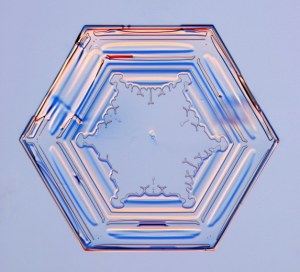
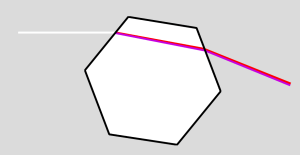
The explanation for these ‘moon halos’ is simple refraction of light through tiny hexagonal shaped ice crystals suspended in high altitide cirrus clouds.  These halos are usually observed extending a 22 degree circle from the moon, because this corresponds to the minimum angle of refraction produced when light enters and leaves a hexagon shaped piece of glass (or ice).  The full range of refraction is between 22 and 50 degrees.

ice

An ice crystal with its beautiful six fold symmetry.  An uncountable number of these drift within high altitude clouds.

Under certain conditions ice crystals will collectively orientate themselves in the atmosphere such that moonlight refracts through them coherently – hence the intense corona like circle of light beginning at 22 degrees from source (the moon).   And because different wavelengths of light are refracted by slightly different amounts, a subtle rainbow effect is also seen.  The 22 degree minimum angle also results in a queer darkening of the sky between the moon and the halo itself as no refracted light gets scattered into this void region.  This phenomena needs to be witnessed with the naked eye, as photographs tend to over saturate the image with white light (as above).  The overall impression is that of a dark portal suspended in the sky, with the moon at centre!

hexagon

When light enters a medium of higher density it bends towards the surface normal, then away from the normal when exiting.

In general crystals of ice in the atmosphere would be randomly orientated, leading to no such phenomena.  The mechanism leading to the crystals orientating themselves along the same plane isn’t fully understood, but supposedly conditions exist for this to happen dozens of times a year.  Either way, it’s a phenomena I’ll be keenly looking out for in the future.

The Mathematics of Refraction

SinØi / SinØr = n

This simple equation from high school physics determines the angle of refraction Ør, after a ray of light enters a more dense medium at an angle Øi to the surface normal. n is the refractive index of the material, and will vary slightly depending on the frequency of the incident light.  The refractive index of ice is 1.309, slightly lower than that of liquid water at 1.333.

The Whirlpool Galaxy (M51)

They say good things come to those who wait.  Never  was this more exemplified than this evening after several hours in bitterly cold conditions on Culloden moor with my video telescope.  The cold made setup and targeting much more fraught than usual, and the small gas stove I’d balanced pecariously beside the monitor did little to help.

However, near the end of my session I hit the jackpot when this stunning image of the Whirlpool galaxy, over 23 million light years away,  materialised from the video screen.

Whirlpool galaxy

This image is a true testament to the power of video astronomy and the huge increase in aperture it lends to amature telescopes.  Dust lanes and connective spiral arms are clearly in evidence here.  The best naked eye views of the Whirlpool I’ve seen have only really resolved the two central cores of the interacting galaxies.  You generally need a scope of 16 inches or more to reveal dust tendrils in this much detail.

This is how the Earl of Rosse sketched the galaxy back in 1845 with his monstrous 72 inch dobsonian from the grounds of Birr Castle in Ireland.

M51Sketch

Of course back then these structures were given the loose classification of ‘nebulae’ and were assumed part of our local galaxy.  It wasn’t until the 1920s when Edwin Hubble observed cepheid variable stars within each bright core of the Whirlpool that this image was understood to be two distinct but interacting galaxies, the larger of which has been estimated to be 35% the size of our own Milky Way galaxy.

M51 is still a hot target for professional astronomers, not least because of the black hole that exists within the heart of the larger galaxy.  This central region is undergoing rapid stellar changes and star formation.

Venus

Venus has been a constant jewel in the evening sky recently, popping into view during twilight in the south west and burning with an astonishing intensity in the western skies after darkness.

I’ve been taking my telescope out a few evenings in a row to view the planet from kerb side and marvelled at how well resolved it is at high power.  It’s a half crescent right now, revealing a lovely hazy terminator where Venusian day meets night.  Eager to record its majesty,  I trained my video setup on it this evening, using leg stabilisers and a barrow to maximise the surface area per pixel captured on my Samsung’s CCD chip.  Here’s what I captured.

The visual scale of Venus is impressive here compared to general viewing with eyepiece observation.  This is one of the advantages of having a smaller CCD sensor.  Whilst more limited for large deep sky objects (without focal reduction) it permits big and bold presentations of the planets with just a modest x2 barlow lens.

Notice the pronounced atmospheric haze and refraction of light at the terminator between day and night.  Venus has a thick cloud covered atmosphere which is highly reflective – giving the planet its bright white appearance.  There’s also the slightest hint of mottling or streaking on the surface.  These fine streaks are large cloud structures that ebb and flow slowly within the Venusian atmosphere.

Not so long ago Venus was the target for many pulpy science fiction stories.  These authors imagined the planet full of swamps with dinosaurs and primitive tribes battling across vast continents.  These fantasies were shot down after robotic probe and satellite recognisance of the planet was undertaken, first by the Soviets and later NASA.

Our current understanding of Venus is that it’s a planetary embodiment of hell.  An atmosphere of nearly 96% carbon dioxide traps heat from the sun, raising the pressure to 92 times that of earth, with surface temperatures approaching those inside the finest Italian pizza ovens.  This pizza analogy would apply to any human making it all the way down to the surface of Venus!

The Mathematics of Gods

As well as providing the bedstone for modern physics and the sciences, mathematics has often strayed into the metaphysical.  It’s therefore no coincidence that many theologians and mystics were often competent mathematicians.

One such theologian and philosopher was Anselm of Canterbury (1033–1109) who proposed a so-called ontological argument in the second and third chapters of his famous Proslogion.  In essence the argument attempts to use the language of Greek axiomatic logic to prove the existence of god.

St. Anselm in carbonite on the exterior of Canterbury Cathedral.

St. Anselm, entombed in carbonite, on the exterior of Canterbury Cathedral.

“For I do not seek to understand in order that I may believe, but I believe in order to understand!  For this also I believe – ‘that unless I believe I shall not understand’.”  – St Anselm of Canterbury circa 1077

Anselm’s Ontological Argument

Here is Anselm’s argument step by step:

1.  Let ‘God’ be a being about which nothing greater can be conceived or imagined.

2.  ‘God’ exists as an idea in the human mind.

3.  A being that exists as an idea in the mind and in reality is clearly greater than a being that exists only as an idea in the mind.

4.  Thus, if God exists only as an idea in the mind, we can imagine something greater than God.

5.  But we cannot imagine something that is greater than God (a contradiction of statement 1).

6.  Therefore, ‘God’ exists.

Whilst this argument cannot be judged as serious mathematics it does offer an interesting insight into the historical interplay between religion, philosophy and mathematics.  Much of the modern fundamentals of mathematics use analogous axiomatic-theoretic language to build desired rigour.  It also has an undeniable elegance – it attempts to prove existence using only the definition of God as a basis.

Godel and God

Surprisingly Anselm’s original ontological argument has been developed into modern times, most famously by the Austrian meta-mathematician Kurt Godel.

Kurt Godel

Kurt Godel was part of a depressing list of mathematicians whose life ended in tragedy – in Godels case he starved himself to death.

This work came to light only after Godel’s death in 1978.  Famous for his incompleteness theorem, Godel was a tangential thinker who liked to stress-test logical and axiomatic structures and explore where they could lead – sometimes rigour and clarity yes, but also outright insanity.

Essentially Godel took Anselm’s original argument and set about adding mathematical rigour using the formal framework of modal logic.  Achieving this involved building definitions and axioms over and above the more simplistic construction of Anselm.  At the root of this construction was the idea of something being true on a finite number of infinite worlds (weak truth), or on all possible world (strong truth).

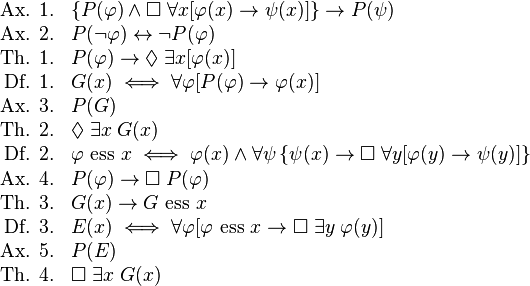
The full proof is very long so I’ll record only a flavour of it here using some of the definitions, axioms and Theorems Godel constructed.

  • Definition 1: x is God-like if and only if x has as essential properties those and only those properties which are positive
  • Definition 2: A is an essence of x if and only if for every property B, x has B necessarily if and only if A entails B
  • Definition 3: x necessarily exists if and only if every essence of x is necessarily exemplified
  • Definition 4: if x is an object in some world, then the property P is said to be an essence of x if P(x) is true in that world and if P entails all other properties that x has in that world.
  • Axiom 1: Any property entailed by—i.e., strictly implied by—a positive property is positive
  • Axiom 2: A property is positive if and only if its negation is not positive
  • Axiom 3: The property of being God-like is positive
  • Axiom 4: If a property is positive, then it is necessarily positive
  • Axiom 5: Necessary existence is a positive property
  • Theorem 1: If a property is positive, then it is consistent, i.e., possibly exemplified.
  • Theorem 2: The property of being God-like is consistent.
  • Theorem 3: If something is God-like, then the property of being God-like is an essence of that thing.
  • Theorem 4: Necessarily, the property of being God-like is exemplified.

And using formal modal logic notation:

Godel's modal logic proof

It’s important to note that this work did not imply Godel believed in God.  In fact his scepticism was likely the reason this work was kept under wraps for most of his life.  His friend Oskar Morgenstern stated that Godel didn’t disclose out of fear others might think “that he actually believes in God, whereas he is only engaged in a logical investigation – that is, in showing that such a proof with classical assumptions correspondingly axiomatized, is possible.”.

It’s interesting that Godel’s proof only considered existence – he didn’t extend the work into that equally important ream of mathematical fundamentals – uniqueness.  Which leaves open the possibility of a universe overcrowded with powerful deities!

“The more I think about language, the more it amazes me that people ever understand each other at all.” – Kurt Godel

Hyperspace and La Grande Hypercube

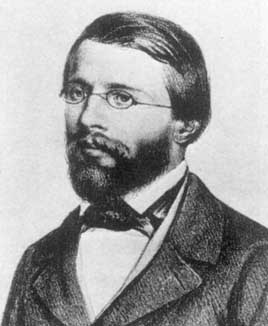
Hyperspace.  What does it mean?  Science fiction has largely hijacked the word but its real foundations are embedded in the mathematics of higher or n-dimensional space pioneered by Bernhard Riemann in the late 19th century.  Riemann lay the foundations for extra dimensional spaces and so-called non-euclidean geometries that were self consistent and logical.  His Riemann tensor generalised geometry to curved surfaces, breaking free from over two millennia of Euclid’s dominance over the subject.  In this new geometry of the curved surface, parallel lines can intersect and the angles of a triangle do not necessarily add to 180 degrees.

Bernhard Riemann broke past the established doctrine of 'flat' Euclidean geometry.

Bernhard Riemann broke past the established doctrine of ‘flat’ Euclidean geometry.

‘Therefore, either the reality on which our space is based must form a discrete manifold or else the reason for the metric relationships must be sought for, externally, in the binding forces acting on it’ – Bernhard Riemann

Riemann’s curvature tensor was part of a developmental framework encapsulating the idea that forces could be considered as alterations in the fabric or ‘geometry’ of space rather than an instantaneous phenomena acting at a distance.  The reason a three dimensional creature felt the effects of a force could then be explained by a warpage in the fabric of the four dimensional geometry it moved through.  The analogy of a 2D ant residing on an undulating 3D surface is a good way to understand this thought process.  As the ant moves around it cannot see the curvature of the larger 3D space it inhabits yet it feels the effects as a force as it moves across the world.

Hyperspace in Science Fiction

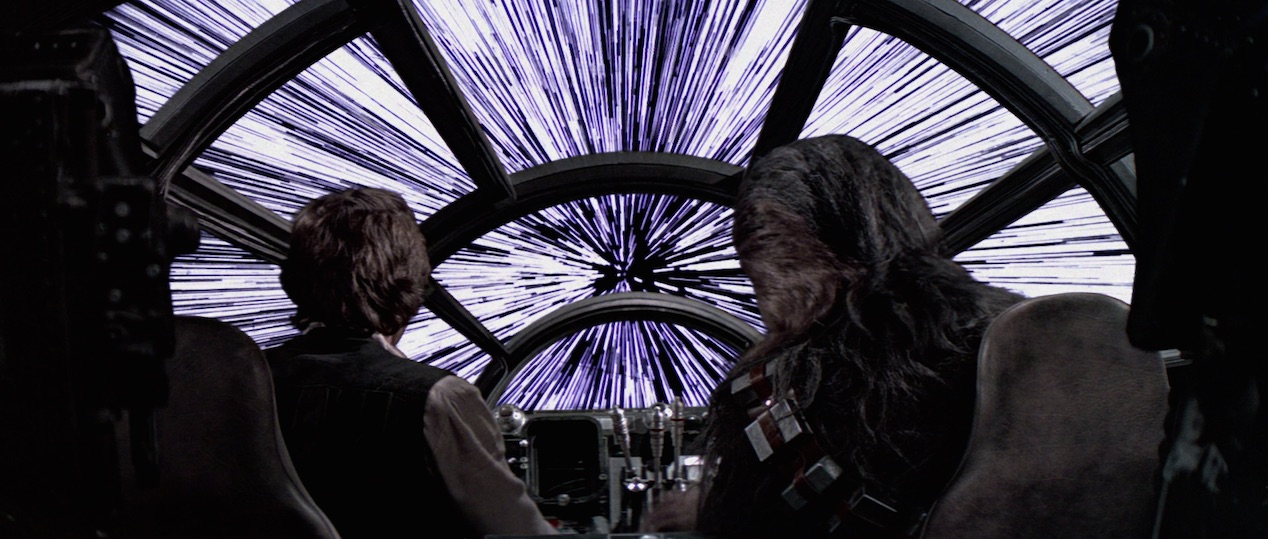
Han-Solo and Chewbacca are seasoned hyperspace users in the film Star Wars.

Han-Solo and Chewbacca are seasoned hyperspace users in the film Star Wars.

‘Traveling through hyperspace ain’t like dusting crops, boy!’ – Han Solo

Hyperspace has been popularised in science fiction since the late 1920s and early 1930s, coincident with Albert Einstein’s special and general theories of relativity which became widely accepted around this time, and involved the idea of time as an additional dimension.  By directly applying the Riemann tensor to his work on universal gravity Einstein was able to powerfully simplify his approach and construct his general theory of relativity.  It was this application of the multi-dimensional to our understanding of gravity, light and space-time that propelled hyperspace into fiction and art. In a science fiction context the word represents a vague notion of transcending into higher dimensions to facilitate quick interstellar travel (Star Wars), or in the case of Howard Phillips Lovecraft’s ‘Dreams in the Witch House’, a gateway into a shadow realm of cosmic horrors.  It also spawned the notion of the worm hole – a higher dimensional bridge permitting a traveler to move between normally disconnected and independent spaces (or possibly times).

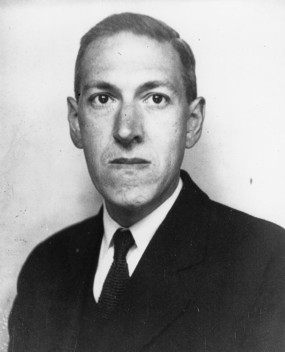
Lovecraft used concepts from hyperspace and non-euclidean geometry in his cosmic horror tale 'Dreams in The Witch House'.

Lovecraft used concepts from hyperspace and non-euclidean geometry in his cosmic horror tale ‘Dreams in The Witch House’.

‘One afternoon there was a discussion of possible freakish curvatures in space, and of theoretical points of approach or even contact between our part of the cosmos and various other regions as distant as the farthest stars or the transgalactic gulfs themselves – or even as fabulously remote as the tentatively conceivable cosmic units beyond the whole Einsteinian space-time continuum.’ – The Dreams in the Witch House by H P Lovecraft.

So how far away is the real mathematics of hyperspace from this popularised notion?  And can mathematics let us glimpse into these mysterious spaces?

Mathematical Hyperspace – a journey into the 4th Dimension

Mathematics can represent higher dimensions with relative ease and in doing so can often reduce formerly complex problems to more elegant and simpler forms. But what can mathematics reveal to us visually or conceptually about higher dimensions?   It’s a vast topic but let’s try exploring one geometrical dimension up – the fourth dimension – by constructing one of the simplest 4D objects to conceptualise, the hypercube.  Follow me on an imaginative journey into the fourth dimension!

Journey into the fourth dimension

  • To kickstart our journey into hyperspace lets begin by imagining a single point in space – a singularity.  A singularity has no dimensions so resides in zero dimensional space – the sort of place the universe may have originated from or a black hole will take you.
  • Now take this point and draw an imaginary straight line from it to a second point.  We’re now in 1D space and have 2 points with a line segment connecting them.
  • Now take each point of our line and drag it up or down to make a square with 4 points.  Here we are in two dimensional space.  How many line segments do we have now?
  • Next  grab  those four points and pull them up or down at a right angle to make a cube.   We’re now in familiar 3-dimensional space with 8 points and 12 connecting line segments.

Now for an imaginative leap into hyperspace.  Let’s pull those 8 points out of our reality and into the fourth dimension!  What do you see?  Or let’s put it another way – what should we expect to see? Although we can’t directly visualise it we can infer some of the properties of this four dimensional cube from mathematical extrapolation.  For starters it should have 16 points. How about edges?  Well each point will connect to 4 edges so that’s 4 x 16.  But each vertex will share all its edges with another vertex so we half this value.  Therefore it must have 4 x 16 /2 = 32 edges.

Dimension Descriptor Points Edges
0 Singularity 1 0
1 Line 2 1
2 Square 4 4
3 Cube 8 12
4 Hypercube 16 32

This 4D analogue of a cube is also known as a Tesseract.  Now that we’ve inferred some of its properties can we say anything about what it might look like?  Well in the same way that a sphere only reveals a shadow of itself on a flat plane, we can only visualise a 4D hypercube from its shadow projected into our 3D world.  As it happens such a shadowy denizen from another dimension actually exists on earth.

La Grande Arche a la Hypercube

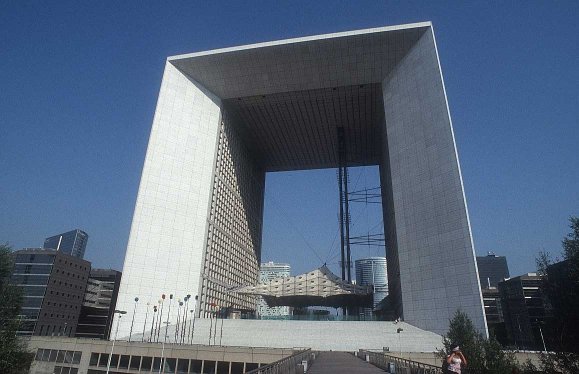
Most Parisians walking in La Defense are probably oblivious to the fact that there’s a manifestation of the fourth dimension nearby. La Grande Arche was designed by Danish architect Johann Otto von Spreckelsen.  It’s a mystery whether or not this grand design was ever consciously inspired by mathematics but it’s nonetheless a beautiful and radical piece of architecture.

A real earth based projection of a four dimensional cube - The famous Paris arch

A real earth based projection of a four dimensional cube – The famous Paris arch

Despite being only a shadow of a 4D cube this structure contains most of the defining properties of a 4D cube – crucially it has 16 points connecting 32 edges.  One of the properties it lacks is uniformity of distance along its edges.  In the same way a square in two dimensions has equal sides, a real hypercube in 4D space would have all its connecting edges exactly the same length.  But this projection clearly doesn’t (note the lengths of the inner edges are shorter than the outer edges).  That’s because any projection from a higher to a lower dimension doesn’t necessarily preserve the distance between points, or indeed the angles between edges and faces.  Looking at the shadow of a cube on a piece of paper is a good example of this; no orientation can preserve the three dimensional distances between points.  In other words information is lost whenever we try to represent a higher dimensional object in a lower dimensional setting.

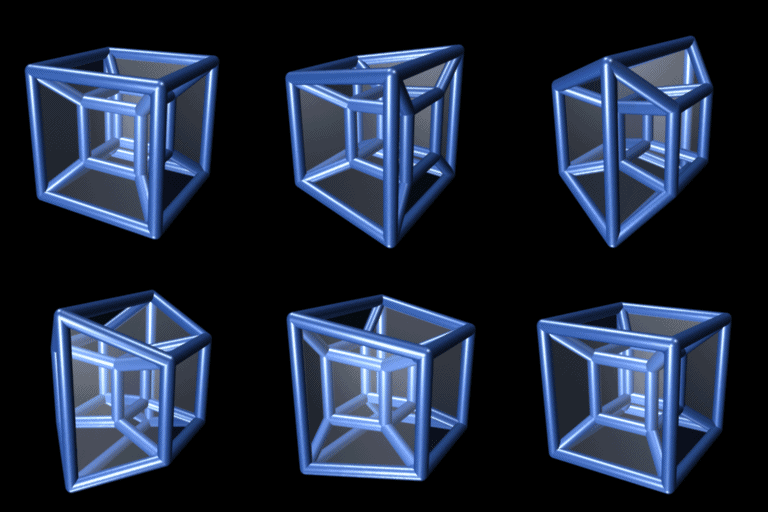
Projection of a hypercube  rotation about a single plane bisecting its middle.

Projection of a hypercube rotating about a single plane bisecting its center.

Mathematics can even rotate the hypercube and we can observe the weird and impossible dance made by its three dimensional shadow (above).  The object is seen to move through itself in a way that defies the rational behavior of solids in our 3D world.  The same effect can be seen by rotating a 3D cube in front of a lamp and watching the behavior of its two dimensional projection.  You would really see these  sort of visual oddities if four dimensional objects or beings entered our 3D world.

n-cubes

Of course mathematically cubes don’t stop in 4 dimensions. You can move into five, six or even more dimensions and build n-cubes in all these worlds. For example, a hypercube in n dimensions will have  2^n vertices. From each of these vertices there will be n edges emerging, each of which are counted twice, so the N-dimensional cube has n.2^{n-1} edges.  I’ll leave the task of imagining such n-cubes to the reader!

Dimension Descriptor Points Edges
n n-cube  2^n  n.2^{n-1}