This weekend is peak activity for the annual Perseid Meteor Shower. Below is a quick guide for successful viewing under northern skies.
Guidelines for Viewing
You don’t need any special observing equipment, just your eyes and a good clear horizon away from as much street lighting as possible.
It’s much more enjoyable viewing meteor showers in a relaxed state, so why not get an old deck chair or picnic rug to lie down on? Meanwhile avoid any hand torches or mobile phone use as it’ll destroy your dark adaption.
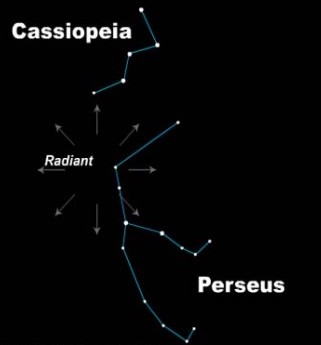
After 11.30pm on Friday, Saturday or Sunday, look North East. The constellation Perseus will be about 30 degrees above the horizon, below the distinctive W shape of Cassiopeia.
This is the area of sky from which the meteor activity will originate. At peak (probably after midnight) up to 100 shooting stars per hour could be seen, although its worth pointing out that a waning gibbous moon will begin rising in the east around the same time, which could blot out some activity.
These shooting stars are remnants from the comet Swift-Turtle which last hurtled around our sun back in 1992, but left a trail dust and ice particles which impact our atmosphere at a whopping speed of 135,000 mph.
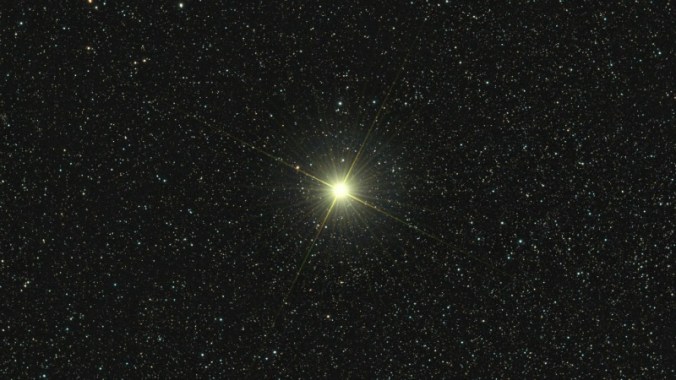
Capella
While you wait for meteors why not contemplate the very bright star ‘Capella’, sitting just left and below Perseus. Capella appears to be one star but is actually a binary system – composed of two giant stars orbiting each other at about 70% the distance of our Earth from the Sun (you’d need a very powerful telescope to see both). These giant stars have exhausted their hydrogen stores, and cooled and swollen, moving off the main sequence towards red giant oblivion.
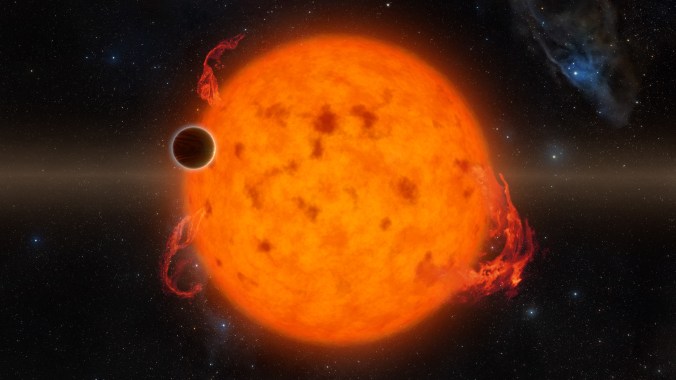
Artists impression of a giant exoplanet occulting part of its parent star.
Recent advances in telescope and sensor technology have finally allowed us to start answering one of the great unknowns of the 21st century – how many habitable worlds are there in our Milky Way galaxy?
Until recently it was simply assumed that a fairly high fraction of stars ‘probably’ contained planets, and that some further fraction of those would be in the so-called habitable zone. These assumptions were based from simple extrapolation from our own solar system (along with some inconclusive inferential data gathered in the 1990s). But as has been painfuly demonstrated with the hunt for life in our solar system, assumptions like this need careful confirmation, and extrapolating from a sample size of one is seldom convincing. Often, what we want to believe is, regrettably, not compatible with reality. The video link from the late Carl Sagan at the end of the piece will give you a flavour for what people ‘guessed’ in the 1980s.
The good news is we now have concrete evidence that an abundance of other planets are out there orbiting other suns – in fact roughly 70% of all stars are accompanied by other worlds. How do we know this? There are two simple detection methods which I’d like to explain in more detail, which both ‘indirectly’ detect the presence of other planets. These are:
Transit Photometry
Radial velocity
Transit Photometry
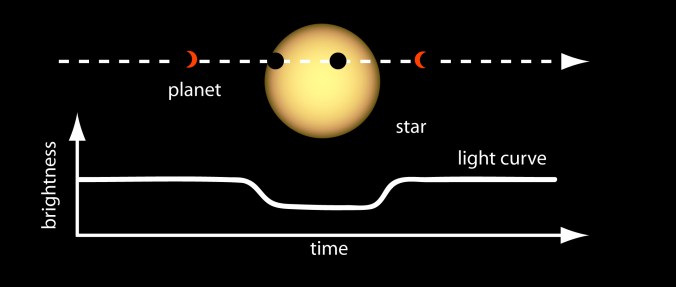
The first method involves closely observing a star over a period of time with a photometer, looking for any subtle changes in its brightness. Any dip in brightness which is periodic and cannot be explained by general stellar dynamics is then assumed to be a large body passing between us and the star.
Incredibly, even amateurs with 12 inch backyard telescopes have been able to detect these illumination changes for very large planets, producing crude light curve plots that have later been verified by professional astronomers.
As the exoplanet passes in front of the host star the number of photons reaching the objective lens of the telescope drops in a characteristic way.
This method of detection works out to distances of several thousand light years, and allows an approximate calculation of the planet’s size, or radius. Additionally, for certain nearby stars (if clear spectra can be obtained), drops in light from specific elements can be detected, telling us about the possible composition of the planet’s atmosphere. For example, if the planet contained a Nitrogen rich atmosphere, we might detect a dip in the intensity of the spectrum corresponding to the wavelength of Nitrogen – this process is called ‘absorption spectrometry’.
The main disadvantage of the transit method is that it relies on a nearly perfect edge-on view of the planet-sun ecliptic from our earth bound position. Otherwise we simply would not detect any occultation. Thankfully, we can calculate roughly how often this orientation occurs and account for it statistically. There’s no shortage of candidate stars out there with systems well aligned for detection.
Radial Velocity
The second method is similar, but instead focuses on the relative motion of the star. Despite the huge difference in mass between a star and its satellites, as a planet orbits it will impart enough of a gravitational tug to make the star rotate about a small local axis – tiny but detectable. The larger the planet the bigger this wobble will be.
An exaggerated illustration of how a large star will rotate about a local axis due to the gravitational influence of a planet.
To detect this regular movement we can look at the light emanating from the star over time and try and detect if its spectra is being shifted by tiny amounts. By the doppler effect, if the wavelengths of the star’s spectra appear shifted towards the red it must be moving away from us, and the opposite if the spectra is shifted towards the blue. In this way the sun’s speed and local orbital radius can be calculated, and from that a determination made of the mass of the orbiting planet.
As a quick example, the Sun moves by about 13 m/s due to the influence of Jupiter, but only about 12 cm/s due to Earth. Incredibly, velocity variations down to 1 m/s or even less can be detected with modern spectrometers, such as the HARPS. The major limitation of this method is distance. At the moment it’s generally only useful for star systems up to 200 light years away.
Bringing both methods together, however, lets us form a picture of an exoplanet’s size and mass, and therefore it’s overall density. From that, inferences can even be made about the internal structure of the planet. All this information without even observing the planet!
The Complete Picture
So what do these methods tell us, so far, about the likely number of habitable or earth like planets in our Milky Way galaxy? The answer is absolutely staggering.
Based on Kepler mission data, as many as 40 billion earth like planets in the habitable zone could be orbiting around red dwarf and sun-like stars. Taking away the red dwarfs leaves an upper calculation of 11 billion around Sun like stars. Just think about those numbers for a moment.
That’s as many as one earth-like planet in the habitable zone for every 10 stars in our local galaxy! A stupendously high number of candidate worlds from which life may have originated.
But here again, we must be cautious. 11 billion is 11×10^9. But what if the probability of life forming on rocky planets within the habitable zone was actually as low as low as 11 x 10^-9, or even 11 x 10^-99? Then there might only be one or no candidate planets containing life. A depressing possibility, but one we should never allow our natural bias to discount. The lesson here is that any large number can quickly be diminished in stature by an equally small probability.
At the moment we simply don’t know what this probability of emergent life is. Some biologists are more optimistic and consider it relatively high for simple single cell life, but other figures, for more complex multi cellular organisms, are much more pessimistic. But when we do know this figure, calculating the number of planets on which life has arisen will be comparatively simple, and Frank Drake’s famous equation for estimating the number of ‘technical civilisations’ will be one step closer to a final solution.
How did we view the question of ‘other planets’ in the context of life outside Earth in the 1980s. Watch the late Carl Sagan to find out.
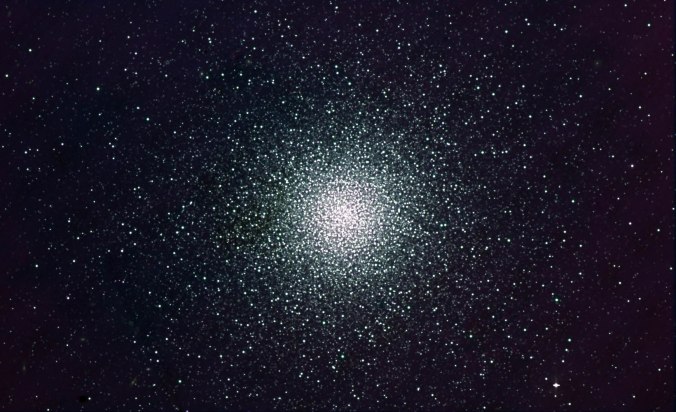
Globular clusters are some of the best deep space objects to view with a video telescope setup. These tightly bound swarms of stars orbit our Milky Way at a distance of 100,000 lights years or more and contain many more older stars than open clusters. The density near the core of these stellar globules is very pronounced indeed, such that any inhabitants of a planet deep inside one would see a night sky peppered with incredibly bright stellar neighbours. This artist impression from William Harris and Jeremy Webb illustrates the point beautifully.
What the sky might look like inside globular cluster ’47 Tucana’ where nearly 600 thousand stars jostle within a volume of space only 120 light years across.
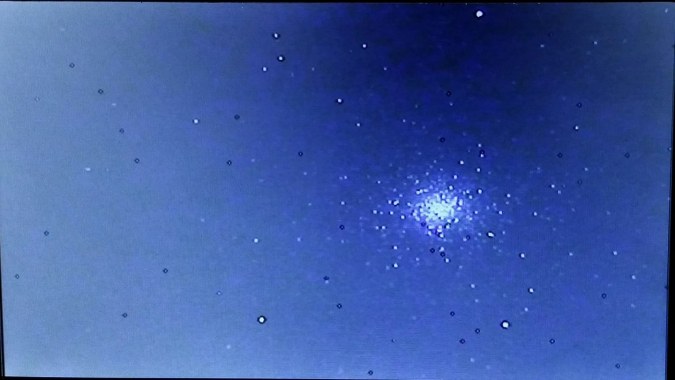
I planned to video the famous M3 globular tonight after seeing its relative high altitude and fortuitous position in SkySafari, and noting with some relief how clear and enticing the moonless sky looked.
After very little effort, and with a short 3 second integration time, I was able to watch this spectacular sight slowly materialise in the video monitor
M3 contains over 500 thousand suns at a distance of 34 thousand light years from earth.
This image is incredibly bright and vibrant compared to naked eye views of M3 and is only slightly marred by a few visual artefacts due to the sensor technology. The bloated white dots at the widest periphery of the image are not stars but hot spots due to the video chip heating up during long exposures. Despite this I’m sure you’ll agree the view is a triumph of video observing, readily revealing the awesome density and structure of the cluster.
There are over 150 of these satellite clusters orbiting our Milky Way galaxy and their formation is the topic of excited debate. The fact they harbour such a high proportion of older stars suggests they were some of the first stars to evolve within the overall galactic neighbourhood.
As far as the question of technological life existing within these systems, the chaos from closely interacting stars (on average only 1 light year apart) might prove an unfavourable environment. Stars and planets in such a system would be under constant perturbation from nearby neighbours imparting gravitation ‘tugs’, resulting in unstable planetary orbits.
I was delighted to be approached by Caroline Snow, who manages the local Merkinch Nature Reserve, to host an astronomy evening in March. Our mutual friend Russel Deacon introduced us via Facebook and after some informal chat we agreed enough of an initial proposal for Caroline to begin promoting the event on social media and some local papers.
From a dark sky perspective the area isn’t perfect as there’s a fair bit of light pollution facing south and east back towards Inverness. But it’s a beautiful location overall with lovely clear views north and west and perfectly acceptable dark skies in those directions. It was also a good compromise between darkness and accessibility for the people we hoped to attract from the local area and beyond.
We initially planned the tour for Friday 24th of March but the weather was a bit patchy and looking better the following day. So after some further discussion Caroline and I decided to go for for the clearest night possible, and delayed the event until Saturday.
The next day was sunny and clear as forecast and when twilight fell I headed over to the reserve to setup an hour or so early. This was the lovely scene as the sun set over the observing site.
Sunset at Merkinch Nature Reserve looking North West.
My first challenge arose when unloading the telescope beside the picnic benches at our chosen spot. I realised I had some company next to me in the form of a few local teenagers who were blaring out Johnny Cash and Elvis from a brightly flashing ghetto blaster! I approached them to say hello and explain what I was doing here, and in return was offered a swig from a Buckfast bottle! After declining and explaining I had my van with me, one of the party lurched towards me and gave me a giant bear hug, which was a lovely welcoming gesture but threatened to unbalance me and the large bag of astronomical equipment I was carrying! Dusting myself down, I thanked them and invited them to join the tour when it got underway. I then continued with my astronomical setup, calmed by the soothing melodies of ‘Love Me Tender’ drifting through the darkness.
Elvis performing in front of a large comet.
The plan for the evening was a naked eye and binocular constellation tour, focusing on some interesting targets I’d prepared to discuss in advance. The telescope would serve to give more detailed views of a few select objects we’d be looking at. At this stage I was only expecting perhaps a dozen people to turn up but I severely underestimated Caroline’s promotional skills; over the course of the evening about 30-40 people appeared. This was obviously fantastic but meant individual telescope time was going to be limited.
As the tour started the next challenge arose. Both laser pointers we’d taken down with us failed, producing a pitiful beam only I could see. An audience member came to the rescue and offered me his laser pointer, but incredibly that failed too! The result was that only a few of the more experienced stargazers really knew what I was pointing at. The only real way out of this pinch was to use the telescope to track to each object in turn and invite people over to the eyepiece. This let everyone know the rough direction I was pointing at and afforded them a great view of each target. Phew!
Eventually the pens warmed up and the party really kicked off when people started asking questions – really interesting ones. What were supernova? How large is the universe? Why are stars different colours? Where does the plane of the milky way sit? The list was impressive and resulted to some great crowd chat and one to one conversations. Some of the best questions came from the younger members of the audience, some of whom were so small they had to be lifted up to the eyepiece to see through the telescope (note to self: bring a step next time).
In rough order our stellar tour took us through the following:
The Plough (Mizar/Alcor double, Alkaid)
Plaeides cluster
Aldebaran (the follower)
Hyades cluster
Orion (Rigel, Betelgeuse and the great Orion nebulae)
Double Cluster in Perseus
Beehive Cluster
Auriga (M37 and Capella)
M3 Globular
Simon Garrod took this nice image of Orion from our observing position at the Merkinch Nature Reserve.
Highlights? The Orion nebulae and the M3 globular cluster were real crowd pleasers in the scope. M3 looked great in the eyepiece despite being in the light polluted eastern sky, its densely speckled core in clear evidence.
The M3 globular cluster is a fantastic target even with moderate light pollution.
After an hour or so people began to filter off home but the stragglers were rewarded with Jupiter just beginning to rise in the East. Despite a view impinged by a tree the telescope did a great job of bringing Jupiter and its moons in for some closeup action. There was general gratitude and thanks all round, leaving Caroline and myself thoroughly rewarded by a successful night.
If you’d like more information on the Merkinch Nature Reserve and all the events Caroline’s coordinating visit their Facebook page at Friends of Merkinch Local Nature Reserve and look out for another astronomy evening later this year.
Why this galaxy on this particular night? Simply because it was a relatively bright object that was high in the sky within Leo and facing south, the direction of least obstruction from my local observing position. One of the best tips I learned about observing deep sky objects, in particular galaxies, is to never underestimate the benefits of superior elevation.
Setting up my video telescope at its maximum integration time of 10 seconds, I wasn’t holding too much hope of anything spectacular appearing from these semi light polluted skies. I was thankfully mistaken.
Despite its staggering distance of nearly 30 million light years, the video screen began resolving a beautifully presented barred spiral galaxy with easily discernible spiral pathways, surrounding a very bright core. I’m always in awe when viewing distant galaxies like this in real time. The main idea that captures my imagination is the understanding of what makes up those dim dust lanes – billions of suns!
NGC 2903 is only slightly smaller than our own Milky Way at over 80,000 light years across and is very similar in structure to our own island universe. Its central bar is a common feature in spiral galaxies found in around two thirds of them. The formation of these bar structures is still poorly understood. The most popular hypothesis is due to a density wave propagating from the galactic core, reshaping surrounding dust into a long column. In general these structures indicate relative maturity for a galaxy – younger galactic siblings don’t have them.
This was the sight that greeted people looking skyward last night, captured by Nynke Jansen.
This photograph from Nynke Jansen captures the mesmerising spectacle many people in the north of Scotland witnessed when they looked moon ward on March 9th – a bright halo of white light encircling the full moon.
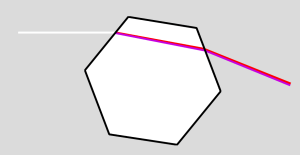
The explanation for these ‘moon halos’ is simple refraction of light through tiny hexagonal shaped ice crystals suspended in high altitide cirrus clouds. These halos are usually observed extending a 22 degree circle from the moon, because this corresponds to the minimum angle of refraction produced when light enters and leaves a hexagon shaped piece of glass (or ice). The full range of refraction is between 22 and 50 degrees.
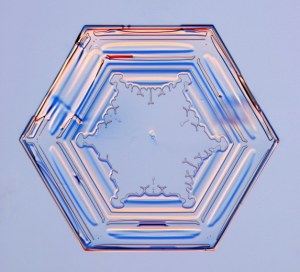
An ice crystal with its beautiful six fold symmetry. An uncountable number of these drift within high altitude clouds.
Under certain conditions ice crystals will collectively orientate themselves in the atmosphere such that moonlight refracts through them coherently – hence the intense corona like circle of light beginning at 22 degrees from source (the moon). And because different wavelengths of light are refracted by slightly different amounts, a subtle rainbow effect is also seen. The 22 degree minimum angle also results in a queer darkening of the sky between the moon and the halo itself as no refracted light gets scattered into this void region. This phenomena needs to be witnessed with the naked eye, as photographs tend to over saturate the image with white light (as above). The overall impression is that of a dark portal suspended in the sky, with the moon at centre!
When light enters a medium of higher density it bends towards the surface normal, then away from the normal when exiting.
In general crystals of ice in the atmosphere would be randomly orientated, leading to no such phenomena. The mechanism leading to the crystals orientating themselves along the same plane isn’t fully understood, but supposedly conditions exist for this to happen dozens of times a year. Either way, it’s a phenomena I’ll be keenly looking out for in the future.
The Mathematics of Refraction
SinØi / SinØr = n
This simple equation from high school physics determines the angle of refraction Ør, after a ray of light enters a more dense medium at an angle Øi to the surface normal. n is the refractive index of the material, and will vary slightly depending on the frequency of the incident light. The refractive index of ice is 1.309, slightly lower than that of liquid water at 1.333.
They say good things come to those who wait. Never was this more exemplified than this evening after several hours in bitterly cold conditions on Culloden moor with my video telescope. The cold made setup and targeting much more fraught than usual, and the small gas stove I’d balanced pecariously beside the monitor did little to help.
However, near the end of my session I hit the jackpot when this stunning image of the Whirlpool galaxy, over 23 million light years away, materialised from the video screen.
This image is a true testament to the power of video astronomy and the huge increase in aperture it lends to amature telescopes. Dust lanes and connective spiral arms are clearly in evidence here. The best naked eye views of the Whirlpool I’ve seen have only really resolved the two central cores of the interacting galaxies. You generally need a scope of 16 inches or more to reveal dust tendrils in this much detail.
This is how the Earl of Rosse sketched the galaxy back in 1845 with his monstrous 72 inch dobsonian from the grounds of Birr Castle in Ireland.
Of course back then these structures were given the loose classification of ‘nebulae’ and were assumed part of our local galaxy. It wasn’t until the 1920s when Edwin Hubble observed cepheid variable stars within each bright core of the Whirlpool that this image was understood to be two distinct but interacting galaxies, the larger of which has been estimated to be 35% the size of our own Milky Way galaxy.
M51 is still a hot target for professional astronomers, not least because of the black hole that exists within the heart of the larger galaxy. This central region is undergoing rapid stellar changes and star formation.